. 2010 Jan;38(Database issue):D457-62.
doi: 10.1093/nar/gkp851. Epub 2009 Oct 20.

TriTrypDB: a functional genomic resource for the Trypanosomatidae

Affiliations

TriTrypDB: a functional genomic resource for the Trypanosomatidae

Martin Aslett et al. Nucleic Acids Res. 2010 Jan.

Abstract

TriTrypDB (http://tritrypdb.org) is an integrated database providing access to genome-scale datasets for kinetoplastid parasites, and supporting a variety of complex queries driven by research and development needs. TriTrypDB is a collaborative project, utilizing the GUS/WDK computational infrastructure developed by the Eukaryotic Pathogen Bioinformatics Resource Center (EuPathDB.org) to integrate genome annotation and analyses from GeneDB and elsewhere with a wide variety of functional genomics datasets made available by members of the global research community, often pre-publication. Currently, TriTrypDB integrates datasets from Leishmania braziliensis, L. infantum, L. major, L. tarentolae, Trypanosoma brucei and T. cruzi. Users may examine individual genes or chromosomal spans in their genomic context, including syntenic alignments with other kinetoplastid organisms. Data within TriTrypDB can be interrogated utilizing a sophisticated search strategy system that enables a user to construct complex queries combining multiple data types. All search strategies are stored, allowing future access and integrated searches. 'User Comments' may be added to any gene page, enhancing available annotation; such comments become immediately searchable via the text search, and are forwarded to curators for incorporation into the reference annotation when appropriate.


Figures
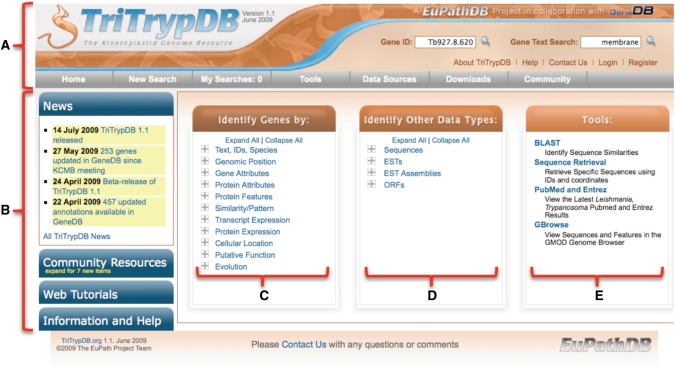
Figure 1.
Figure 1.
Screen shot of the TriTrypDB home page. (A) Interactive banner present on all TriTrypDB web pages, including quick search windows and a tool bar (grey). (B) Side bar components contain expandable sections for release notes, community resources, tutorials and help (new items are highlighted with a yellow alert). (C) Gene searches; clicking on ‘+’ symbols reveals a list of searches available within each category. (D) Searches of non-gene entities, such as ESTs and ORFs of genome sequence. (E) Links to available tools, including the genome browser (based on GBrowse), BLAST against TriTrypDB, the sequence retrieval tool and recent PubMed records pertaining to TriTrypDB organisms.
Figure 2.
Figure 2.
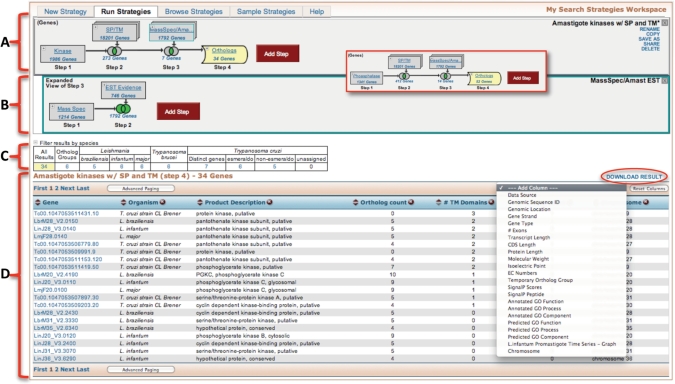
Screen shot of the search strategy and results summary page. (A) The expanding search strategy—a search strategy is built by adding steps, which constitute a search combined with the previous step using Boolean operators (intersect, union and minus). Any step in a strategy may be revised, deleted or expanded—the insert in the red box shows the effect of revising the first step in the strategy in A. (B) An example of a nested strategy—the search feeding into Step 3 in (A) was expanded to include other searches without the need to re-run the entire strategy. (C) The filter table, which represents a summary of results in all species represented in TriTrypDB, provides a bird’s-eye view of all results and allows quick access to those results by simply clicking on the cells in the table. (D) Tabular representation of results [highlighted in yellow in the strategy in (A) and table in (C)—this table is interactive allowing the addition, deletion and reordering of columns]. Results of searches may be downloaded by clicking on the download results link (red circle).
Figure 3.
Figure 3.
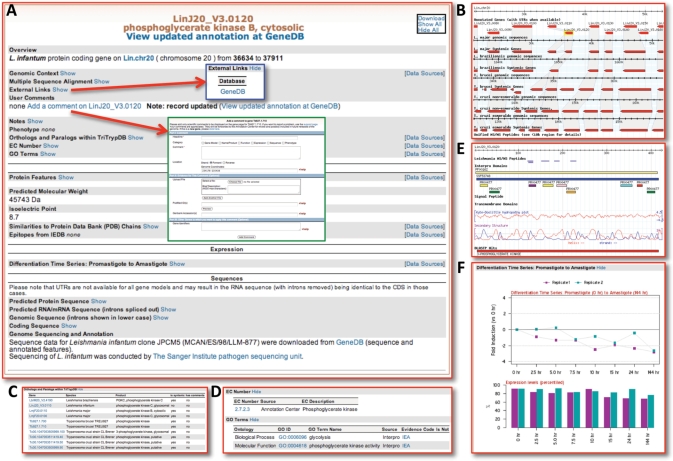
Screen shot of a gene record page in TriTrypDB. (A) The gene page, with all data ‘hidden’; any available data type can be viewed by clicking on ‘show’. Display preferences (and prior queries) are saved for registered users. (B) Genomic context view, showing SynView (19) synteny map between organisms supported in TriTrypDB. (C) Orthologs and paralogs table. (D) Tables representing EC (enzyme commission) numbers and GO (Genome Ontology) associations. (E) Protein features, including mapped peptides from proteomics experiments, InterPro domain predictions, hydropathy plots and BlastP results. (F) Evidence of transcript expression, from microarray experiments.

References

    1. Cox FE. History of sleeping sickness (African trypanosomiasis) Infect. Dis. Clin. North Am. 2004;18:231–245. - PubMed
    1. The World Health Organization. Human African trypanosomiasis (sleeping sickness): epidemiological update. Wkly. Epidemiol. Rec. 2006;81:71–80. - PubMed
    1. Simarro PP, Jannin J, Cattand P. Eliminating human African trypanosomiasis: where do we stand and what comes next? PLoS Med. 2008;5:e55. - PMC - PubMed
    1. Hotez PJ, Bottazzi ME, Franco-Paredes C, Ault SK, Periago MR. The neglected tropical diseases of Latin America and the Caribbean: a review of disease burden and distribution and a roadmap for control and elimination. PLoS Negl. Trop. Dis. 2008;2:e300. - PMC - PubMed
    1. World Health Organization. Geneva: World Health Organization; 2009. [(July 2009, last date accessed)]. Leishmaniasis: magnitude of the problem. http://www.who.int/leishmaniasis/burden/magnitude/burden_magnitude/en/in....

Publication types

Substances