


Transient receptor potential ankyrin receptor 1 is a novel target for pro-tussive agents
- PMID: 19845671
- PMCID: PMC2795228
- DOI: 10.1111/j.1476-5381.2009.00438.x
Transient receptor potential ankyrin receptor 1 is a novel target for pro-tussive agents
Erratum in
- Br J Pharmacol. 2010 Feb;159(4):982
Abstract
Background and purpose: The transient receptor potential ankyrin receptor 1 (TRPA1) is a cation channel, co-expressed with the pro-tussive transient receptor potential vanilloid type 1 (TRPV1) channel in primary sensory neurons. TRPA1 is activated by a series of irritant exogenous and endogenous alpha,beta-unsaturated aldehydes which seem to play a role in airway diseases. We investigated whether TRPA1 agonists provoke cough in guinea pigs and whether TRPA1 antagonists inhibit this response.
Experimental approach: Animals were placed in a Perspex box, and cough sounds were recorded and counted by observers unaware of the treatment used.
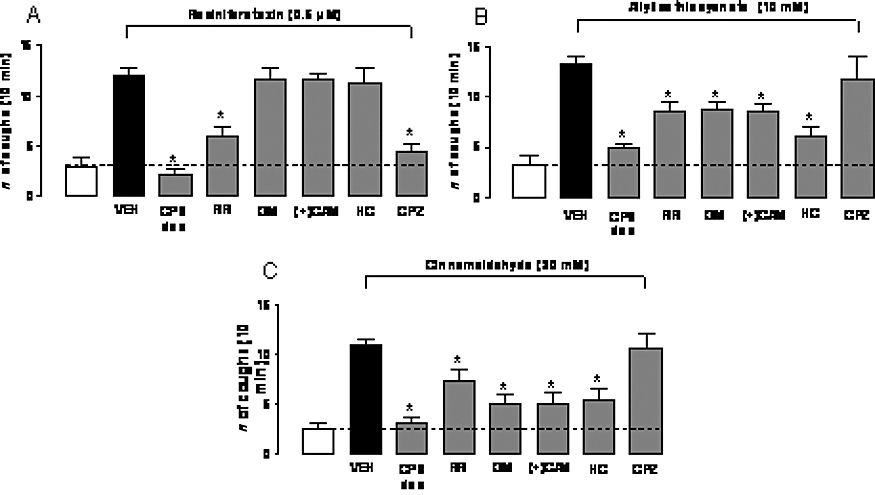
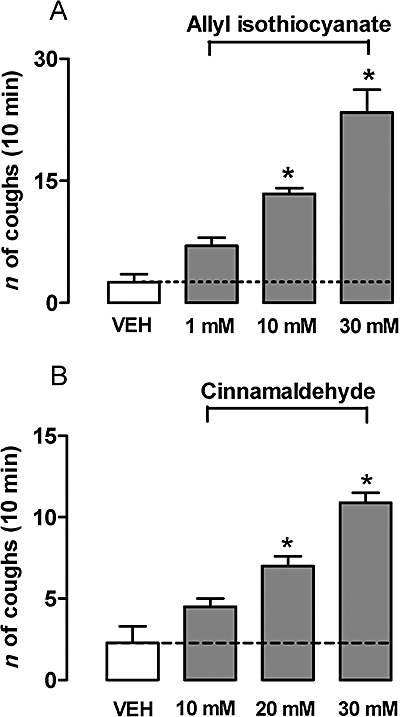
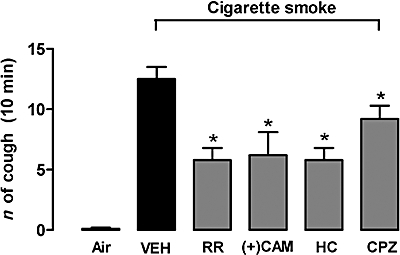
Key results: Inhalation of two selective TRPA1 agonists, allyl isothiocyanate and cinnamaldehyde, dose-dependently caused cough in control guinea pigs, but not in those with airway sensory nerves desensitized by capsaicin. Coughs elicited by TRPA1 agonists were reduced by non-selective (camphor and gentamicin) and selective (HC-030031) TRPA1 antagonists, whereas they were unaffected by the TRPV1 antagonist, capsazepine. Acrolein and crotonaldehyde, two alpha,beta-unsaturated aldehydes recently identified as TRPA1 stimulants and contained in cigarette smoke, air pollution or produced endogenously by oxidative stress, caused a remarkable tussive effect, a response that was selectively inhibited by HC-030031. Part of the cough response induced by cigarette smoke inhalation was inhibited by HC-030031, suggesting the involvement of TRPA1.
Conclusions and implications: A novel pro-tussive pathway involves the TRPA1 channel, expressed by capsaicin-sensitive airway sensory nerves and is activated by a series of exogenous (cigarette smoke) and endogenous irritants. These results suggest TRPA1 may be a novel target for anti-tussive medicines.
Figures

References
-
- Adcock JJ. TRPV1 receptors in sensitisation of cough and pain reflexes. Pulm Pharmacol Ther. 2009;22:65–70. - PubMed
-
- Aldini G, Dalle-Donne I, Facino RM, Milzani A, Carini M. Intervention strategies to inhibit protein carbonylation by lipoxidation-derived reactive carbonyls. Med Res Rev. 2007;27:817–868. - PubMed
-
- Anand U, Otto WR, Facer P, Zebda N, Selmer I, Gunthorpe MJ, et al. TRPA1 receptor localisation in the human peripheral nervous system and functional studies in cultured human and rat sensory neurons. Neurosci Lett. 2008;438:221–227. - PubMed
Publication types
MeSH terms
Substances
LinkOut - more resources
Full Text Sources
Other Literature Sources
Medical
Molecular Biology Databases
