


Memory suppression is an active process that improves over childhood
- PMID: 19847313
- PMCID: PMC2763797
- DOI: 10.3389/neuro.09.024.2009
Memory suppression is an active process that improves over childhood
Abstract
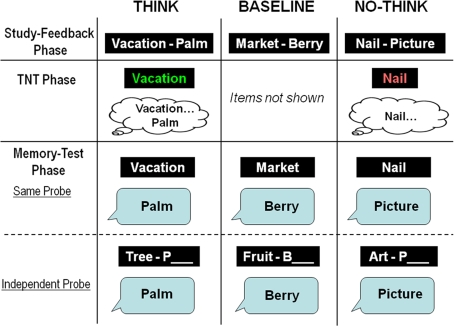
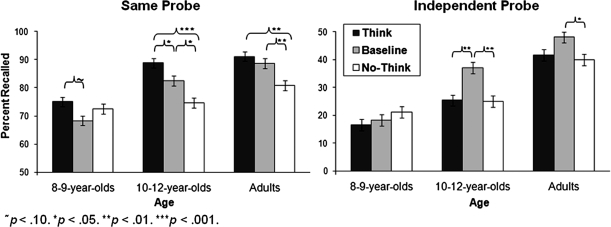
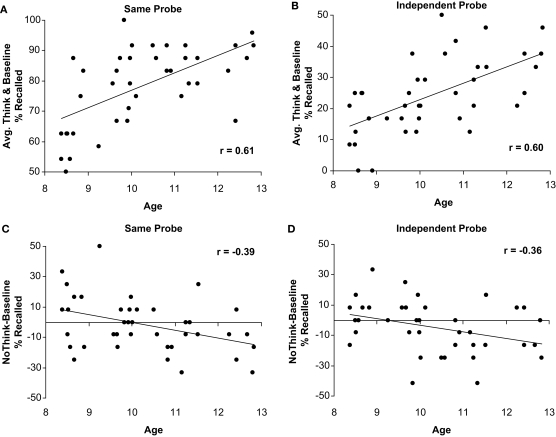
We all have memories that we prefer not to think about. The ability to suppress retrieval of unwanted memories has been documented in behavioral and neuroimaging research using the Think/No-Think (TNT) paradigm with adults. Attempts to stop memory retrieval are associated with increased activation of lateral prefrontal cortex (PFC) and concomitant reduced activation in medial temporal lobe (MTL) structures. However, the extent to which children have the ability to actively suppress their memories is unknown. This study investigated memory suppression in middle childhood using the TNT paradigm. Forty children aged 8-12 and 30 young adults were instructed either to remember (Think) or suppress (No-Think) the memory of the second word of previously studied word-pairs, when presented with the first member as a reminder. They then performed two different cued recall tasks, testing their memory for the second word in each pair after the TNT phase using the same first studied word within the pair as a cue (intra-list cue) and also an independent cue (extra-list cue). Children exhibited age-related improvements in memory suppression from age 8 to 12 in both memory tests, against a backdrop of overall improvements in declarative memory over this age range. These findings suggest that memory suppression is an active process that develops during late childhood, likely due to an age-related refinement in the ability to engage PFC to down-regulate activity in areas involved in episodic retrieval.
Keywords: childhood; cognitive development; episodic retrieval; inhibition; medial temporal lobe; memory suppression; prefrontal cortex.
Figures
References
-
- Ackerman B. P. (1982). Retrieval variability: the inefficient use of retrieval cues by young children. J. Exp. Child Psychol. 33, 413–428 10.1016/0022-0965(82)90056-X - DOI
Grants and funding
LinkOut - more resources
Full Text Sources
Miscellaneous
