


Small ubiquitin-like modifier-2 modification of retinoic acid receptor-alpha regulates its subcellular localization and transcriptional activity
- PMID: 19850744
- PMCID: PMC2795702
- DOI: 10.1210/en.2009-0868
Small ubiquitin-like modifier-2 modification of retinoic acid receptor-alpha regulates its subcellular localization and transcriptional activity
Abstract
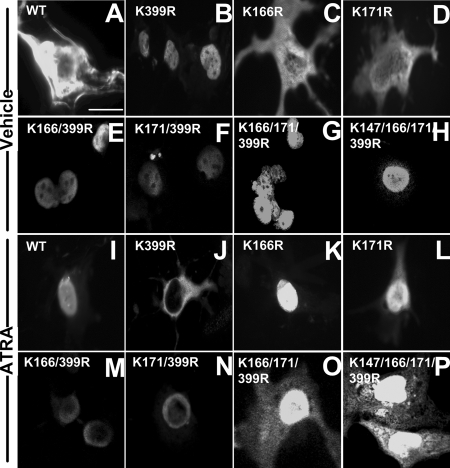
The retinoic acid receptor-alpha (Rara) gene is critical for germ cell development in the testis, as demonstrated by infertile Rara knockout male mice. The encoded protein for Rara (RARA) is expressed in both Sertoli cells and germ cells, but it is not always in the nucleus. Previously, all-trans retinoic acid (ATRA) was shown to increase the nuclear localization and transcriptional activity of RARA in Sertoli cells. Here, we identified a small ubiquitin-like modifier-2 (SUMO-2) modification as a novel posttranslational regulatory mechanism controlling the ATRA-dependent RARA subcellular localization and transcription. ATRA increased the SUMO-2 modification of RARA. In the presence of ATRA, lysine 166 (K166) and K171 of RARA were modified at a physiological concentration of SUMO-2, whereas in the absence of ATRA, K399 was the only site that was modified, but at a higher SUMO-2 concentration. However, K399 was critical for ATRA-controlled nuclear trafficking of RARA. In the presence of ATRA, a K399 mutation to arginine resulted in the cytoplasmic localization of K399R mutant, indicating that K166 and K171 sumoylations were inhibitory to nuclear localization. This may be due to SUMO/sentrin-specific peptidase 6 (SENP6) not being able to bind K399R mutant to desumoylate K166 and K171 in Sertoli cells, whereas it can bind RARA with intact K399. On the other hand, functional K166 and K171 sites for sumoylation were required for a full transcriptional activity, when K399 was intact. These results together suggest that both K166 and K171 sumoylation and desumoylation are critical for optimal RARA function.
Figures




References
-
- Doyle TJ, Braun KW, McLean DJ, Wright RW, Griswold MD, Kim KH 2007 Potential functions of retinoic acid receptor A in Sertoli cells and germ cells during spermatogenesis. Ann NY Acad Sci 1120:114–130 - PubMed
-
- Akmal KM, Dufour JM, Kim KH 1997 Retinoic acid receptor α gene expression in the rat testis: potential role during the prophase of meiosis and in the transition from round to elongating spermatids. Biol Reprod 56:549–556 - PubMed
-
- Dufour JM, Kim KH 1999 Cellular and subcellular localization of six retinoid receptors in rat testis during postnatal development: identification of potential heterodimeric receptors. Biol Reprod 61:1300–1308 - PubMed
-
- Akmal KM, Dufour JM, Vo M, Higginson S, Kim KH 1998 Ligand-dependent regulation of retinoic acid receptor α in rat testis: in vivo response to depletion and repletion of vitamin A. Endocrinology 139:1239–1248 - PubMed
Publication types
MeSH terms
Substances
Grants and funding
LinkOut - more resources
Full Text Sources
Molecular Biology Databases
Research Materials
