. 2009 Nov 10;106(45):19120-5.
doi: 10.1073/pnas.0907912106. Epub 2009 Oct 22.

Interaction of an autotransporter passenger domain with BamA during its translocation across the bacterial outer membrane

Affiliations

Interaction of an autotransporter passenger domain with BamA during its translocation across the bacterial outer membrane

Raffaele Ieva et al. Proc Natl Acad Sci U S A. .

Abstract

Autotransporters are a superfamily of virulence factors produced by Gram-negative bacteria consisting of a large N-terminal extracellular domain ("passenger domain") and a C-terminal beta barrel domain ("beta domain"). The mechanism by which the passenger domain is translocated across the outer membrane (OM) is unknown. Here we show that the insertion of a small linker into the passenger domain of the Escherichia coli O157:H7 autotransporter EspP effectively creates a translocation intermediate by transiently stalling translocation near the site of the insertion. Using a site-specific photocrosslinking approach, we found that residues adjacent to the stall point interact with BamA, a component of a heterooligomeric complex (Bam complex) that catalyzes OM protein assembly, and that residues closer to the EspP N terminus interact with the periplasmic chaperones SurA and Skp. The EspP-BamA interaction was short-lived and could be detected only when passenger domain translocation was stalled. These results support a model in which molecular chaperones prevent misfolding of the passenger domain before its secretion and the Bam complex catalyzes both the integration of the beta domain into the OM and the translocation of the passenger domain across the OM in a C- to N-terminal direction.


Conflict of interest statement

The authors declare no conflict of interest.

Figures
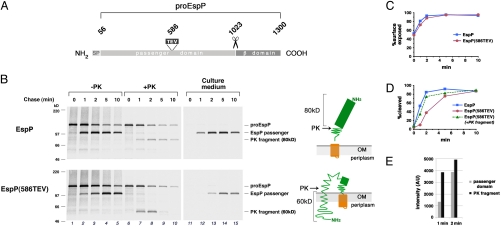
Fig. 1.
Fig. 1.
A linker insertion transiently stalls EspP passenger domain translocation. (A) Illustration of the primary structure of the EspP precursor showing the signal peptide (residues 1–55), the passenger domain (residues 56–1023), the site of the TEV linker (residue 586), and the β domain (residues 1024–1300). ProEspP is the form of the protein that contains covalently linked passenger and β domains. (B) AD202 transformed with pRLS5 (Ptrc-espP) or pJH97 [Ptrc-espP(586TEV)] were subjected to pulse-chase labeling after the addition of 100 μM IPTG. Half of the cells were treated with PK, and EspP-containing polypeptides were immunoprecipitated from cell and culture medium fractions using an N-terminal anti-EspP antiserum. The cartoons illustrate the source of each PK fragment. (C) The percentage of the WT EspP (squares) or EspP(TEV586) (circles) passenger domain that was surface-exposed. (D) The percentage of the WT EspP (squares) or EspP(TEV586) (circles) passenger domain that was cleaved from proEspP. (E) The radioactive signal of the cleaved passenger domain and PK fragment [in arbitrary units (AUs)] at the 1 min and 2 min time points in the lower panel of (B).
Fig. 2.
Fig. 2.
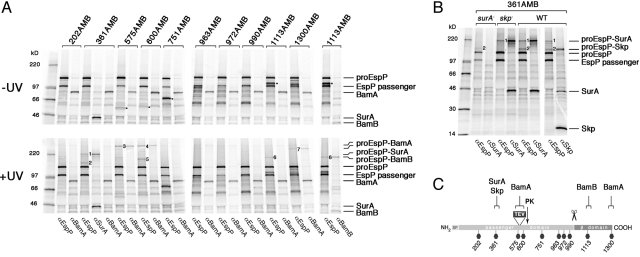
Crosslinking of an EspP secretion intermediate to the Bam complex, SurA and Skp. (A) AD202 was transformed with pDULEBpa and a derivative of pRI23 [Plac-espP(586TEV)] harboring an amber codon at the indicated position. Cells were pulse-labeled and subjected to a 1 min chase after the addition of 200 μM IPTG. Half of each sample was UV-irradiated, and equal portions were used for immunoprecipitation with antisera specific for an EspP N-terminal peptide, BamA, BamB, or SurA. Major crosslinked adducts are numbered 1–7. Truncated forms of the protein that resulted from translation termination at the amber codon are denoted by an asterisk. (B) The experiment in (A) was repeated using AD202 (WT), HDB130 (AD202 surA-), and HDB131 (AD202 skp-). Only the UV-irradiated samples are shown. (C) Summary of the data in (A) and (B) showing the proteins that were crosslinked at each position and the position at which PK cleaves the translocation intermediate.
Fig. 3.
Fig. 3.
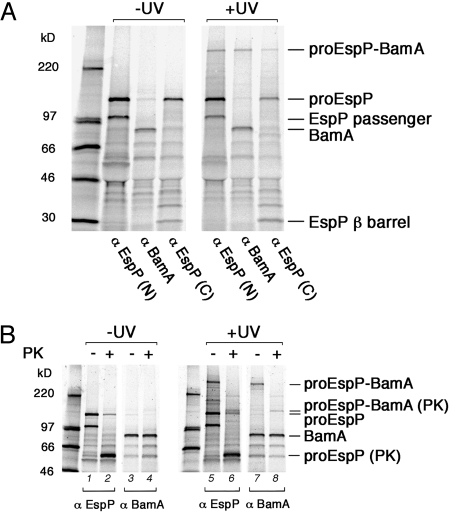
BamA interacts specifically with proEspP. AD202 transformed with pDULEBpa and a derivative of pRI23 harboring an amber codon at residue 575 were subjected to pulse-chase labeling and UV irradiation as described in the legend to Fig. 2. (A) Equal aliquots of both UV-irradiated and untreated samples were subjected to immunoprecipitation using antisera specific for EspP N- and C-terminal peptides and BamA. (B) Cells that were UV-irradiated or untreated were divided into 2 portions, one of which was treated with PK. Samples were then subjected to immunoprecipitation using anti-EspP N-terminal and anti-BamA antisera.
Fig. 4.
Fig. 4.
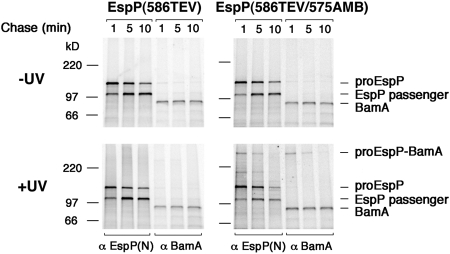
The EspP–BamA interaction is transient. AD202 was transformed with pDULEBpa and pRI23 or pRI23 harboring an amber codon at residue 575. Cells were pulse-labeled and subjected to a 1, 5, or 10 min chase after the addition of 200 μM IPTG. One of the 2 samples obtained at each time point was UV irradiated, and immunoprecipitation was performed using anti-EspP N-terminal and BamA antisera.

References

    1. Henderson IR, et al. Type V secretion pathway: The autotransporter story. Microbiol Mol Biol Rev. 2004;68:692–744. - PMC - PubMed
    1. Junker M, et al. Pertactin β-helix folding mechanism suggests common themes for the secretion and folding of autotransporter proteins. Proc Natl Acad Sci USA. 2006;103:4918–4923. - PMC - PubMed
    1. Oomen CJ, et al. Structure of the translocator domain of a bacterial autotransporter. EMBO J. 2004;23:1257–1266. - PMC - PubMed
    1. Barnard TJ, et al. Autotransporter structure reveals intra-barrel cleavage followed by conformational changes. Nat Struct Mol Biol. 2007;14:1214–1220. - PMC - PubMed
    1. Pohlner J, et al. Gene structure and extracellular secretion of Neisseria gonorrhoeae IgA protease. Nature. 1987;325:458–462. - PubMed

Publication types

MeSH terms