. 2010 Jan;53(1):128-38.
doi: 10.1007/s00125-009-1570-x. Epub 2009 Oct 23.

Single pancreatic beta cells co-express multiple islet hormone genes in mice

Affiliations

Single pancreatic beta cells co-express multiple islet hormone genes in mice

H Katsuta et al. Diabetologia. 2010 Jan.

Abstract

Aims/hypothesis: It is widely accepted that production of insulin, glucagon, somatostatin and pancreatic polypeptide in islet cells is specific to beta, alpha, delta and pancreatic polypeptide cells, respectively. We examined whether beta cells express other genes encoding islet hormones.

Methods: Nested RT-PCR was performed on single beta cells of transgenic mice with green fluorescent protein (GFP) driven by mouse insulin I promoter (MIP-GFP).

Results: Only 55% of adult beta cells expressed the insulin gene alone, while others expressed two or more islet hormone genes; 4% expressed all four hormone genes. In embryonic and neonatal cells, 60% to 80% of GFP(+) cells co-expressed pancreatic polypeptide and insulin genes in contrast to 29% in adult. To clarify cell fate, we conducted lineage tracing using rat insulin II promoter-cre mice crossed with reporter mice Gt(ROSA)26Sor-loxP-flanked STOP-cassette-GFP. All GFP(+) cells expressed insulin I and II genes, and showed similar heterogeneity of co-expression to that seen in MIP-GFP mice. Although we report expression of other hormone genes in a significant proportion of beta cells, our lineage tracing results demonstrate that after inducing InsII (also known as Ins2) expression, beta cell progenitors do not redifferentiate to non-beta cells.

Conclusions/interpretation: This study shows co-expression of multiple hormone genes in beta cells of adult mice as well as in embryos and neonates. This finding could: (1) represent residual expression from beta cell precursors; (2) result from alternative developmental pathways for beta cells; or (3) denote the differentiation potential of these cells. It may be linked to functional heterogeneity. This heterogeneity in gene expression may provide a means to characterise the functional, cellular and developmental heterogeneity seen in beta cells.


Figures
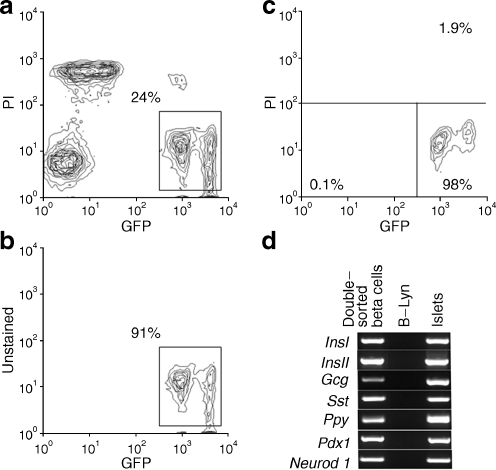
Fig. 1
Fig. 1
Sorting of GFP+ cells from adult MIP-GFP mice. a First sort with propidium iodide (PI) staining of MIP-GFP islets, (b) second sort without propidium iodide staining of MIP-GFP islets, (c) FCM analysis of double-sorted GFP+ cells and (d) gene expression of sorted beta cells from adult MIP-GFP. The percentages of the cells included in each region vs total FCM-sorted single cells are indicated in the figure. B-Lym, peripheral B lymphocytes
Fig. 2
Fig. 2
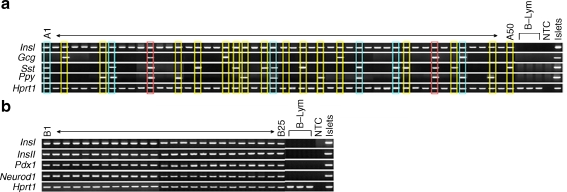
Multiplex single-cell nested RT-PCR analysis demonstrates the heterogeneity of islet hormone gene expression in single beta cells from adult, P1 neonatal and E15.5 embryonic MIP-GFP mice. a Representative data for InsI, Gcg, Sst and Ppy in single GFP+ beta cells from adult MIP-GFP mice (A1–50). The profiles with two, three and four islet hormone genes expression are indicated by yellow, blue and red outlines, respectively. b Representative data for InsI, InsII, Pdx1 and Neurod1 in single beta cells from adult MIP-GFP mice (B1–25). B-Lym, peripheral B lymphocytes; NTC, no template control
Fig. 3
Fig. 3
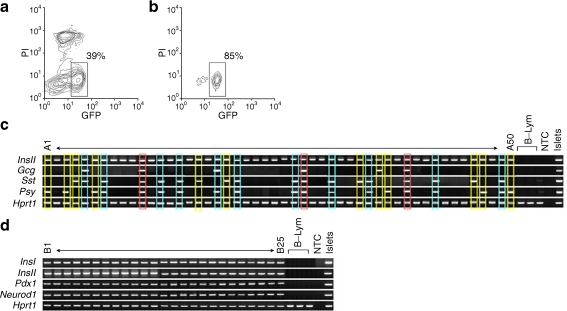
Multiplex single-cell nested RT-PCR analysis demonstrates the heterogeneity of islet hormone gene expression in single GFP+ (beta) cells from adult rInsII-cre: ROSA-loxP-stop-loxP-GFP mice. a First and (b) second sort of rInsII-cre: ROSA-loxP-stop-loxP-GFP mice. c Representative data for InsII, Gcg, Sst, and Ppy in single GFP+ (beta) cells from adult animals as above (a, b) (A1–50). Profiles with two, three and four islet hormone genes expression are indicated by yellow, blue and red outlines, respectively. d Representative data for InsI, InsII, Pdx1 and Neurod1 in single beta cells as above (a, b) (B1–25). The percentages of the cells included in each region vs total FCM-sorted single cells are indicated in the figure. B-Lym, peripheral B lymphocytes; NTC, no template control

References

    1. Salomon D, Meda P. Heterogeneity and contact-dependent regulation of hormone secretion by individual B cells. Exp Cell Res. 1986;162:507–520. doi: 10.1016/0014-4827(86)90354-X. - DOI - PubMed
    1. Stefan Y, Meda P, Neufeld M, Orci L. Stimulation of insulin secretion reveals heterogeneity of pancreatic B cells in vivo. J Clin Invest. 1987;80:175–183. doi: 10.1172/JCI113045. - DOI - PMC - PubMed
    1. Schuit FC, In 't Veld PA, Pipeleers DG. Glucose stimulates proinsulin biosynthesis by a dose-dependent recruitment of pancreatic beta cells. Proc Natl Acad Sci U S A. 1988;85:3865–3869. doi: 10.1073/pnas.85.11.3865. - DOI - PMC - PubMed
    1. Kiekens R, In 't Veld P, Mahler T, Schuit F, van de Winkel M, Pipeleers D. Differences in glucose recognition by individual rat pancreatic β cells are associated with intercellular differences in glucose-induced biosynthetic activity. J Clin Invest. 1992;89:117–125. doi: 10.1172/JCI115551. - DOI - PMC - PubMed
    1. Heimberg H, de Vos A, Vandercammen A, Schaftingen E, Pipeleers D, Schuit F. Heterogeneity in glucose sensitivity among pancreatic β-cells is correlated to differences in glucose phosphorylation rather than glucose transport. EMBO J. 1993;12:2873–2879. - PMC - PubMed

Publication types

MeSH terms