


Prognostic value of symptom burden for overall survival in patients receiving chemotherapy for advanced nonsmall cell lung cancer
- PMID: 19852033
- PMCID: PMC3148693
- DOI: 10.1002/cncr.24703
Prognostic value of symptom burden for overall survival in patients receiving chemotherapy for advanced nonsmall cell lung cancer
Abstract
Background: Patient-reported outcomes have shown independent prognostic value for patients with nonsmall cell lung cancer (NSCLC). However, translating patient-reported outcomes into useful prognostic information for individual patients has been problematic.
Methods: A total of 94 patients with advanced NSCLC and an Eastern Cooperative Oncology Group performance status (PS) of 0 to 2 who qualified for chemotherapy rated symptom severity using the M. D. Anderson Symptom Inventory before and after their first chemotherapy cycle. Prognostic values of baseline symptoms and changes in symptom severity were examined by Cox proportional hazards models.
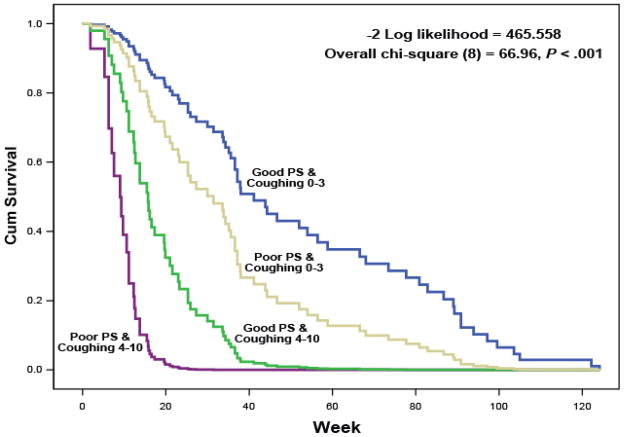
Results: In multivariate analysis, controlled for demographic and other factors, baseline coughing rated > or =4 independently predicted significantly higher risk for shorter survival (hazards ratio [HR], 8.69; P < .0001). Patients with coughing > or =4 and a PS of 2 were more likely to have shorter survival (HR, 20.6; P < .0001) than patients with coughing <4 and a PS of 0 to 1. A 1-point or greater increase in severity of fatigue (P < .05), shortness of breath, or poor appetite (P < .01) from baseline to the end of the first chemotherapy cycle was also found to be independently associated with higher risk for poor survival.
Conclusions: An increased risk for shorter survival was indicated by moderate to severe coughing at baseline or by increased fatigue or shortness of breath during the first chemotherapy cycle in patients with advanced NSCLC. Although cross-validation is needed, these data suggest that an individual patient's symptom severity scores, quickly obtainable in the clinic, might contribute clinically useful information for treatment planning for that patient. Society.
Copyright 2010 American Cancer Society.
Figures
References
-
- Cooley ME. Symptoms in adults with lung cancer. A systematic research review. J Pain Symptom Manage. 2000;19:137–153. - PubMed
-
- Temel JS, Pirl WF, Lynch TJ. Comprehensive symptom management in patients with advanced-stage non-small-cell lung cancer. Clin Lung Cancer. 2006;7:241–249. - PubMed
-
- Cleeland CS. Symptom burden: multiple symptoms and their impact as patient-reported outcomes. J Natl Cancer Inst Monographs. 2007;37:16–21. - PubMed
-
- Oken MM, Creech RH, Tormey DC, et al. Toxicity and response criteria of the Eastern Cooperative Oncology Group. Am J Clin Oncol. 1982;5:649–655. - PubMed
-
- Gralla RJ, Griesinger F. Interpreting clinical trials in lung cancer: impact of methodology and endpoints. J Thorac Oncol. 2007;2:S51–S58. - PubMed
Publication types
MeSH terms
Grants and funding
LinkOut - more resources
Full Text Sources
Medical
