. 2010 Jan;43(1):157-63.
doi: 10.1016/j.mcn.2009.10.006. Epub 2009 Oct 21.

Ablation of TrpV1 neurons reveals their selective role in thermal pain sensation

Affiliations

Ablation of TrpV1 neurons reveals their selective role in thermal pain sensation

Santosh K Mishra et al. Mol Cell Neurosci. 2010 Jan.

Abstract

Here we make use of neural ablation to investigate the properties of the TrpV1-expressing neurons in the trigeminal and dorsal root ganglia of mice. Resiniferotoxin (RTX), a potent TrpV1 agonist, administered either by direct injection in the ganglion or intrathecally killed approximately 70% of TrpV1 cells and resulted in modest thermal analgesia. Interestingly, after carageenan injection in the hind paw, the analgesic effects of RTX were dramatically increased with mice now paradoxically showing far less response to heat applied at sites of inflammation. This additional carageenan and RTX-induced analgesia was transient, lasting less than 2 days, and likely resulted from deafferentation of remaining TrpV1 neurons. Remarkably, although RTX affected sensitivity to heat, mechanical sensitivity (both of normal and inflamed tissue) was completely unaltered by toxin-mediated silencing of the TrpV1 sensory input. Thus, our data demonstrate that TrpV1 neurons are selectively tuned nociceptors that mediate responses to thermal but not mechanical pain and insinuate a labeled line model for somatosensory coding.


Figures

Figure 1
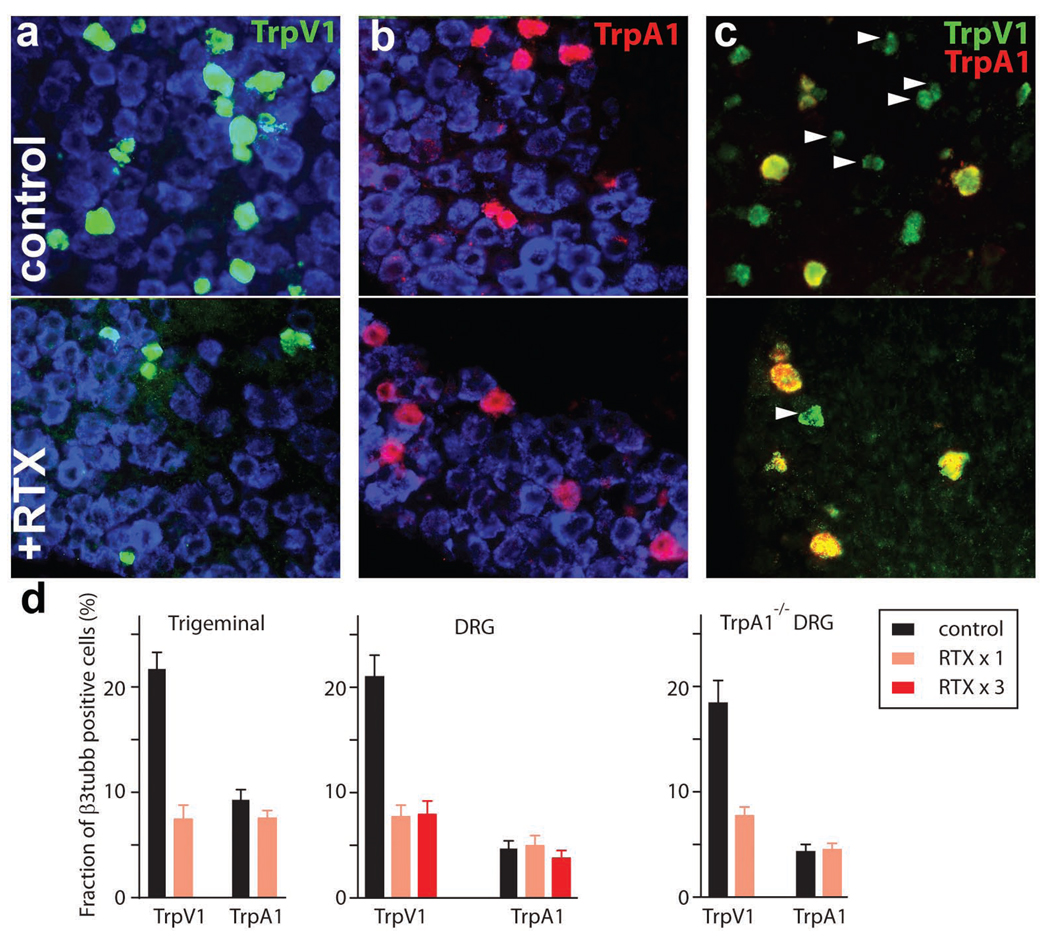
Figure 1. RTX kills a large subset of TrpV1-positive neurons
Double-label in situ hybridization was used to examine RTX induced cell ablation. Trigeminal neurons were identified using an antisense β3-tubulin probe (blue, a, b); upper panels (a–c) show control sections from untreated ganglia. Trigeminal RTX treatment (lower panels, a–c) dramatically reduced the fraction of neurons containing TrpV1 (green, a) but not TrpA1 (red, b). After RTX-treatment (c, lower panel) TrpV1, TrpA1 double positive neurons but almost no TrpV1 positive, TrpA1 negative cells (arrowheads) remain. (d) Quantitation of the effects of RTX on the proportion of neurons expressing TrpV1 or TrpA1 in trigeminal and DRG ganglia of normal and TrpA1−/−-mice; mean ± SEM (n=9).
Figure 2
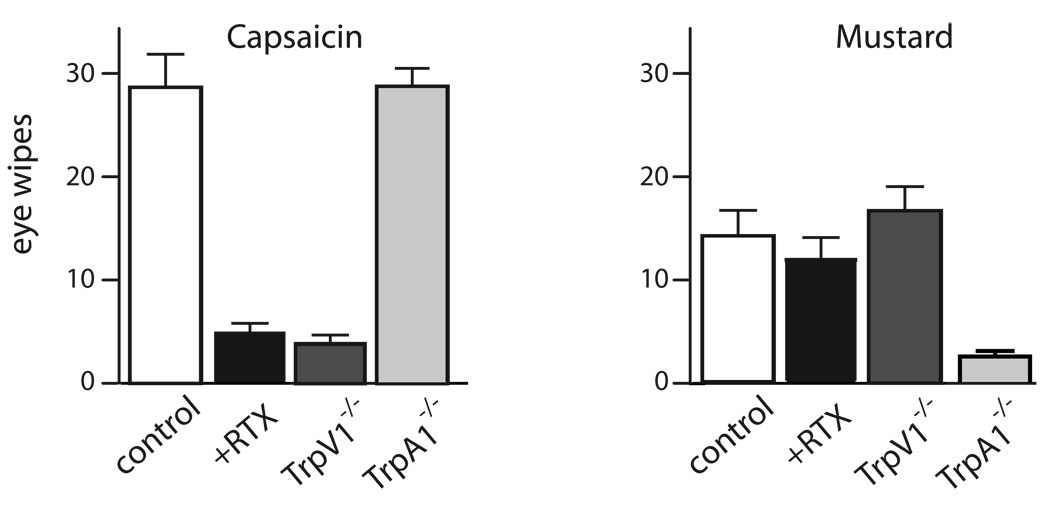
Figure 2. RTX treatment differentially affects TrpV1 and TrpA1 mediated responses
Eye wipe responses to 100 µM capsaicin and 10 mM mustard oil demonstrate that trigeminal RTX treatment dramatically reduces irritation caused by TrpV1 but not TrpA1 agonists. As a control we also demonstrated that TrpV1−/− and TrpA1−/−-mice selectively lost responses to capsaicin and mustard oil respectively; mean ± SEM (n>8 animals tested two times).
Figure 3
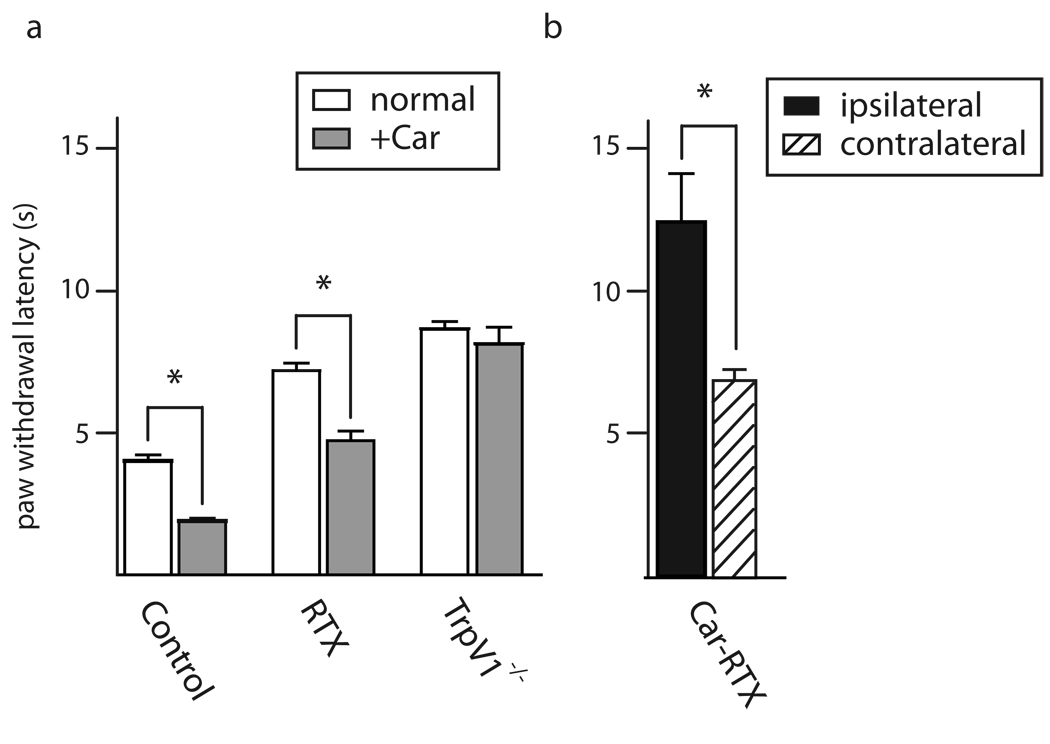
Figure 3. RTX treatment and inflammation alter thermal sensation
Paw withdrawal latency was used to monitor thermal sensitivity of uninflamed (open bars) and inflamed (carageenan treated, +Car, filled bars) tissue (a). For uninflamed tissue, intrathecal RTX treatment or knockout of TrpV1 reduced thermal sensitivity approx. 2-fold. In inflamed tissue, the effectiveness of RTX was determined by when it was administered. RTX prior to inflammation, (gray bar) was approx. 2-fold less effective than knockout of TrpV1. In contrast, (b) injection of RTX after inflammation (black bar) much more dramatically reduced thermal sensitivity and time for withdrawal of the inflamed paw was now significantly greater that for the contralateral uninflamed paw (stippled bar); mean ± SEM (n=5 animals each tested ≥3 times) * P<0.001, unpaired Student’s t-test.
Figure 4
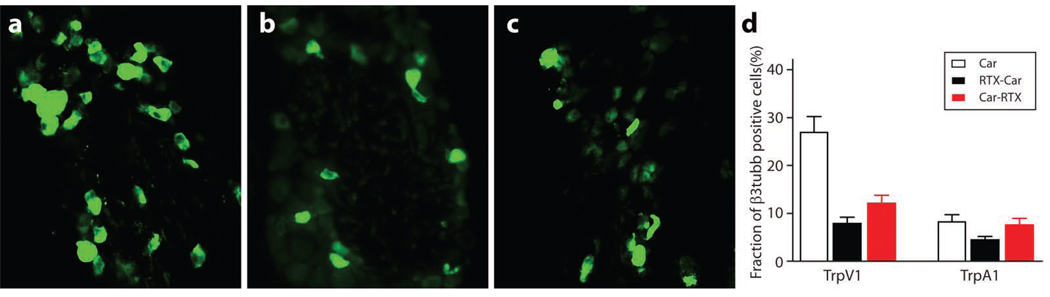
Figure 4. RTX mediated cell ablation is not affected by peripheral inflammation
Immuno-localization and in situ hybridization for TrpV1 and TrpA1 in DRG demonstrate that carageenan induced inflammation does not change the effectiveness of RTX mediated neural ablation. Shown are immunohistochemistry for TrpV1 in the relevant lumber DRG of mice: (a) control carageenan alone; (b) RTX then carageenan; (c) carageenan then RTX; (d) quantitation of double label in situ hybridization of TrpV1 or TrpA1 versus β3-tubulin; mean ± SEM (n=9).
Figure 5
Figure 5. TrpV1 afferents in the dorsal horn are eliminated by RTX treatment after peripheral inflammation
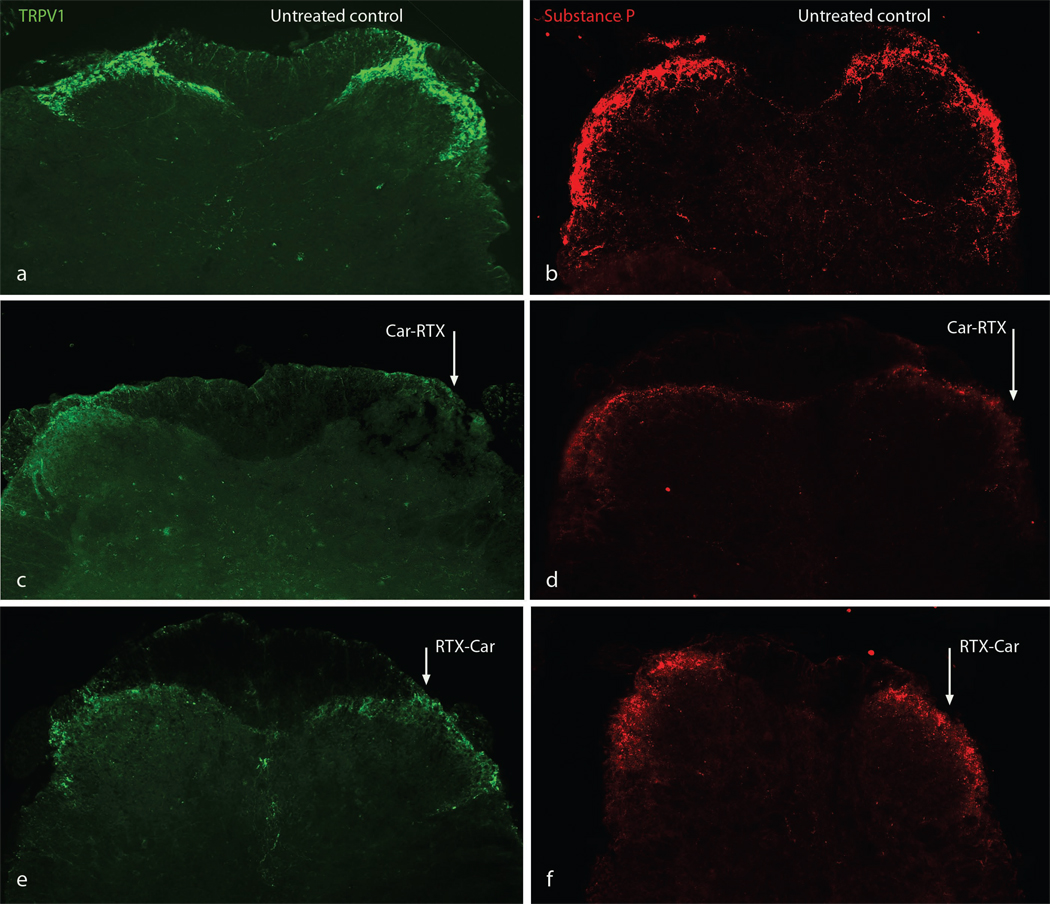
TrpV1 (a, c, e) and substance P (b, d, f) immunostaining in the dorsal horn of mice revealed sensory efferents in laminae I and II. The level of immunostaining was dramatically reduced after RTX treatment (compare untreated controls a and b with RTX treated c, d, e and f). Peripheral tissue inflammation by carageenan injection after RTX treatment (e and f, right side arrowed, RTX-Car) reduced TrpV1- and substance P-immunostaining. However, inflammation before RTX treatment (c and d, right side arrowed, Car-RTX and d) essentially eliminated all stained fibers in the dorsal horn.
Figure 6
Figure 6. RTX treatment after inflammation induces both a long-lasting and a transient decrease in thermal sensitivity and inflammatory hyperalgesia
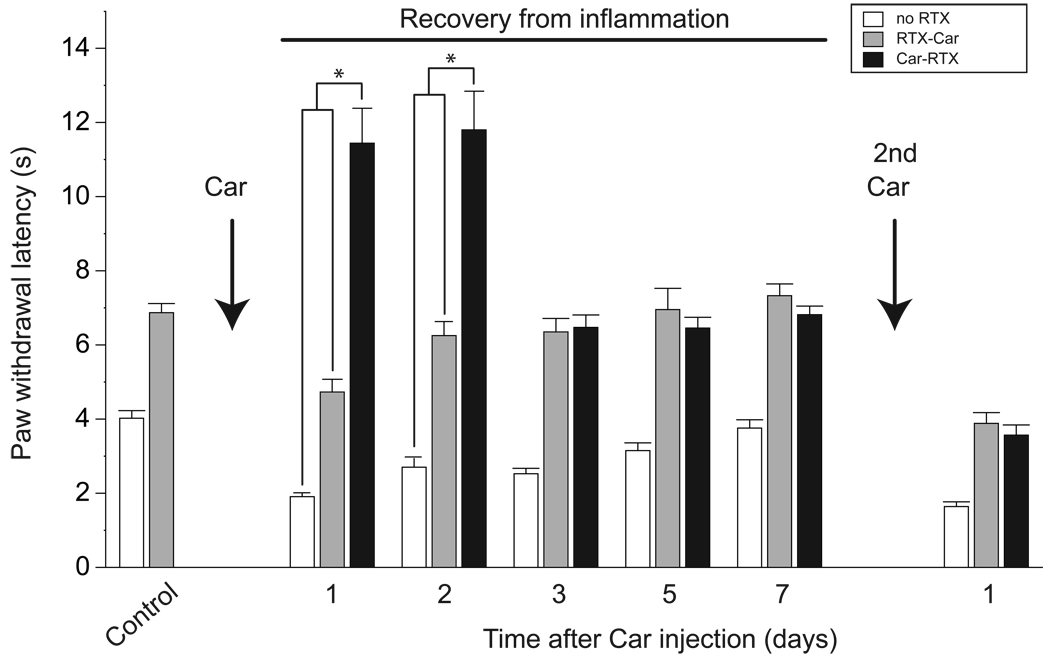
Paw withdrawal latency was used to monitor thermal sensitivity both before and at intervals after injection of carageenan (Car) into the paw. In control animals (open bars, no RTX), inflammatory hyperalgesia declined over a period of seven days but could be re-evoked by a second carageenan injection. RTX-treatment prior to inflammation (gray bars) decreased thermal sensitivity with responses paralleling those of controls at all time points. Injection of RTX after inflammation (black bars) initially resulted in a dramatic and significant reduction of thermal sensitivity; * P<0.001 compared to untreated and RTX-Car treated mice (unpaired Student’s t-test), however, by 3 days after inflammation, responses were indistinguishable from those of animals treated with RTX before carageenan. Subsequent inflammatory challenges increased (rather than decreased) thermal sensitivity; means ± SEM (n=5 animals each tested ≥3 times).
Figure 7
Figure 7. Mechanical stimulation is not affected by RTX mediated neural ablation and deafferation
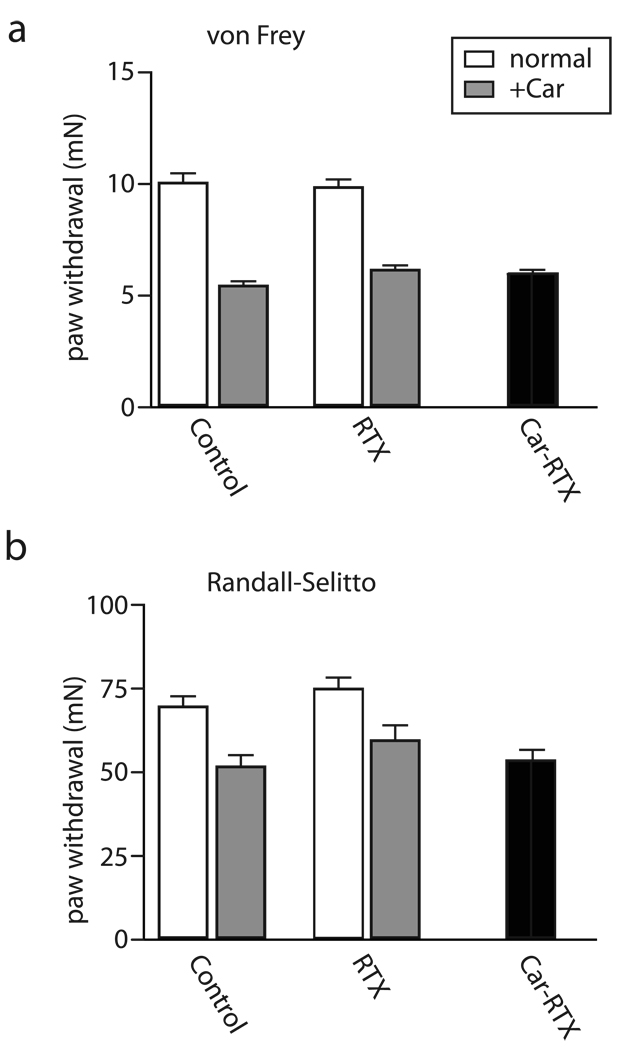
Paw withdrawal to von Frey filaments (A) and tail flinch responses to pinch (B) were used to monitor mechanical pain in normal (open bars) and inflamed (carageenan treated, +CAR, filled bars) tissue. Inflammation reduced the threshold stimulation required for both types of responses. However, intrathecal RTX treatment did not alter mechanical responses either in normal or inflamed tissue. Notably even RTX administration after inflammation (Car-RTX), which dramatically attenuates thermal pain (Fig. 3), had no effect on responses to either type of mechanical stimulation (black bars); mean ± SEM (n=5 animals each tested 3≥ times).

References

    1. Abrahamsen B, Zhao J, Asante CO, Cendan CM, Marsh S, Martinez-Barbera JP, Nassar MA, Dickenson AH, Wood JN. The cell and molecular basis of mechanical, cold, and inflammatory pain. Science (New York, N.Y. 2008;321:702–705. - PubMed
    1. Adler E, Hoon MA, Mueller KL, Chandrashekar J, Ryba NJ, Zuker CS. A novel family of mammalian taste receptors. Cell. 2000;100:693–702. - PubMed
    1. Amaya F, Oh-hashi K, Naruse Y, Iijima N, Ueda M, Shimosato G, Tominaga M, Tanaka Y, Tanaka M. Local inflammation increases vanilloid receptor 1 expression within distinct subgroups of DRG neurons. Brain research. 2003;963:190–196. - PubMed
    1. Bautista DM, Jordt SE, Nikai T, Tsuruda PR, Read AJ, Poblete J, Yamoah EN, Basbaum AI, Julius D. TRPA1 mediates the inflammatory actions of environmental irritants and proalgesic agents. Cell. 2006;124:1269–1282. - PubMed
    1. Bautista DM, Sigal YM, Milstein AD, Garrison JL, Zorn JA, Tsuruda PR, Nicoll RA, Julius D. Pungent agents from Szechuan peppers excite sensory neurons by inhibiting two-pore potassium channels. Nature neuroscience. 2008;11:772–779. - PMC - PubMed

Publication types

MeSH terms