


Midline and right frontal brain function as a physiologic biomarker of remission in major depression
- PMID: 19853417
- PMCID: PMC2804067
- DOI: 10.1016/j.pscychresns.2009.04.011
Midline and right frontal brain function as a physiologic biomarker of remission in major depression
Abstract
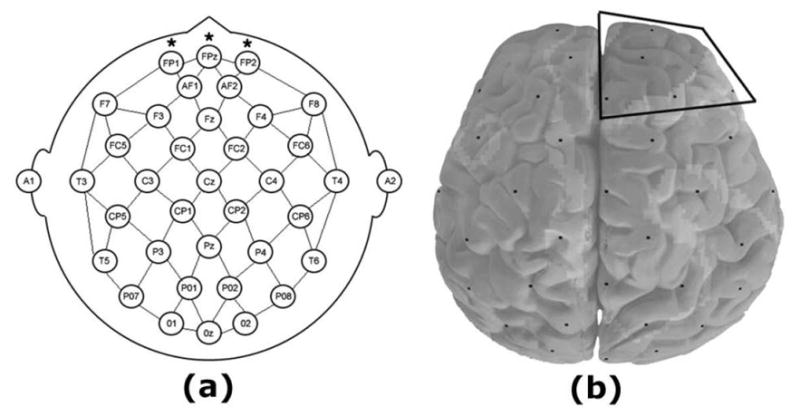
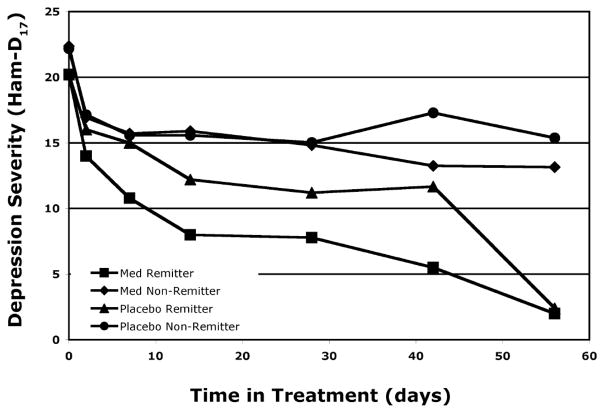
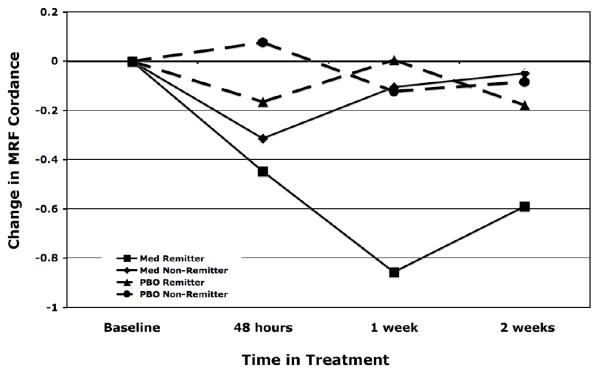
Prior investigations have reported that changes in the prefrontal electroencephalogram (EEG) precede symptom improvement from antidepressant medications, and could serve as a biomarker of treatment outcome in major depressive disorder (MDD). A new physiologically defined region of interest (ROI), overlying the midline and right frontal (MRF) cortical area, was examined here for a relationship between early decreases in theta-band cordance and remission. Subjects were 72 adults with unipolar MDD who had completed placebo-controlled antidepressant treatment trials, with 37 randomized to medication and 35 to placebo. We assessed changes in cordance and absolute and relative power in the MRF region at 48 h, 1 week, and 2 weeks after start of drug, as potential predictors of remission (final score on the 17-item Hamilton Depression Rating Scale of 5 or below. Out of 37 medication-treated subjects, 11 (30%) remitted versus 6 of 35 placebo subjects (17%). Change in MRF cordance 1 and 2 weeks after the beginning of treatment was significantly associated with remission in medication-treated subjects at 1 week, with receiver operating characteristic (ROC) analysis yielding 0.76 area under the curve. Decreases in MRF cordance at 1 week predicted remission with medication with 69% overall accuracy (90% sensitivity; 60% specificity). MRF cordance changes were not associated with remission with placebo. Absolute and relative power did not differentiate groups. These results suggest that remission may be predictable from physiologic measurements after 1 week of treatment, and that this region merits further investigation in the neurobiology of treatment response.
Figures
References
-
- Anderer P, Saletu B, Pascual-Marqui RD. Effect of the 5-HT(1A) partial agonist buspirone on regional brain electrical activity in man: a functional neuroimaging study using low-resolution electromagnetic tomography (LORETA) Psychiatry Research. 2000;100:81–96. - PubMed
-
- Asada H, Fukuda Y, Tsunoda S, Yamaguchi M, Tonoike M. Frontal midline theta rhythms reflect alternative activation of prefrontal cortex and anterior cingulate cortex in humans. Neuroscience Letters. 1999;274:29–32. - PubMed
-
- Bareš M, Brunovsky M, Kopeček M, Stopková P, Novák T, Kozeny J, Hoschl C. Changes in QEEG prefrontal cordance as a predictor of response to antidepressants in patients with treatment resistant depressive disorder: A pilot study. Journal of Psychiatric Research. 2007;41:319–335. - PubMed
-
- Bareš M, Brunovsky M, Kopeček M, Novák T, Stopková P, Kozeny J, Sos P, Krajca V, Höschl C. Early reduction in prefrontal theta QEEG cordance value predicts response to venlafaxine treatment in patients with resistant depressive disorder. European Psychiatry. 2008;23:350–355. - PubMed
-
- Blackhart GC, Minnix JA, Kline JP. Can EEG asymmetry patterns predict future development of anxiety and depression? A preliminary study. Biological Psychology. 2006;72:46–50. - PubMed
Publication types
MeSH terms
Substances
Grants and funding
LinkOut - more resources
Full Text Sources
Miscellaneous
