


Association of IRF5 polymorphisms with activation of the interferon alpha pathway
- PMID: 19854706
- PMCID: PMC3135414
- DOI: 10.1136/ard.2009.118315
Association of IRF5 polymorphisms with activation of the interferon alpha pathway
Abstract
Objective: The genetic association of interferon regulatory factor 5 (IRF5) with systemic lupus erythematosus (SLE) susceptibility has been convincingly established. To gain understanding of the effect of IRF5 variation in individuals without SLE, a study was undertaken to examine whether such genetic variation predisposes to activation of the interferon alpha (IFNalpha) pathway.
Methods: Using a computer simulated approach, 14 single nucleotide polymorphisms (SNPs) and haplotypes of IRF5 were tested for association with mRNA expression levels of IRF5, IFNalpha and IFN-inducible genes and chemokines in lymphoblastoid cell lines (LCLs) from individuals of European (CEU), Han Chinese (CHB), Japanese (JPT) and Yoruba Nigerian (YRI) backgrounds. IFN-inducible gene expression was assessed in LCLs from children with SLE in the presence and absence of IFNalpha stimulation.
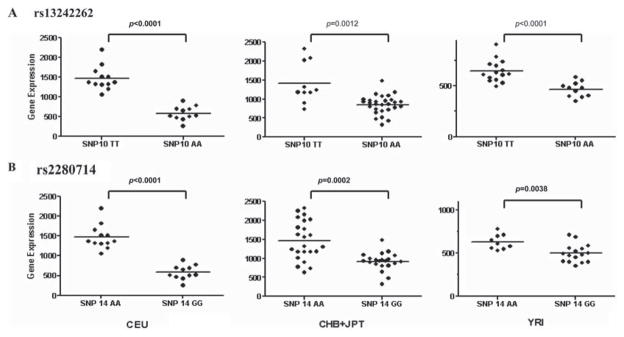
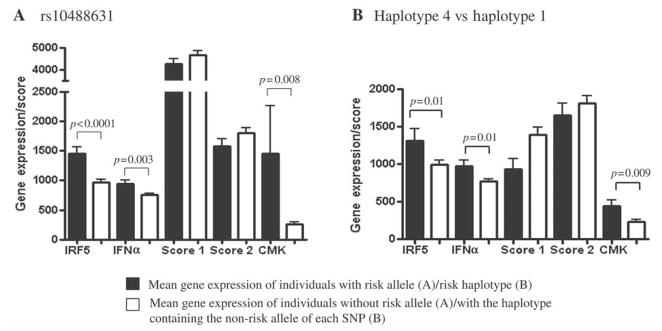
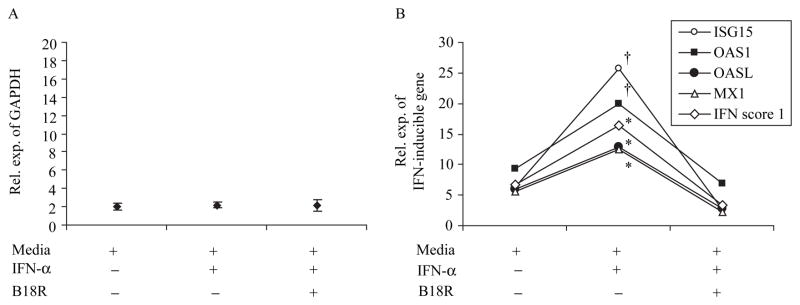
Results: The major alleles of IRF5 rs13242262 and rs2280714 were associated with increased IRF5 mRNA expression levels in the CEU, CHB+JPT and YRI samples. The minor allele of IRF5 rs10488631 was associated with increased IRF5, IFNalpha and IFN-inducible chemokine expression in CEU (p(c)=0.0005, 0.01 and 0.04, respectively). A haplotype containing these risk alleles of rs13242262, rs10488631 and rs2280714 was associated with increased IRF5, IFNalpha and IFN-inducible chemokine expression in CEU LCLs. In vitro studies showed specific activation of IFN-inducible genes in LCLs by IFNalpha.
Conclusions: SNPs of IRF5 in healthy individuals of a number of ethnic groups were associated with increased mRNA expression of IRF5. In European-derived individuals, an IRF5 haplotype was associated with increased IRF5, IFNalpha and IFN-inducible chemokine expression. Identifying individuals genetically predisposed to increased IFN-inducible gene and chemokine expression may allow early detection of risk for SLE.
Figures

References
-
- Crow MK, Kirou KA. Interferon-alpha in systemic lupus erythematosus. Curr Opin Rheumatol. 2004;16:541–7. - PubMed
-
- Pascual V, Farkas L, Banchereau J. Systemic lupus erythematosus: all roads lead to type I interferons. Curr Opin Immunol. 2006;18:676–82. - PubMed
-
- Pascual V, Banchereau J, Palucka AK. The central role of dendritic cells and interferon-alpha in SLE. Curr Opin Rheumatol. 2003;15:548–56. - PubMed
Publication types
MeSH terms
Substances
Grants and funding
LinkOut - more resources
Full Text Sources
Medical
