. 2010;61(2):335-45.
doi: 10.1093/jxb/erp307. Epub 2009 Oct 23.

Flower numbers, pod production, pollen viability, and pistil function are reduced and flower and pod abortion increased in chickpea (Cicer arietinum L.) under terminal drought

Affiliations

Flower numbers, pod production, pollen viability, and pistil function are reduced and flower and pod abortion increased in chickpea (Cicer arietinum L.) under terminal drought

Xiangwen Fang et al. J Exp Bot. 2010.

Abstract

Terminal drought during the reproductive stage is a major constraint to yield of chickpea in many regions of the world. Termination of watering (WS) during podding in a small-seeded desi chickpea (Cicer arietinum L.) cultivar, Rupali, and a large-seeded kabuli chickpea cultivar, Almaz, induced a decrease in predawn leaf water potential (LWP), in the rate of photosynthesis, and in stomatal conductance. Compared to well-watered (WW) controls, the WS treatment reduced flower production by about two-thirds. In the WW treatment, about 15% of the flowers aborted and 42% (Rupali) and 67% (Almaz) of the pods aborted, whereas in the WS treatment 37% and 56% of the flowers aborted and 54% and 73% of the pods aborted, resulting in seed yields of 33% and 15% of the yields in WW plants in Rupali and Almaz, respectively. In vitro pollen viability and germination in Rupali decreased by 50% and 89% in the WS treatment, and pollen germination decreased by 80% in vivo when pollen from a WS plant was placed on a stigma of a WW plant. While about 37% of the germinated pollen tubes from WW plants and 22% from the WS plants reached the ovary in the WW plants, less than 3% of pollen grains reached the ovary when pollen from either WS or WW plants was placed on a stigma of a WS plant. It is concluded that, in addition to pod abortion, flower abortion is an important factor limiting yield in chickpea exposed to terminal drought and that water deficit impaired the function of the pistil/style more than the pollen.


Figures

Fig. 1.
Fig. 1.
Change with time after the imposition of treatments [Day 0=78 DAS (12 August) in A and B and 39 DAS (1 February) in C and D] in soil water content [SWC, % of field capacity (FC)] (A, C), and predawn leaf water potential (LWP) (B, D) of Rupali and Almaz chickpea cultivars in Experiment 1 (A, B) and in Rupali in Experiment 2 (C, D) in well-watered (WW) and water-stressed (WS) treatments. Values are means ±SE (n=5). Note change of scale of y-axis between (B) and(D).
Fig. 2.
Fig. 2.
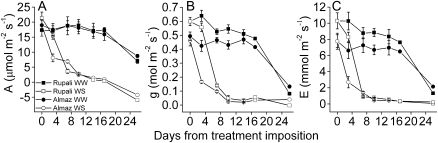
Change with time after imposition of treatments (Day 0=78 DAS) in (A) photosynthetic rate, (B) stomatal conductance, and (C) transpiration rate of Rupali and Almaz chickpea cultivars in well-watered (WW) and water-stressed (WS) treatments in Experiment 1. Values are means ±SE (n=5).
Fig. 3.
Fig. 3.
Cumulative number of flowers, total pods, filled pods, and seeds, and cumulative seed weight per plant in well-watered (A, C) and water-stressed (B, D) treatments of Rupali (A, B) and Almaz (C, D) from the imposition of treatments (Day 0=78 DAS) to maturity in Experiment 1. Values are means ±SE (n=4).
Fig. 4.
Fig. 4.
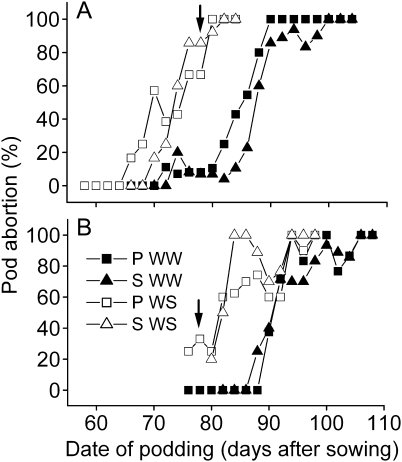
Pod abortion by maturity in relation to the date of podding for pods on primary (P) and secondary (S) branches of Rupali (A) and Almaz (B) chickpeas in well-watered (WW) and water-stressed treatments (WS) in Experiment 1. The time of imposition of treatments is shown by a vertical arrow.
Fig. 5.
Fig. 5.
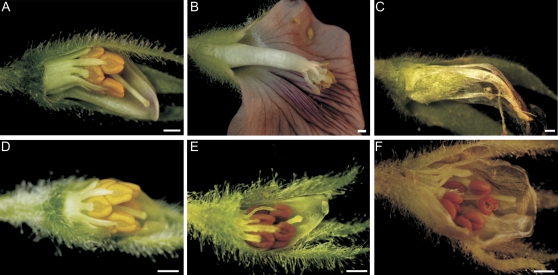
Flowers of Rupali at three stages of development in well-watered (WW) (A–C) and water-stressed (WS) plants (D–F) that developed at the same time in Experiment 2: (i) 3 d before WW flowers opened (A, D); (ii) at flowering (LWP was –1.2 MPa in WS plants) (B, E); and (iii) 3 d after WW flowers opened (C, F). Photographs were taken after the removal of some petals and sepals and show that anthers of flowers in the WS plants did not burst when LWP decreased to –1.2 MPa. Scale bar=500 μm (note the smaller magnification in B and C). (This figure is available in colour at JXB online.)
Fig. 6.
Fig. 6.
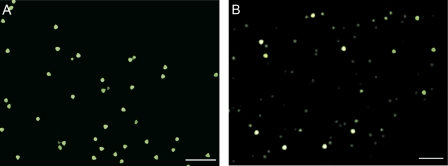
Pollen viability of Rupali in well-watered (A) and water-stressed (B) treatments when predawn leaf water potential decreased to –1.2 MPa in the WS treatment in Experiment 2. Bright pollen grains are viable while grey pollen grains have lost viability. Scale bar=200 μm. (This figure is available in colour at JXB online.)
Fig. 7.
Fig. 7.
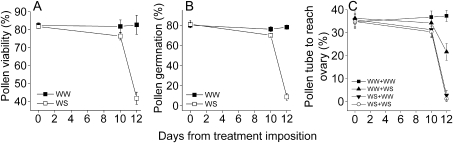
Percentage pollen viability (A), percentage pollen germination during 4 h culture in vitro (B), and percentage of germinated pollen tubes to reach the ovary after 24 h in hand-pollinated flowers in vivo (C) in Rupali chickpea in well-watered (WW) and water-stressed (WS) treatments. WW+WW, stigmas of WW plants pollinated with pollen from WW plants; WW+WS, stigmas of WW plants pollinated with pollen from WS plants, WS+WW, stigmas of WS plants pollinated with pollen from WW plants; WS+WS, stigmas of WS plants pollinated with pollen from WS plants. Days are from treatment imposition (Day 0=39 DAS) in Experiment 2. Values are means ±SE (n=10).
Fig. 8.
Fig. 8.
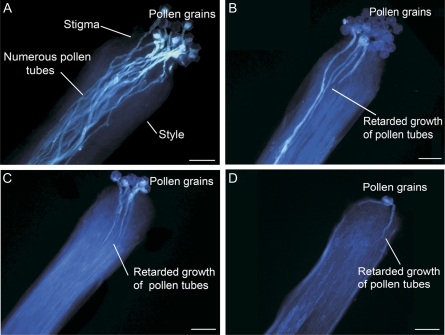
Pollen tube growth down the style in pistils of (A) well-watered (WW) Rupali chickpeas pollinated with pollen from WW plants (WW+WW); (B) WW plants pollinated with pollen from water-stressed (WS) plants (WW+WS); (C) WS plants pollinated with pollen from WW (WW+WS); and (D) WS plants pollinated with pollen from WS plants (WS+WS) in Experiment 2. Styles were harvested when the predawn leaf water potential of WS plants was –1.2 MPa and then fixed 24 h later and stained with aniline blue. Scale bar=50 μm. (This figure is available in colour at JXB online.)
Fig. 9.
Fig. 9.
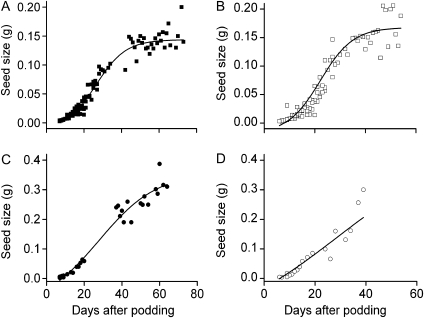
Change in seed size on primary branches with time after podding in Rupali (A, B) and Almaz (C, D) chickpeas in well-watered (A, C) and water-stressed treatments (B, D) in Experiment 1. Note change of scale of y-axis in (C) and (D) from that in (A) and (B).
Fig. 10.
Fig. 10.
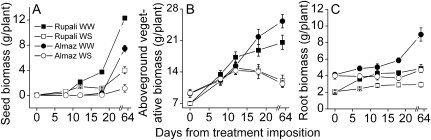
Change with time after imposition of treatments (Day 0=78 DAS) in (A) seed biomass, (B) above-ground vegetative biomass (sum of leaf, pod, and stem), and (C) root biomass of Rupali and Almaz chickpeas in well-watered (WW) and water-stressed (WS) treatments in Experiment 1. Values are means ±SE (n=4).

References

    1. Brewbaker JL, Kwack BH. The essential role of calcium ion in pollen germination and pollen tube growth. American Journal of Botany. 1963;50:859–865.
    1. Clarke HJ, Siddique KHM. Response of chickpea genotypes to low temperature stress during reproductive development. Field Crops Research. 2004;90:323–334.
    1. Davies SL, Turner NC, Siddique KHM, Plummer JA, Leport L. Seed growth of desi and kabuli chickpea (Cicer arietinum L.) in a short-season Mediterranean-type environment. Australian Journal of Experimental Agriculture. 1999;39:181–188.
    1. Duthion C, Pigeaire A. Seed lengths corresponding to the final stage in seed abortion in three grain legumes. Crop Science. 1991;31:1579–1583.
    1. Egli DB. Flowering, pod set and reproductive success in soya bean. Journal of Agronomy and Crop Science. 2005;191:283–291.

Publication types