


Phospholipases A2 and inflammatory responses in the central nervous system
- PMID: 19855947
- PMCID: PMC3075861
- DOI: 10.1007/s12017-009-8092-z
Phospholipases A2 and inflammatory responses in the central nervous system
Abstract
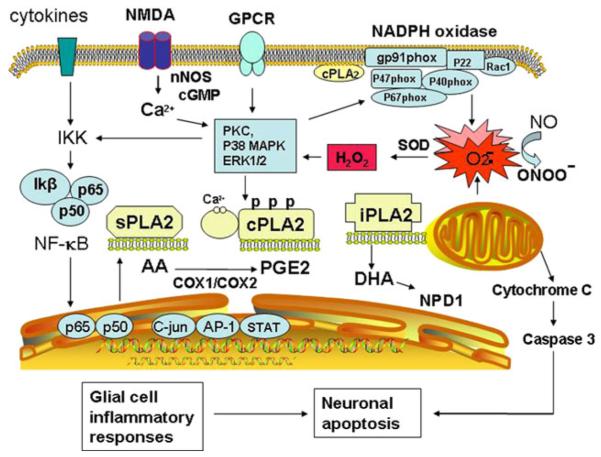
Phospholipases A2 (PLA2s) belong to a superfamily of enzymes responsible for hydrolyzing the sn-2 fatty acids of membrane phospholipids. These enzymes are known to play multiple roles for maintenance of membrane phospholipid homeostasis and for production of a variety of lipid mediators. Over 20 different types of PLA2s are present in the mammalian cells, and in snake and bee venom. Despite their common function in hydrolyzing fatty acids of phospholipids, they are diversely encoded by a number of genes and express proteins that are regulated by different mechanisms. Recent studies have focused on the group IV calcium-dependent cytosolic cPLA2, the group VI calcium-independent iPLA2, and the group II small molecule secretory sPLA2. In the central nervous system (CNS), these PLA2s are distributed among neurons and glial cells. Although the physiological role of these PLA2s in regulating neural cell function has not yet been clearly elucidated, there is increasing evidence for their involvement in receptor signaling and transcriptional pathways that link oxidative events to inflammatory responses that underline many neurodegenerative diseases. Recent studies also reveal an important role of cPLA2 in modulating neuronal excitatory functions, sPLA2 in the inflammatory responses, and iPLA2 with childhood neurologic disorders associated with brain iron accumulation. The goal for this review is to better understand the structure and function of these PLA2s and to highlight specific types of PLA2s and their cross-talk mechanisms in these inflammatory responses under physiological and pathological conditions in the CNS.
Figures
References
-
- Alexandrov P, Cui JG, Zhao Y, Lukiw WJ. 24S-hydroxycholesterol induces inflammatory gene expression in primary human neural cells. Neuroreport. 2005;16:909–913. - PubMed
Publication types
MeSH terms
Substances
Grants and funding
LinkOut - more resources
Full Text Sources
Other Literature Sources
