


Pre-steady-state kinetic analysis of cis-3-chloroacrylic acid dehalogenase: analysis and implications
- PMID: 19856961
- PMCID: PMC2790542
- DOI: 10.1021/bi901349z
Pre-steady-state kinetic analysis of cis-3-chloroacrylic acid dehalogenase: analysis and implications
Abstract
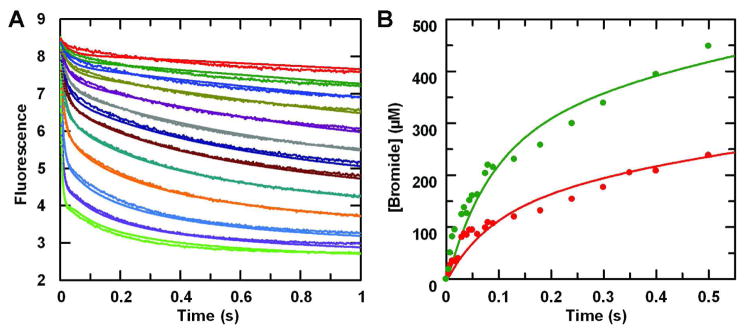
Isomer-specific 3-chloroacrylic acid dehalogenases catalyze the hydrolytic dehalogenation of the cis- and trans-isomers of 3-chloroacrylate to yield malonate semialdehyde. These reactions represent key steps in the degradation of the nematocide, 1,3-dichloropropene. The kinetic mechanism of cis-3-chloroacrylic acid dehalogenase (cis-CaaD) has now been examined using stopped-flow and chemical-quench techniques. Stopped-flow analysis of the reaction, following the fluorescence of an active site tryptophan, is consistent with a minimal three-step model involving substrate binding, chemistry, and product release. Chemical-quench experiments show burst kinetics, indicating that product release is at least partially rate limiting. Global fitting of all of the kinetic results by simulation is best accommodated by a four-step mechanism. In the final kinetic model, the enzyme binds substrate with an immediate isomerization to an alternate fluorescent form and chemistry occurs, followed by the ordered release of two products, with the release of the first product as the rate-limiting step. Bromide ion is a competitive inhibitor of the reaction indicating that it binds to the free enzyme rather than to the enzyme with one product still bound. This observation suggests that malonate semialdehyde is the first product released by the enzyme (rate limiting), followed by halide. A comparison of the unliganded cis-CaaD crystal structure with that of an inactivated cis-CaaD where the prolyl nitrogen of Pro-1 is covalently attached to (R)-2-hydroxypropanoate provides a possible explanation for the isomerization step. The structure of the covalently modified enzyme shows that a seven-residue loop comprised of residues 32-38 is closed down on the active site cavity where the backbone amides of two residues (Phe-37 and Leu-38) interact with the carboxylate group of the adduct. In the unliganded form, the same loop points away from the active site cavity. Similarly, substrate binding may cause this loop to close down on the active site and sequester the reaction from the external environment.
Conflict of interest statement
Financial conflict of interest disclosure: K.A.J. is President of KinTek Corporation.
Figures



References
-
- Hartmans S, Jansen MW, van der Werf MJ, de Bont JAM. Bacterial metabolism of 3-chloroacrylic acid. J Gen Microbiol. 1991;137:2025–2032. - PubMed
-
- van Hylckama Vlieg JET, Janssen DB. Bacterial degradation of 3-chloroacrylic acid and the characterization of cis- and trans-specific dehalogenases. Biodegradation. 1992;2:139–150. - PubMed
-
- Poelarends GJ, Serrano H, Person MD, Johnson WH, Jr, Murzin AG, Whitman CP. Cloning, expression, and characterization of a cis-3-chloroacrylic acid dehalogenase: insights into the mechanistic, structural, and evolutionary relationship between isomer-specific 3-chloroacrylic acid dehalogenases. Biochemistry. 2004;43:759–772. - PubMed
Publication types
MeSH terms
Substances
Grants and funding
LinkOut - more resources
Full Text Sources
