. 2009 Oct;12(5):1023-8.
doi: 10.1089/jmf.2009.0128.

Inulin increases glucose transport in C2C12 myotubes and HepG2 cells via activation of AMP-activated protein kinase and phosphatidylinositol 3-kinase pathways

Affiliations

Inulin increases glucose transport in C2C12 myotubes and HepG2 cells via activation of AMP-activated protein kinase and phosphatidylinositol 3-kinase pathways

Hee Yun et al. J Med Food. 2009 Oct.

Abstract

Inulin, a naturally occurring, functional food ingredient found in various edible plants, has been reported to exert potential health benefits, including decreased risk of colonic diseases, non-insulin-dependent diabetes, obesity, osteoporosis, and cancer. However, the mechanism of the antidiabetic activity of inulin has not yet been elucidated. In this study, we showed that inulin increased the uptake of glucose in C2C12 myotubes, which was associated with both AMP-activated protein kinase (AMPK) and phosphatidylinositol 3-kinase (PI3-K) signaling pathways, but both of these pathways appeared to transmit their signals in an independent manner. Moreover, we found that inulin was able to increase the uptake of glucose in C2C12 myotubes in which insulin resistance was induced by exposing cells to high glucose concentrations. The identical effects of inulin were also observed in HepG2 hepatoma cells. Collectively, we report the antidiabetic activity of inulin and further demonstrate for the first time that such activity is associated with AMPK and PI3-K activation.


Figures
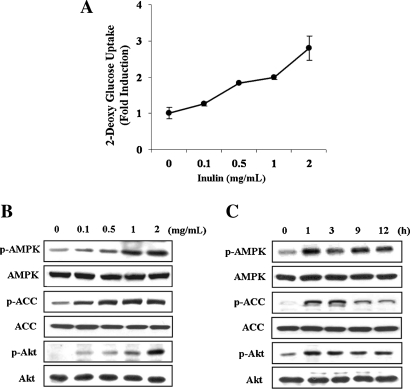
FIG. 1.
FIG. 1.
Inulin stimulates glucose uptake and activates both PI3-K/Akt and AMPK in C2C12 myotubes. C2C12 myotubes were incubated with the indicated concentrations of inulin for 1 hour or with 1 mg/mL inulin for the indicated time periods. (A) Glucose uptake was measured as described in Materials and Methods. Data are mean ± SD values for two independent assays performed in triplicate. (B and C) Protein extracts were prepared and subjected to western blot assay using anti-phosphospecific ACC-Ser79 (p-ACC), total ACC (ACC), anti-phosphospecific AMPK-Thr172 (p-AMPK), total AMPK (AMPK-α), anti-phosphospecific Akt-Ser473 (p-Akt), and total Akt (AKT) antibodies, varying (B) inulin concentration or (C) incubation time. Experiments were repeated three times with similar results, and a representative result is shown.
FIG. 2.
FIG. 2.
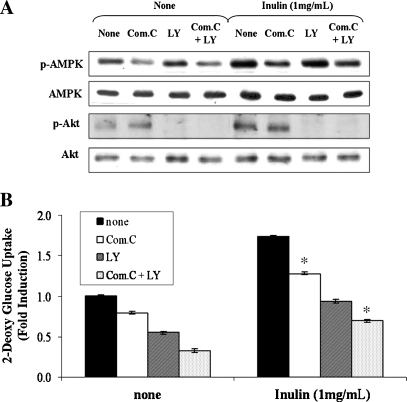
Effect of inulin on glucose uptake is dependent upon both AMPK and Akt in C2C12 myotubes. C2C12 cells were pretreated with or without 20 μM compound C (Com.C) or 25 μM LY24002 for 30 minutes and then treated with 1 mg/mL inulin for 1 hour. (A) Protein extracts were prepared and subjected to western blot analysis using anti-phosphospecific AMPK-Thr172 (p-AMPK), total AMPK (AMPK-α), anti-phosphospecific Akt-Ser473 (p-Akt), and total Akt (AKT) antibodies. Experiments were repeated three times with similar results, and a representative result is shown. (B) Glucose uptake was measured as described in Materials and Methods. Data are mean ± SD values for two independent assays performed in triplicate. *P < .05 versus inulin alone.
FIG. 3.
FIG. 3.
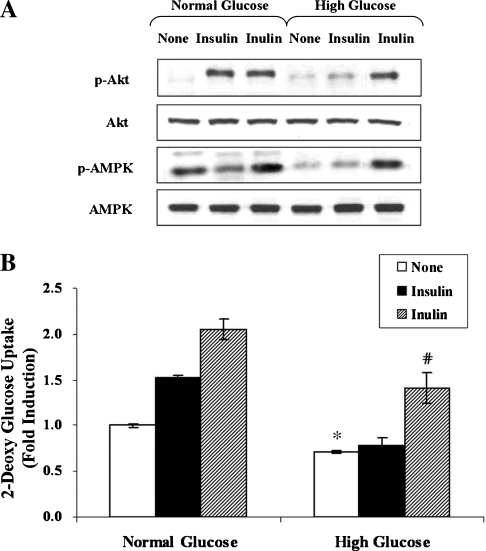
Inulin overcomes insulin resistance in a PI3-K/Akt- and AMPK-dependent manner. C2C12 cells were incubated in serum-free medium overnight and incubated in serum-free medium containing either normal (5.5 mM) or high (30 mM) concentrations of d-glucose for an additional 24 hours. Before harvesting, the cells were stimulated with 1 mg/mL inulin or 100 nM insulin for 1 hour. (A) The phosphorylation of AMPK and Akt was analyzed with anti-phospho-Ser473 Akt and anti-phospho-Thr172 AMPK antibodies, respectively. Experiments were repeated three times with similar results, and a representative result is shown. (B) Glucose uptake was measured as described in Materials and Methods. Data are mean ± SD values for two independent assays performed in triplicate. *P < .05 versus normal glucose; #P < .05 versus high glucose alone.
FIG. 4.
FIG. 4.
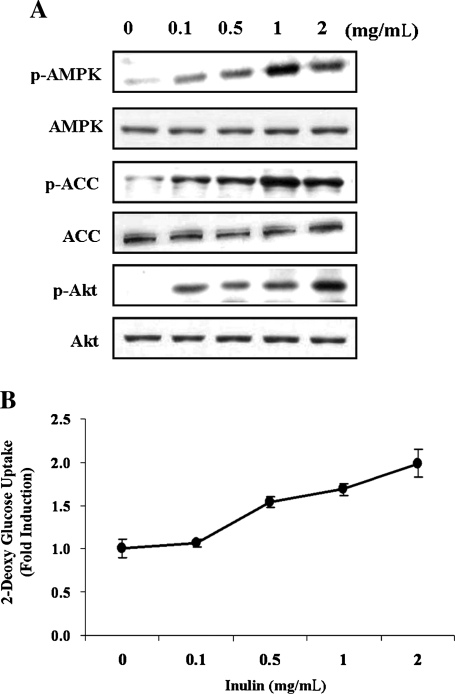
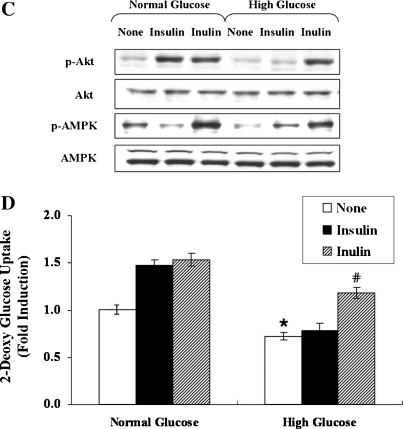
Inulin increases glucose uptake and overcomes insulin resistance in HepG2 hepatoma cells. HepG2 cells were incubated with the indicated concentrations of inulin for 1 hour. (A) Protein extracts were prepared and subjected to western blot assay using anti-phosphospecific ACC-Ser79 (p-ACC), total ACC (ACC), anti-phosphospecific AMPK-Thr172 (p-AMPK), total AMPK (AMPK-α), anti-phosphospecific Akt-Ser473 (p-Akt), and total Akt (AKT) antibodies. Experiments were repeated three times with similar results, and a representative result is shown. (B) Glucose uptake was measured as described in Materials and Methods. Data are mean ± SD values for two independent assays performed in triplicate. (C) HepG2 cells were incubated in serum-free medium overnight and incubated in serum-free medium containing either normal (5.5 mM) or high (30 mM) concentrations of d-glucose for an additional 24 hours. Before harvesting, the cells were stimulated with 1 mg/mL inulin or 100 nM insulin for 1 hour. The phosphorylation of AKT, and AMPK was analyzed with anti-phospho-Ser473 Akt and anti-phospho-Thr172 AMPK antibodies, respectively. Experiments were repeated three times with similar results, and a representative result is shown. (D) Glucose uptake was measured as described in Materials and Methods. Data are mean ± SD values for two independent assays performed in triplicate. *P < .05 versus normal glucose; #P < .05 versus high glucose alone.
FIG. 4.
FIG. 4.
Inulin increases glucose uptake and overcomes insulin resistance in HepG2 hepatoma cells. HepG2 cells were incubated with the indicated concentrations of inulin for 1 hour. (A) Protein extracts were prepared and subjected to western blot assay using anti-phosphospecific ACC-Ser79 (p-ACC), total ACC (ACC), anti-phosphospecific AMPK-Thr172 (p-AMPK), total AMPK (AMPK-α), anti-phosphospecific Akt-Ser473 (p-Akt), and total Akt (AKT) antibodies. Experiments were repeated three times with similar results, and a representative result is shown. (B) Glucose uptake was measured as described in Materials and Methods. Data are mean ± SD values for two independent assays performed in triplicate. (C) HepG2 cells were incubated in serum-free medium overnight and incubated in serum-free medium containing either normal (5.5 mM) or high (30 mM) concentrations of d-glucose for an additional 24 hours. Before harvesting, the cells were stimulated with 1 mg/mL inulin or 100 nM insulin for 1 hour. The phosphorylation of AKT, and AMPK was analyzed with anti-phospho-Ser473 Akt and anti-phospho-Thr172 AMPK antibodies, respectively. Experiments were repeated three times with similar results, and a representative result is shown. (D) Glucose uptake was measured as described in Materials and Methods. Data are mean ± SD values for two independent assays performed in triplicate. *P < .05 versus normal glucose; #P < .05 versus high glucose alone.

References

    1. Flamm G. Glinsmann W. Kritchevsky D. Prosky L. Roberfroid M. Inulin and oligofructose as dietary fiber: a review of the evidence. Crit Rev Food Sci Nutr. 2001;41:353–362. - PubMed
    1. Kaur N. Gupta AK. Applications of inulin and oligofructose in health and nutrition. J Biosci. 2002;27:703–714. - PubMed
    1. Roberfroid MB. Functional foods: concepts and application to inulin and oligofructose. Br J Nutr. 2002;87(Suppl 2):S139–S143. - PubMed
    1. Luo J. Rizkalla SW. Alamowitch C, et al. Chronic consumption of short-chain fructooligosaccharides by healthy subjects decreased basal hepatic glucose production but had no effect on insulin-stimulated glucose metabolism. Am J Clin Nutr. 1996;63:939–945. - PubMed
    1. Kok NN. Taper HS. Delzenne NM. Oligofructose modulates lipid metabolism alterations induced by a fat-rich diet in rats. J Appl Toxicol. 1998;18:47–53. - PubMed

Publication types

MeSH terms