


Pharmacokinetic properties of azithromycin in pregnancy
- PMID: 19858250
- PMCID: PMC2798488
- DOI: 10.1128/AAC.00771-09
Pharmacokinetic properties of azithromycin in pregnancy
Abstract
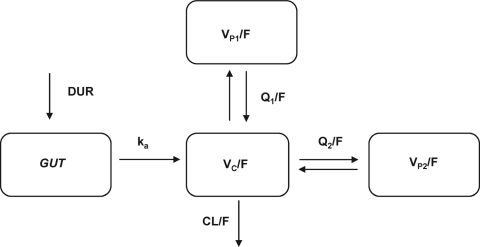
Azithromycin (AZI) is an azalide antibiotic with antimalarial activity that is considered safe in pregnancy. To assess its pharmacokinetic properties when administered as intermittent preventive treatment in pregnancy (IPTp), two 2-g doses were given 24 h apart to 31 pregnant and 29 age-matched nonpregnant Papua New Guinean women. All subjects also received single-dose sulfadoxine-pyrimethamine (SP) (1,500 mg or 75 mg) or chloroquine (450-mg base daily for 3 days). Blood samples were taken at 0, 1, 2, 3, 6, 12, 24, 32, 40, 48, and 72 h and on days 4, 5, 7, 10, and 14 for AZI assay by ultra-high-performance liquid chromatography-tandem mass spectrometry. The treatments were well tolerated. Using population pharmacokinetic modeling, a three-compartment model with zero-order followed by first-order absorption and no lag time provided the best fit. The areas under the plasma concentration-time curve (AUC(0-infinity)) (28.7 and 31.8 mg.h liter(-1) for pregnant and nonpregnant subjects, respectively) were consistent with the results of previous studies, but the estimated terminal elimination half-lives (78 and 77 h, respectively) were generally longer. The only significant relationship for a range of potential covariates, including malarial parasitemia, was with pregnancy, which accounted for an 86% increase in the volume of distribution of the central compartment relative to bioavailability without a significant change in the AUC(0-infinity). These data suggest that AZI can be combined with compounds with longer half-lives, such as SP, in combination IPTp without the need for dose adjustment.
Figures
References
-
- Adebayo, R. A., G. G. Sofowora, O. Onayemi, S. J. Udoh, and A. A. Ajayi. 1997. Chloroquine-induced pruritus in malaria fever: contribution of malaria parasitaemia and the effects of prednisolone, niacin, and their combination, compared with antihistamine. Br. J. Clin. Pharmacol. 44:157-161. - PMC - PubMed
-
- Amsden, G. W., and C. L. Gray. 2001. Serum and WBC pharmacokinetics of 1500 mg of azithromycin when given either as a single dose or over a 3 day period in healthy volunteers. J. Antimicrob. Chemother. 47:61-66. - PubMed
-
- Anderson, B. J., and N. H. Holford. 2008. Mechanism-based concepts of size and maturity in pharmacokinetics. Annu. Rev. Pharmacol. Toxicol. 48:303-332. - PubMed
-
- Anderson, G. D. 2005. Pregnancy-induced changes in pharmacokinetics: a mechanistic-based approach. Clin. Pharmacokinet. 44:989-1008. - PubMed
-
- Anderson, S. L., A. J. Oloo, D. M. Gordon, O. B. Ragama, G. M. Aleman, J. D. German, D. B. Tang, M. W. Dunne, and G. D. Shanks. 1998. Successful double-blinded, randomized, placebo-controlled field trial of azithromycin and doxycycline as prophylaxis for malaria in Western Kenya. Clin. Infect. Dis. 26:146-150. - PubMed
Publication types
MeSH terms
Substances
LinkOut - more resources
Full Text Sources
Medical
