


Hormone therapy and physical function change among older women in the Women's Health Initiative: a randomized controlled trial
- PMID: 19858764
- PMCID: PMC3106270
- DOI: 10.1097/gme.0b013e3181ba56c7
Hormone therapy and physical function change among older women in the Women's Health Initiative: a randomized controlled trial
Abstract
Objective: Although estrogen may be linked to biological pathways that maintain higher physical function, the evidence is derived mostly from observational epidemiology and therefore has numerous limitations. We examined whether hormone therapy affected physical function in women 65 to 79 years of age at enrollment.
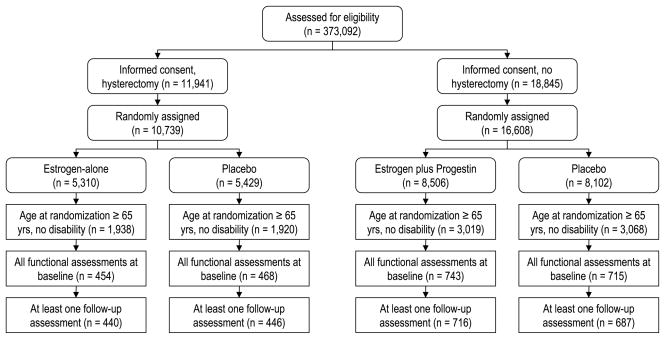
Methods: This study involves an analysis of the Women's Health Initiative randomized controlled trials of hormone therapy in which 922 nondisabled women who had previous hysterectomies were randomized to receive estrogen therapy or a placebo and 1,458 nondisabled women with intact uteri were randomized to receive estrogen + progestin therapy or a placebo. Changes in physical function were analyzed for treatment effect, and subgroup differences were evaluated. All women completed performance-based measures of physical function (grip strength, chair stands, and timed walk) at baseline. These measures were repeated after 1, 3, and 6 years.
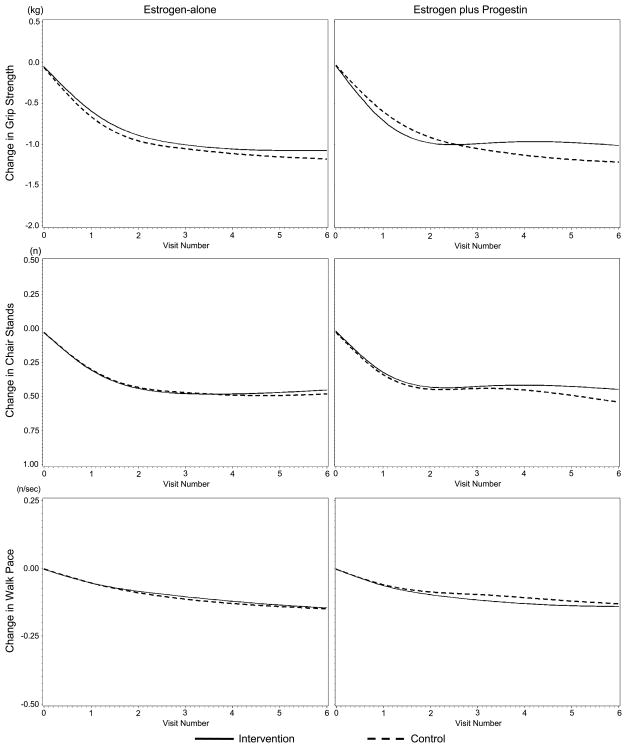
Results: Overall, participants' grip strength declined by 12.0%, chair stands declined by 3.5%, and walk pace slowed by 11.4% in the 6 years of follow-up (all P values <0.0001). Hormone therapy, as compared with placebo, was not associated with an increased or decreased risk of decline in physical function in either the intention-to-treat analyses or in analyses restricted to participants who were compliant in taking study pills.
Conclusions: Hormone therapy provided no overall protection against functional decline in nondisabled postmenopausal women 65 years or older in 6 years of follow-up. This study did not address the influence of hormone therapy for women of younger ages.
Conflict of interest statement
Financial disclosure/conflicts of interest: None reported.
Figures
Comment in
-
The Women's Health Initiative tells us more about what estrogen can and cannot do but does not give us the answer.Menopause. 2010 Mar;17(2):235-6. doi: 10.1097/gme.0b013e3181ce996c. Menopause. 2010. PMID: 20216273 No abstract available.
References
-
- Guralnik JM, LaCroix AZ, Abbott RD, et al. Maintaining mobility in late life. I. Demographic characteristics and chronic conditions. Am J Epidemiol. 1993;137:845–857. - PubMed
-
- Leveille SG, Penninx BW, Melzer D, Izmirlian G, Guralnik JM. Sex differences in the prevalence of mobility disability in old age: the dynamics of incidence, recovery, and mortality. J Gerontol A Biol Sci Med Sci. 2000;55:S41–S50. - PubMed
-
- Onder G, Penninx BW, Lapuerta P, et al. Change in physical performance over time in older women: the Women’s Health and Aging Study. J Gerontol A Biol Sci Med Sci. 2002;57:M289–M293. - PubMed
-
- Lemoine S, Granier P, Tiffoche C, Rannou-Bekono F, Thieulant ML, Delamarche P. Estrogen receptor α mRNA in human skeletal muscles. Med Sci Sports Exerc. 2003;35:439–443. - PubMed
-
- Sipila S. Body composition and muscle performance during menopause and hormone replacement therapy. J Endocrinol Invest. 2003;26:893–901. - PubMed
Publication types
MeSH terms
Substances
Grants and funding
LinkOut - more resources
Full Text Sources
