


Review
doi: 10.1038/sj.bjc.6605345.
Epub 2009 Sep 29.
Mechanisms of HTLV-1 persistence and transformation
Affiliations
- PMID: 19861996
- PMCID: PMC2778510
- DOI: 10.1038/sj.bjc.6605345
Item in Clipboard
Review
Mechanisms of HTLV-1 persistence and transformation
Br J Cancer.
.
Abstract
Adult T-cell leukaemia (ATL) is caused by the human T-cell lymphotropic virus type 1 (HTLV-1). HTLV-1 has elaborated strategies to persist and replicate in the presence of a strong immune response. In this review, we summarise these mechanisms and their contribution to T-cell transformation and ATL development.
Figures
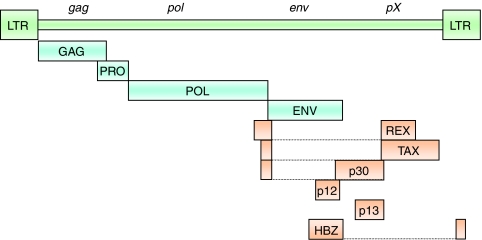
The HTLV-1 proviral genome.

Role of TAX and HBZ in viral persistence and ATL development. In asymptomatic carriers, TAX stimulates viral and cellular gene expression, thereby promoting T-cell proliferation and allowing viral replication. The host immune response efficiently destroys most lymphocytes expressing viral antigens and selects for cells lacking or expressing low levels of TAX. Infected cell proliferation is then progressively promoted by HBZ, another viral factor encoded by the complementary strand. Forced and sustained cell replication by TAX generates DNA damage that activates checkpoints, a second barrier to transformation. In rare cases, this barrier may be breached through checkpoint adaptation mechanisms, allowing fixation of growth promoting mutations and subsequent ATL development.
References
-
- Bartek J, Bartkova J, Lukas J (2007) DNA damage signalling guards against activated oncogenes and tumour progression. Oncogene 26: 7773–7779 - PubMed
Publication types
MeSH terms
Substances
LinkOut - more resources
Full Text Sources
Other Literature Sources
