. 2009 Oct 28;29(43):13735-41.
doi: 10.1523/JNEUROSCI.2547-09.2009.

What "works" in working memory? Separate systems for selection and updating of critical information

Affiliations

What "works" in working memory? Separate systems for selection and updating of critical information

Christoph Bledowski et al. J Neurosci. .

Abstract

Cognition depends critically on working memory, the active representation of a limited number of items over short periods of time. In addition to the maintenance of information during the course of cognitive processing, many tasks require that some of the items in working memory become transiently more important than others. Based on cognitive models of working memory, we hypothesized two complementary essential cognitive operations to achieve this: a selection operation that retrieves the most relevant item, and an updating operation that changes the focus of attention onto it. Using functional magnetic resonance imaging, high-resolution oculometry, and behavioral analysis, we demonstrate that these two operations are functionally and neuroanatomically dissociated. Updating the attentional focus elicited transient activation in the caudal superior frontal sulcus and posterior parietal cortex. In contrast, increasing demands on selection selectively modulated activation in rostral superior frontal sulcus and posterior cingulate/precuneus. We conclude that prioritizing one memory item over others invokes independent mechanisms of mnemonic retrieval and attentional focusing, each with its distinct neuroanatomical basis within frontal and parietal regions. These support the developing understanding of working memory as emerging from the interaction between memory and attentional systems.


Figures

Figure 1.
Figure 1.
Experimental design. a, Subjects saw four dots (black) and retained their locations in working memory (indicated here by white squares for illustration only). After a variable interval, a cue line ran through the vicinity of one or two of the dots. Participants were asked to select in the mind the location of the dot that was closest to the cue line and maintain it as a specific target item. The number of cue presentations varied from two up to five. At the end of a trial subjects judged whether a probe matched the dot-position that had been cued by the immediately preceding line and received a feedback. A short response window (0.9 s) ensured that each cue was actively attended and processed (for details, see Materials and Methods). b, The sequence of cues determined the demands for updating: During the high-selection/update-condition (+S+U), the cue line ran through the vicinity of two of the encoded dots requiring the selection of the closer dot position. In addition, the cue indicated a different target dot as on the immediately preceding cue presentation, thus needing an update of the focus of attention. In the high selection/no-update-condition (+S−U), the cue was ambiguous too but indicated the same target as the preceding cue, hence not requiring any change of the focus of attention. In the low-selection/update-condition (−S+U), the cue line ran through the vicinity of only one dot and required an update of the focus of attention. In the low-selection/no-update-condition (−S−U), a cue unambiguously denoted the same target as in the preceding presentation. ISI, Interstimulus interval; ITI, intertrial interval.
Figure 2.
Figure 2.
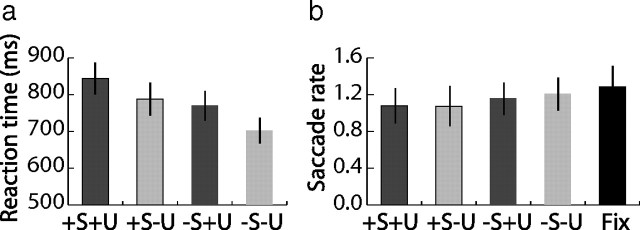
Reaction times and saccadic eye movements. a, Reaction times (mean ± SEM) during behavioral control revealed that subjects needed more time to process high selection cues and when updating the cued location. However, there was no interaction effect between selection and updating, indicating that demands on selection and updating were manipulated independently. b, The rate of saccades during the cue presentation did not differ between experimental conditions. There were no significant differences which may have arisen from manipulations of selection and updating demands. In a separate baseline fixation session (Fix) without any demands on memory operations, participants produced a comparable number of eye movements as reflected by the overall saccade rate.
Figure 3.
Figure 3.
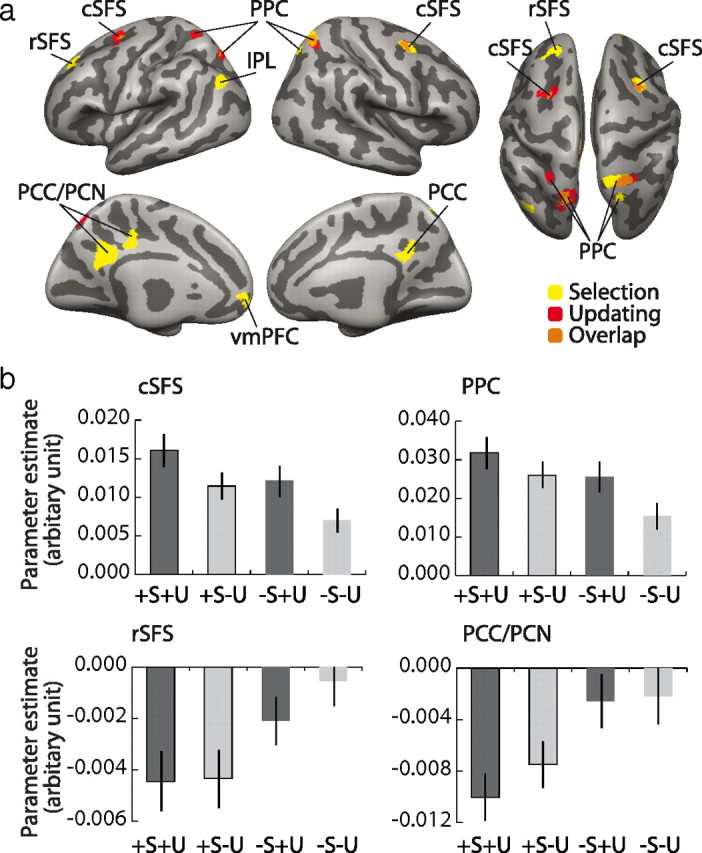
Dissociable neuronal correlates of selection and updating. a, Modulation of regional activation by selection (yellow) and updating (red) projected onto the surface cortex reconstruction of the SPM canonical single-subject brain. Areas of overlap are shown in orange. The full set of coordinates is listed in Table 1. Note that no brain region was sensitive to an interaction between updating and selection. b, Estimated effect size coefficients (mean ± SEM) for the regions of interest showing either main effects of selection and updating (cSFS and PPC) or an exclusive response to selection modulation only (rSFS and PPC/PCN).

References

    1. Awh E, Jonides J. Overlapping mechanisms of attention and spatial working memory. Trends Cogn Sci. 2001;5:119–126. - PubMed
    1. Awh E, Vogel EK, Oh SH. Interactions between attention and working memory. Neuroscience. 2006;139:201–208. - PubMed
    1. Collette F, Hogge M, Salmon E, Van der Linden M. Exploration of the neural substrates of executive functioning by functional neuroimaging. Neuroscience. 2006;139:209–221. - PubMed
    1. Corbetta M, Shulman GL. Control of goal-directed and stimulus-driven attention in the brain. Nat Rev Neurosci. 2002;3:201–215. - PubMed
    1. Corbetta M, Akbudak E, Conturo TE, Snyder AZ, Ollinger JM, Drury HA, Linenweber MR, Petersen SE, Raichle ME, Van Essen DC, Shulman GL. A common network of functional areas for attention and eye movements. Neuron. 1998;21:761–773. - PubMed

Publication types

LinkOut - more resources