. 2009 Dec 8;106(49):20889-94.
doi: 10.1073/pnas.0907075106. Epub 2009 Oct 28.

Simian immunodeficiency virus envelope glycoprotein counteracts tetherin/BST-2/CD317 by intracellular sequestration

Affiliations

Simian immunodeficiency virus envelope glycoprotein counteracts tetherin/BST-2/CD317 by intracellular sequestration

Ravindra K Gupta et al. Proc Natl Acad Sci U S A. .

Abstract

Tetherin is an IFN-inducible restriction factor that inhibits HIV-1 particle release in the absence of the HIV-1 countermeasure, viral protein U (Vpu). Although ubiquitous in HIV-1 and simian immunodeficiency viruses from chimpanzees, greater spot nosed monkeys, mustached monkeys, and Mona monkeys, other primate lentiviruses do not encode a Vpu protein. Here we demonstrate that SIV from Tantalus monkeys (SIVtan) encodes an envelope glycoprotein (SIVtan Env) able to counteract tetherin from Tantalus monkeys, rhesus monkeys, sooty mangabeys, and humans, but not from pigs. We show that sensitivity to Vpu but not SIVtan Env can be transferred with the human tetherin transmembrane region. We also identify a mutation in the tetherin extracellular domain, which almost completely abolishes sensitivity of human tetherin to SIVtan Env without compromising antiviral activity or sensitivity to Vpu. SIVtan Env expression results in a reduction of surface tetherin, as well as reduction in tetherin co-localization with mature surface-associated virus. Immuno-electron microscopy reveals co-localization of SIVtan Env with tetherin in intracellular tubulo-vesicular structures, suggesting that tetherin is sequestered away from budding virions at the cell surface. Along with HIV-1 Vpu and SIV Nef, envelope glycoprotein is the third and most broadly active lentiviral-encoded tetherin countermeasure to be described. Our observations emphasize the importance of tetherin in protecting mammals against viral infection and suggest that HIV-1 Vpu inhibitors may select active envelope mutants.


Conflict of interest statement

The authors declare no conflict of interest.

Figures
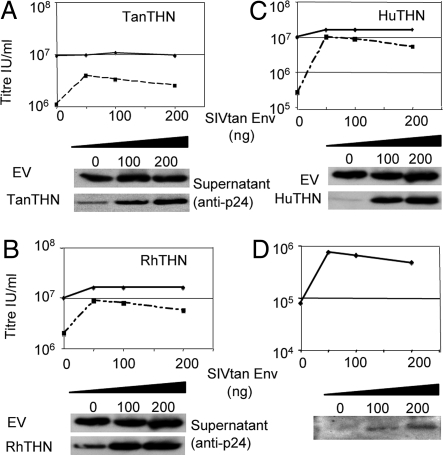
Fig. 1.
Fig. 1.
SIV Tantalus envelope protein antagonizes human, Tantalus, and Rhesus monkey tetherin proteins. (A–C) Titers of HIV-1 released from 293T cells co-transfected with a titration of SIVtan Env plasmid lacking a Nef start codon, HIV-1 vectors and Tantalus monkey tetherin (TanTHN) (A), rhesus monkey tetherin (RhTHN) (B), or human tetherin (HuTHN) (C)-encoding plasmid (100 ng). Filled diamond and solid line denotes cells co-transfected with empty vector (EV) and ■ and broken line, cells co-transfected with tetherin expression vector. Measurement of p24 in supernatant at selected doses of SIVtan Env plasmid or empty vector (EV) were measured by Western blot. (D) HIV-1 vectors were co-transfected with a titration of SIVtan Env into HeLa cells and the titer of HIV-1 released determined. Data represent two independent experiments.
Fig. 2.
Fig. 2.
A point mutant in the extra-cellular domain of human tetherin renders it insensitive to SIVtan Env. (A) The amino acid sequence of pig tetherin is shown aligned to tetherin sequences from human (Hu) and Tantalus monkey (Tan). Similarity (Sim) asterisk, identical residue; colon, conserved substitution; period, semiconserved substitution; gap, no conservation. The transmembrane region is indicated with a line. (B) Pig tetherin is insensitive to SIVtan Env and HIV-1 Vpu. Fixed doses of HIV-1 Vpu or SIVtan Env were co-transfected with a titration of pig tetherin and HIV-1 vectors. Infectious titers released were plotted. (C) An identical experiment using a chimeric pig tetherin with a human transmembrane region, demonstrates that sensitivity to HIV-1 Vpu, but not SIVtan Env can be conferred by the human tetherin transmembrane region. Data represent two independently performed experiments. (D) HIV-1 vectors were co-expressed with wild-type (wt) human tetherin or mutants with empty vector (EV) (black bars) or SIVtan Env (white bars). Titers of virus released are plotted. Control (C) lane represents titer of HIV-1 released with no tetherin co-transfected. (E) Western blots indicate that released p24 levels reflect infectious titers and equal Gag expression. SIVtan Env expression was measured by Western blot detecting the C-terminal HA tag. Data represent two independently performed experiments. Error bars are standard deviations of virus titers.
Fig. 3.
Fig. 3.
SIVtan Env does not reduce total tetherin levels but leads to depletion of tetherin from the cell surface. (A) Empty vector (EV), wild-type human tetherin (WT), or human tetherin mutant A100D, both HA tagged in the ectodomain, were co-transfected with HIV-1 vectors and HA tagged SIVtan Env as shown. HIV-1 p24 levels released into supernatants were measured by Western blot. C terminally HA-tagged Tan Env gp160 band was detected in cell lysates by Western blot. Confocal images of immunofluorescently labeled HA ectodomain tagged human tetherin co-transfected with empty vector (B) or untagged SIVtan Env (C). Images are representative of multiple fields from two separate experiments. (D) Cell surface expression of tetherin in the presence of HIV-1 Vpu or SIVtan Env expression as shown. Black bars indicate cells negative for tetherin expression and white bars those expressing tetherin. Mean fluorescence intensities (MFI) are plotted as a percentage of empty vector control values. Error bars represent standard deviation and data are representative of two independent experiments.
Fig. 4.
Fig. 4.
Tetherin and HIV-1 Gag co-localize in the absence of SIVtan Env and separate on its expression. (A) Double stained 293T cells co-expressing HIV-1 Gag (green), labeled with p17 matrix specific antibody, and tetherin (red), labeled via the N-terminal Xpress tag. Merged images are shown in the third row. (B) Triple stained 293T cells expressing Gag, labeled with anti-p17 matrix (green), tetherin labeled via an N-terminal Xpress tag (red), and SIVtan Env labeled via an HA tag (blue). Images are pseudocolored. Merged images are shown in the bottom panel. Images are representative of 13 fields, all of which had similar protein localizations.
Fig. 5.
Fig. 5.
Tetherin and SIVtan Env co-localize specifically in tubulo-vesicular structures. (A and B) 293T cells expressing HIV-1 Gag and X-THN were stained with anti-tetherin antibodies and 10 nm PAG. Tetherin is seen at the cell surface and on intracellular membranes which can be arranged in tight clusters of >0.5-μm diameter. (C and D) In 293T cells co-expressing HIV-1 Gag, X-THN, and HA-SIVtan Env, tetherin is still found on membranes in the Golgi area and on tight clusters of tubulo-vesicular membranes. (E–G) Staining with mouse anti-HA and 10 nm PAG shows that the HA-SIVtan Env protein is also on Golgi stacks, membranes in the Golgi area, and on tight clusters of tubulo-vesicular membranes, which can be expanded into large clusters (E). (H–J) Double labeling shows co-localization of HA-SIVtan Env and tetherin in tubulo-vesicular membranes. (I) Shows an enlargement of the area marked in H. Sometimes tetherin (PAG 10 nm, e.g., at the black arrows) can be seen in vesicles containing the HA-SIVtan Env (PAG 5 nm). (J) Tetherin (PAG 5 nm, e.g., at the black arrows) co-stains with HA-SIVtan Env (PAG 10 nm). No gold labeling was seen on untransfected cells. G, Golgi apparatus; m, mitochondrion; PM, plasma membrane. (Scale bars, 200 nm.) All images are representative of at least eight cells.

References

    1. Neil SJ, Zang T, Bieniasz PD. Tetherin inhibits retrovirus release and is antagonized by HIV-1 Vpu. Nature. 2008;451:425–430. - PubMed
    1. Van Damme N, et al. The interferon-induced protein BST-2 restricts HIV-1 release and is downregulated from the cell surface by the viral Vpu protein. Cell Host Microbe. 2008;3:245–252. - PMC - PubMed
    1. Jia B, et al. Species-specific activity of SIV Nef and HIV-1 Vpu in overcoming restriction by tetherin/BST2. PLoS Pathog. 2009;5:e1000429. - PMC - PubMed
    1. Zhang F, et al. Nef proteins from simian immunodeficiency viruses are tetherin antagonists. Cell Host Microbe. 2009;6:54–67. - PMC - PubMed
    1. Kupzig S, et al. Bst-2/HM1.24 is a raft-associated apical membrane protein with an unusual topology. Traffic. 2003;4:694–709. - PubMed

Publication types

MeSH terms

Associated data

LinkOut - more resources
