. 2009 Nov 17;106(46):19410-5.
doi: 10.1073/pnas.0902364106. Epub 2009 Oct 28.

Emergent gene order in a model of modular polyketide synthases

Affiliations

Emergent gene order in a model of modular polyketide synthases

Benjamin Callahan et al. Proc Natl Acad Sci U S A. .

Abstract

Polyketides are a class of biologically active heteropolymers produced by assembly line-like multiprotein complexes of modular polyketide synthases (PKS). The polyketide product is encoded in the order of the PKS proteins in the assembly line, suggesting that polyketide diversity derives from combinatorial rearrangement of these PKS complexes. Remarkably, the order of PKS genes on the chromosome follows the order of PKS proteins in the assembly line: This fact is commonly referred to as "collinearity". Here we propose an evolutionary origin for collinearity and demonstrate the mechanism by using a computational model of PKS evolution in a population. Assuming continuous evolutionary pressure for novel polyketides, and that new polyketide pathways are formed by horizontal transfer/recombination of PKS-encoding DNA, we demonstrate the existence of a broad range of parameters for which collinearity emerges spontaneously. Collinearity confers no fitness advantage in our model; it is established and maintained through a "secondary selection" mechanism, as a trait which increases the probability of forming long, novel PKS complexes through recombination. Consequently, collinearity hitchhikes on the successful genotypes which periodically sweep through the evolving population. In addition to computer simulation of a simplified model of PKS evolution, we provide a mathematical framework describing the secondary selection mechanism, which generalizes beyond the context of the present model.


Conflict of interest statement

The authors declare no conflict of interest.

Figures
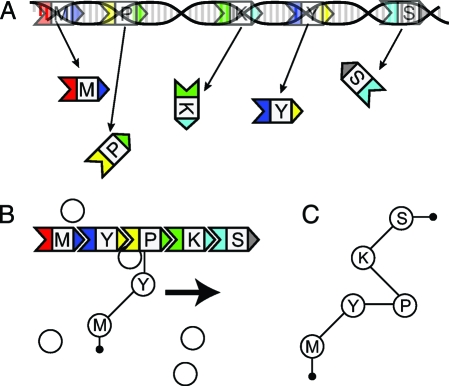
Fig. 1.
Fig. 1.
A schematic representation of the DNA → PKS → polyketide conduit by which genetic information becomes a functional polyketide. (A) The translation of the PKS genes into PKS proteins. The head and tail domains are colored; binding is exclusive between corresponding domains of the same color. The flavor of chain extension performed by the PKS is represented here by a letter. (B) PKSs assemble into multiprotein complexes, which catalyze polyketide production. Individual PKS proteins perform one cycle of chain extension and then pass the result to the next PKS in line. The result, seen in C, is a product polyketide analagous to the functional complex of PKS proteins.
Fig. 2.
Fig. 2.
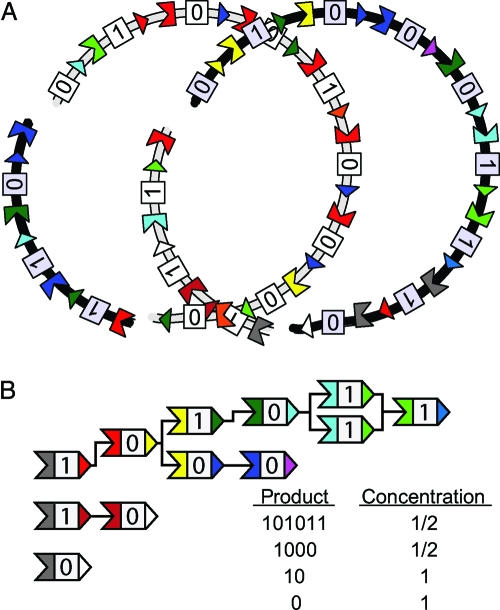
Representation of recombination in the model of PKS system. (A) Two model chromosomes, one gray and one black, undergoing recombination. The genes for synthases are represented by the same arrows as the synthase proteins themselves. The circular chromosomes exchange homologous sections of DNA to form recombinant offspring. Note that because circular chromosomes can recombine upon an arbitrary rotation relative to one another, many outcomes are possible even as a product of two identical parental chromosomes. (B) The products of one of the recombinant offspring are shown with their associated concentrations. The fitness is a sum of the fitness effects of those four products weighted by concentration.
Fig. 3.
Fig. 3.
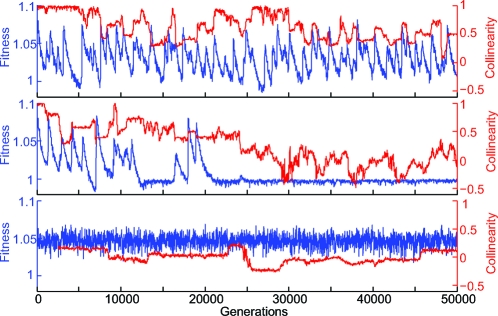
Population-averaged evolutionary trajectories characteristic of the three dynamical behaviors exhibited by the model. (A) The evolving (RQ) behavior; genotypes encoding novel products are repeatedly created and sweep the population, maintaining high fitness and collinearity. (B) Here, environmental decorrelation time τ is reduced by a factor of two (to 500 generations). The faster fitness decay results in the population eventually failing to find a novel product quickly enough to avoid the effects of drift, causing a transition to the Q state. Consequently, the initial collinearity decays away and then fluctuates around the random ensemble average of y = 0. (C) Environmental change has been removed, τ → ∞, and static behavior is observed.
Fig. 4.
Fig. 4.
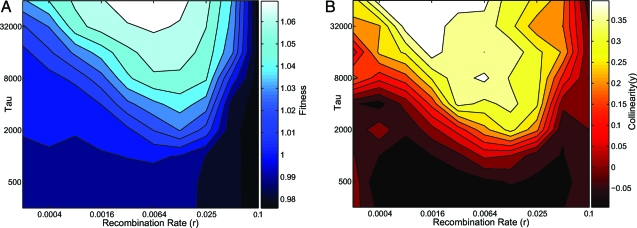
Long-time averages of population fitness (A) and collinearity (B) as a function of recombination rate (r) and decorrelation time (τ). Darker color corresponds to lower values of average fitness (A) and collinearity (B). Individual points are averages taken over 100 replicates of our simulation, each running for 106 generations. The region of high collinearity corresponds to the region of high fitness, which is also the region of (r,τ) parameter space in which populations maintain evolving behavior.
Fig. 5.
Fig. 5.
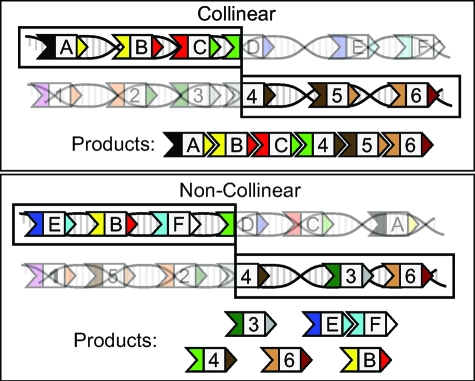
Collinearity increases the likelihood of recombination forming novel products. Recombination between two collinear parents produces a long and potentially high-fitness product. When nonsyntenic parents recombine, many head/tail bonds are cut and the recombinant offspring contains only fragmentary synthase complexes.
Fig. 6.
Fig. 6.
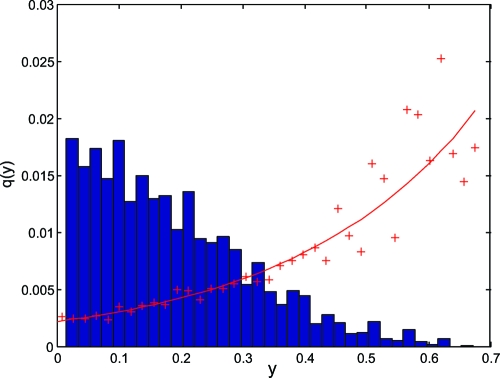
The probability of a recombinant individual encoding a novel L*-long pathway in our model depends on its collinearity (y). This dependence, determined numerically by sampling individuals with collinearity y generated by recombinations between parents of similar collinearity, is shown with red crosses and is approximately exponential, as shown with a solid red line. The blue histogram represents the relative frequency, ρ(y), with which collinearity y appears in the ensemble of randomly ordered genes. This frequency distribution is well fit by a Gaussian centered on y = 0.

References

    1. Ridley C, Lee HY, Khosla C. Evolution of polyketide synthases in bacteria. Proc Natl Acad Sci USA. 2008;105:4595–4600. - PMC - PubMed
    1. Austin, et al. Biosynthesis of Dictyostelium discoideum differentiation-inducing factor by a hybrid type I fatty acid-type III polyketide synthase. Nat Chem Biol. 2006;2:494–502. - PMC - PubMed
    1. Gokhale, et al. Versatile polyketide enzymatic machinery for the biosynthesis of complex mycobacterial lipids. Nat Prod Rep. 2007;24:267–277. - PubMed
    1. Firn RD, Jones CG. Natural products—A simple model to explain chemical diversity. Nat Prod Rep. 2003;20:382–391. - PubMed
    1. Staunton J, Weissman K. Polyketide biosynthesis: A millennium review. Nat Prod Rep. 2001;18:380–416. - PubMed

LinkOut - more resources