


Leptin gene -2548G/A variants predict risperidone-associated weight gain in children and adolescents
- PMID: 19873684
- PMCID: PMC2919234
- DOI: 10.1097/ypg.0b013e3283328e06
Leptin gene -2548G/A variants predict risperidone-associated weight gain in children and adolescents
Abstract
Objective: As the use of atypical antipsychotics in children and adolescents has increased, concerns have been raised about their long-term safety. We aimed to investigate the association between risperidone-induced weight gain, leptin concentration, and the leptin gene (LEP) -2548G/A variants in youths.
Methods: Medically healthy 7- to 17-year-old children and adolescents, in extended naturalistic treatment with risperidone, were recruited through pediatric psychiatry clinics. Anthropometric measures and laboratory testing were conducted. Growth and medication history was obtained from the medical record. The effect of the LEP genotypes on leptin concentration and on the slopes of the weight and body mass index (BMI) Z-score curves before and after the onset of risperidone treatment was investigated .
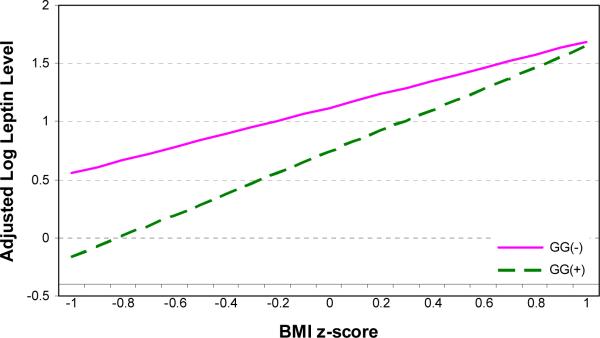
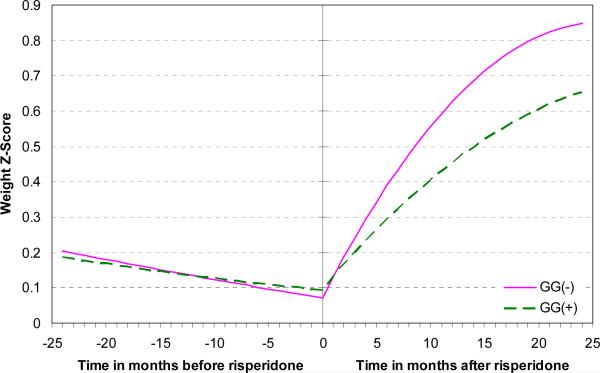
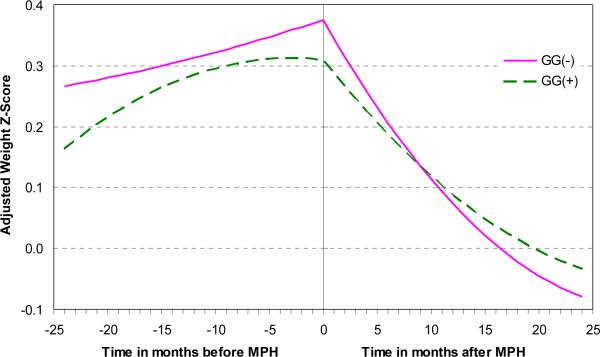
Results: In 74 individuals, chronically treated with risperidone, the A allele was associated with higher leptin concentration at low weight and BMI Z-scores. There was no effect of the LEP genotypes on weight or BMI Z-scores before risperidone was started. Afterwards, however, the A-allele carriers showed a steeper rate of increase in weight and BMI Z-scores. As a result, the GG-genotype carriers were 2.5 times less likely to be overweight/obese (i.e. having a BMI above the 85th percentile). This genetic effect on risperidone-associated weight gain did not extend to weight loss related to psychostimulants.
Conclusion: The LEP - 2548G/A variants seem to moderate the weight-altering effect of risperidone but not psychostimulants. This may be related to genetic differences in tissue sensitivity to leptin, resulting in differential body composition.
Figures
References
-
- National Institute of Mental Health Multimodal Treatment Study of ADHD follow-up: changes in effectiveness and growth after the end of treatment. Pediatrics. 2004;113:762–9. - PubMed
-
- ADA Consensus development conference on antipsychotic drugs and obesity and diabetes. Diabetes Care. 2004;27:596–601. - PubMed
-
- Allison DB, Mentore JL, Heo M, Chandler LP, Cappelleri JC, Infante MC, Weiden PJ. Antipsychotic-induced weight gain: a comprehensive research synthesis. Am J Psychiatry. 1999;156:1686–96. - PubMed
-
- Aman MG, Binder C, Turgay A. Risperidone effects in the presence/absence of psychostimulant medicine in children with ADHD, other disruptive behavior disorders, and subaverage IQ. J Child Adolesc Psychopharmacol. 2004;14:243–54. - PubMed
-
- Aman MG, De Smedt G, Derivan A, Lyons B, Findling RL. Double-blind, placebo-controlled study of risperidone for the treatment of disruptive behaviors in children with subaverage intelligence. Am J Psychiatry. 2002;159:1337–46. - PubMed
Publication types
MeSH terms
Substances
Grants and funding
LinkOut - more resources
Full Text Sources
Molecular Biology Databases
Research Materials
Miscellaneous
