


Rationale and design of Ferinject assessment in patients with IRon deficiency and chronic Heart Failure (FAIR-HF) study: a randomized, placebo-controlled study of intravenous iron supplementation in patients with and without anaemia
- PMID: 19875408
- PMCID: PMC2770581
- DOI: 10.1093/eurjhf/hfp140
Rationale and design of Ferinject assessment in patients with IRon deficiency and chronic Heart Failure (FAIR-HF) study: a randomized, placebo-controlled study of intravenous iron supplementation in patients with and without anaemia
Abstract
Aims: Iron deficiency (ID) and anaemia are common in patients with chronic heart failure (CHF). The presence of anaemia is associated with increased morbidity and mortality in CHF, and ID is a major reason for the development of anaemia. Preliminary studies using intravenous (i.v.) iron supplementation alone in patients with CHF and ID have shown improvements in symptom status. FAIR-HF (Clinical Trials.gov NCT00520780) was designed to determine the effect of i.v. iron repletion therapy using ferric carboxymaltose on self-reported patient global assessment (PGA) and New York Heart Association (NYHA) in patients with CHF and ID.
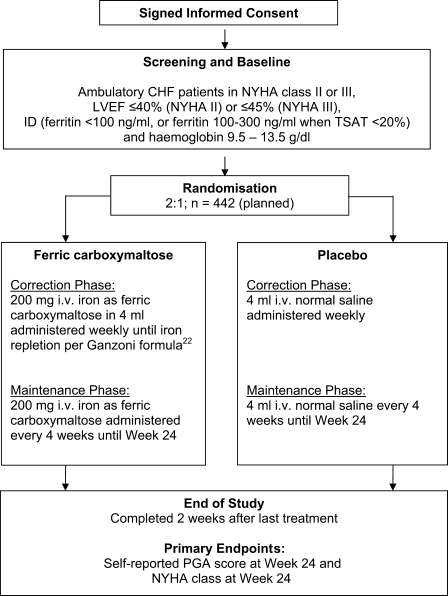
Methods and results: This is a multi-centre, randomized, double-blind, placebo-controlled study recruiting ambulatory patients with symptomatic CHF with LVEF < or = 40% (NYHA II) or < or =45% (NYHA III), ID [ferritin <100 ng/mL or ferritin 100-300 ng/mL when transferrin saturation (TSAT) < 20%], and haemoglobin 9.5-13.5 g/dL. Patients were randomized in a 2:1 ratio to receive ferric carboxymaltose (Ferinject((R))) 200 mg iron i.v. or saline i.v. weekly until iron repletion (correction phase), then monthly until Week 24 (maintenance phase). Primary endpoints are (i) self-reported PGA at Week 24 and (ii) NYHA class at Week 24, adjusted for baseline NYHA class.
Conclusion: This study will provide evidence on the efficacy and safety of iron repletion with ferric carboxymaltose in CHF patients with ID with and without anaemia.
Figures
References
-
- Dickstein K, Cohen-Solal A, Filippatos G, McMurray JJ, Ponikowski P, Poole-Wilson PA, Strömberg A, van Veldhuisen DJ, Atar D, Hoes AW, Keren A, Mebazaa A, Nieminen M, Priori SG, Swedberg K. ESC guidelines for the diagnosis and treatment of acute and chronic heart failure 2008: the Task Force for the diagnosis and treatment of acute and chronic heart failure 2008 of the European Society of Cardiology. Developed in collaboration with the Heart Failure Association of the ESC (HFA) and endorsed by the European Society of Intensive Care Medicine (ESICM) Eur J Heart Fail. 2008;10:933–989. - PubMed
-
- Roger VL, Weston SA, Redfield MM, Hellermann-Homan JP, Killian J, Yawn BP, Jacobsen SJ. Trends in heart failure incidence and survival in a community-based population. J Am Med Assoc. 2004;292:344–350. - PubMed
-
- Berry C, Murdoch DR, McMurray JJ. Economics of chronic heart failure. Eur J Heart Fail. 2001;3:283–291. - PubMed
-
- Pina IL, Apstein CS, Balady GJ, Belardinelli R, Chaitman BR, Duscha BD, Fletcher BJ, Fleg JL, Myers JN, Sullivan MJ American Heart Association Committee on exercise, rehabilitation, prevention. Exercise and heart failure: a statement from the American Heart Association Committee on exercise, rehabilitation, and prevention. Circulation. 2003;107:1210–1225. - PubMed
-
- Clark AL, Poole-Wilson PA, Coats AJS. Exercise limitation in chronic heart failure: central role of the periphery. J Am Coll Cardiol. 1996;28:1092–1102. - PubMed
Publication types
MeSH terms
Substances
Associated data
LinkOut - more resources
Full Text Sources
Other Literature Sources
Medical
Research Materials
Miscellaneous
