. 2009 Dec 18;284(51):35479-84.
doi: 10.1074/jbc.M109.067355.

Oxidative half-reaction of arabidopsis thaliana sulfite oxidase: generation of superoxide by a peroxisomal enzyme

Affiliations

Oxidative half-reaction of arabidopsis thaliana sulfite oxidase: generation of superoxide by a peroxisomal enzyme

Robert S Byrne et al. J Biol Chem. .

Abstract

Vertebrate forms of the molybdenum-containing enzyme sulfite oxidase possess a b-type cytochrome prosthetic group that accepts reducing equivalents from the molybdenum center and passes them on to cytochrome c. The plant form of the enzyme, on the other hand, lacks a prosthetic group other than its molybdenum center and utilizes molecular oxygen as the physiological oxidant. Hydrogen peroxide is the ultimate product of the reaction. Here, we present data demonstrating that superoxide is produced essentially quantitatively both in the course of the reaction of reduced enzyme with O(2) and during steady-state turnover and only subsequently decays (presumably noncatalytically) to form hydrogen peroxide. Rapid-reaction kinetic studies directly following the reoxidation of reduced enzyme demonstrate a linear dependence of the rate constant for the reaction on [O(2)] with a second-order rate constant of k(ox) = 8.7 x 10(4) +/- 0.5 x 10(4) m(-1)s(-1). When the reaction is carried out in the presence of cytochrome c to follow superoxide generation, biphasic time courses are observed, indicating that a first equivalent of superoxide is generated in the oxidation of the fully reduced Mo(IV) state of the enzyme to Mo(V), followed by a slower oxidation of the Mo(V) state to Mo(VI). The physiological implications of plant sulfite oxidase as a copious generator of superoxide are discussed.


Figures
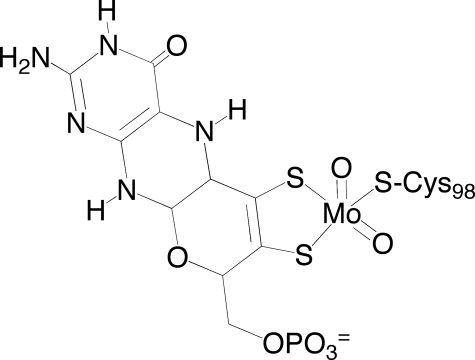
FIGURE 1.
FIGURE 1.
Molybdenum center of plant sulfite oxidase. The pterin cofactor is coordinated to the metal via its enedithiolate side chain. The remainder of the coordination sphere is taken up by a pair of terminal Mo = O ligands and the thiolate of Cys98.
FIGURE 2.
FIGURE 2.
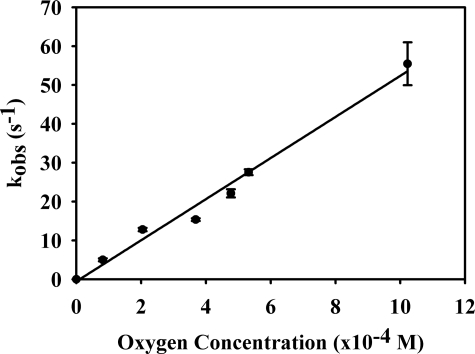
Dependence of observed rate constant versus [O2] for the reoxidation of plant sulfite oxidase. The observed linear dependence yields a slope with kox = 5.3 ± 0.3 × 10⁴ m−1s−1, with a zero y axis intercept. The data points are the average of at least three transients with error bars shown for each point. The reaction was performed in Tris acetate buffer, pH 8.0, at 4 °C.
FIGURE 3.
FIGURE 3.
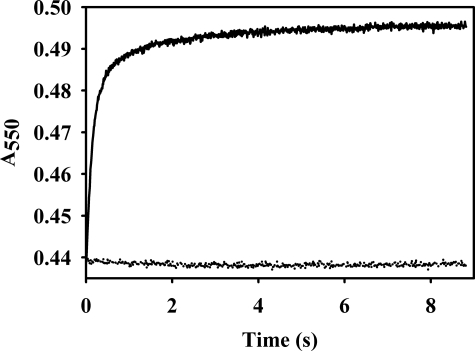
Reduction of cytochrome c in the course of the oxidative half-reaction of plant sulfite oxidase. Reduction of cytochrome c was monitored via stopped flow, following the absorbance change at 550 nm. Representative transients for each reaction are shown. Upper trace, the reaction of 1.5 μm plant sulfite oxidase with 532 μm O2 in the presence of 38 μm cytochrome c. The transients were best fit as biphasic reactions with a faster rate constant of 47.7 ± 0.4 s−1 and a slower rate constant of 7.5 ± 0.1 s−1. Kinetic values reported are the average obtained from at least three transients. This plot was biphasic with an R2 value of 0.9975. Lower trace, the same reaction in the presence of 200 units/ml superoxide dismutase, demonstrating that there is no reduction of cytochrome c in the absence of superoxide. The reaction was carried out in Tris acetate buffer, pH 8.0, at 4 °C.
FIGURE 4.
FIGURE 4.
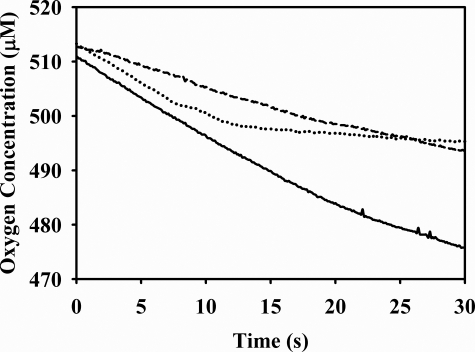
Effect of cytochrome c and superoxide dismutase on the steady-state rate of oxygen consumption by the plant sulfite oxidase reaction as monitored oximetrically. Representative transients for each reaction are shown. Solid line, reaction of sulfite oxidase (60 nm) with sulfite (1.0 mm) and ∼510 μm O2. Dashed line, same reaction in the presence of 200 units/ml superoxide dismutase. Dotted line, same reaction in the presence of 94.5 μm cytochrome c and no superoxide dismutase. Cytochrome c was added at ∼10 s after starting the reaction. The reaction was carried out in Tris acetate buffer, pH 8.0, at 4 °C.
FIGURE 5.
FIGURE 5.
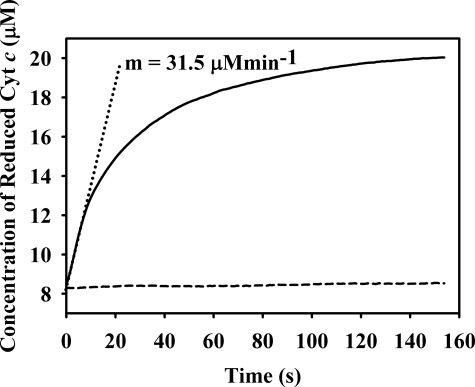
Effect of superoxide dismutase on cytochrome c reduction by plant sulfite oxidase reaction as monitored spectrophotometrically. Representative transients for each reaction are shown. Solid line, reaction of 20 nm plant sulfite oxidase with 1 mm sulfite and 532 μm O2 in the presence of 20 μm cytochrome c. Dashed line, same reaction in the presence of 200 units/ml superoxide dismutase. Dotted line, initial slope of the first reaction, yielding a value of 31.5 μm/min. The experiment was performed in Tris acetate buffer, pH 8.0, at 4 °C.
FIGURE 6.
FIGURE 6.
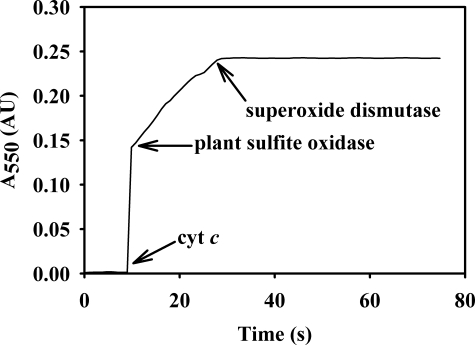
Effect of superoxide dismutase on cytochrome c reduction by plant sulfite oxidase as monitored spectrophotometrically. The reaction was started by sequentially adding cytochrome c (∼20 μm final concentration) and 200 nm plant sulfite oxidase to a sulfite solution (1.0 mm) in a cuvette. Superoxide dismutase (200 units/ml) was added after a short time. Arrows on the spectrum indicate the points of cytochrome c, plant sulfite oxidase, and superoxide dismutase additions to the reaction mix. The experiment was performed in Tris acetate buffer, pH 8.0, at 4 °C.

References

    1. Feng C., Tollin G., Enemark J. H. (2007) Biochim. Biophys. Acta 1774, 527–539 - PMC - PubMed
    1. Cohen H. J., Fridovich I. J. (1971) J. Biol. Chem. 246, 359–366 - PubMed
    1. Niknahad H., O'Brien P. J. (2008) Chem. Biol. Interact. 174, 147–154 - PubMed
    1. Schindelin H., Kisker C., Rajagopalan K. V. (2001) Adv. Protein Chem. 58, 47–94 - PubMed
    1. Hänsch R., Lang C., Rennenberg H., Mendel R. R. (2007) Plant Biol. 9, 589–595 - PubMed

Publication types