Validation of a dysphagia screening tool in acute stroke patients
- PMID: 19875722
- PMCID: PMC2896456
- DOI: 10.4037/ajcc2009961
Validation of a dysphagia screening tool in acute stroke patients
Abstract
Background: Although many dysphagia screening tools exist, none has high sensitivity and reliability or can be administered quickly with minimal training.
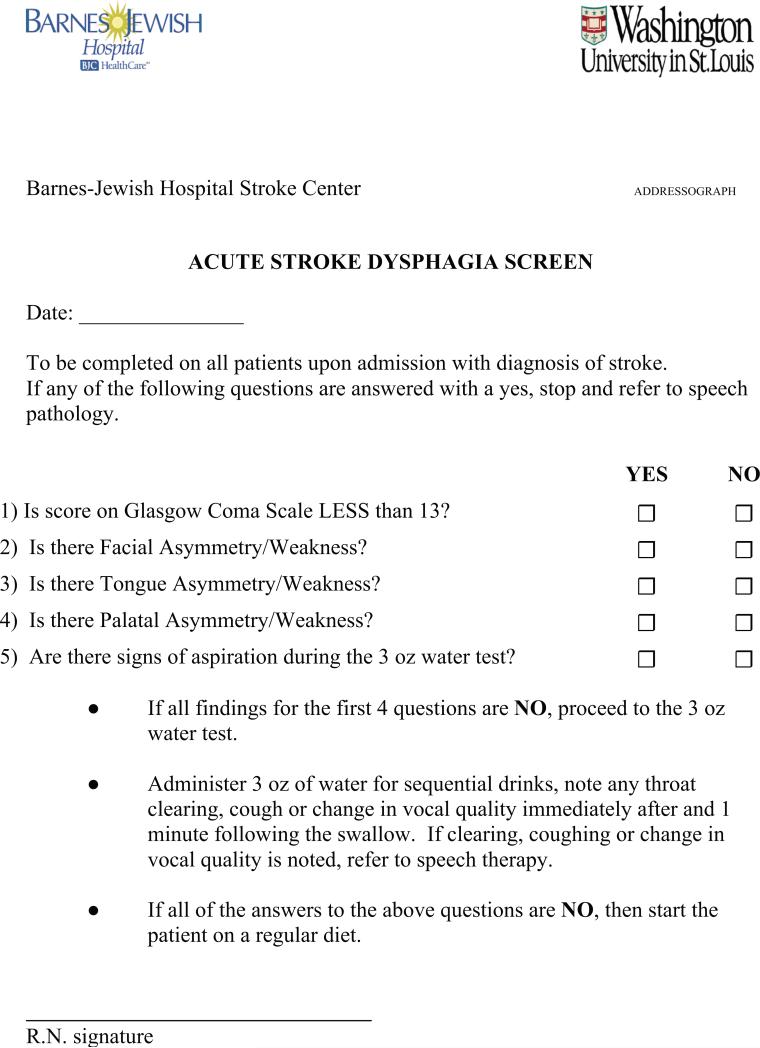
Objective: To design and validate a swallowing screening tool to be used by health care professionals who are not speech language pathologists to identify dysphagia and aspiration risk in acute stroke patients.
Methods: In a prospective study of 300 patients admitted to the stroke service at an urban tertiary care hospital, interrater and test-retest reliabilities of a new tool (the Acute Stroke Dysphagia Screen) were established. The tool was administered by nursing staff when patients were admitted to the stroke unit. A speech language pathologist blinded to the results with the new tool administered the Mann Assessment of Swallowing Ability, a clinical bedside evaluation, with dysphagia operationally defined by a score less than 178.
Results: The mean time from admission to screening with the new tool was 8 hours. The mean time between administration of the new tool and the clinical bedside evaluation was 32 hours. For the new tool, interrater reliability was 93.6% and test-retest reliability was 92.5%. The new tool had a sensitivity of 91% and a specificity of 74% for detecting dysphagia and a sensitivity of 95% and a specificity of 68% for detecting aspiration risk.
Conclusions: The Acute Stroke Dysphagia Screen is an easily administered and reliable tool that has sufficient sensitivity to detect both dysphagia and aspiration risk in acute stroke patients.
Figures
References
-
- Daniels SK, Schroeder MF, McClain M, Corey D, Rosenbek JC, Foundas A. Dysphagia in stroke: development of a standard method to examine swallowing recovery. J Rehabil Res Dev. 2006;43:347–356. - PubMed
-
- Mann G, Hankey G, Cameron D. Swallowing function after stroke: prognosis and prognostic factors at 6 months. Stroke. 1999;30(4):744–748. - PubMed
-
- Smithard DG, O'Neill P, Park C, et al. Can bedside assessment reliably exclude aspiration following acute stroke? Age Ageing. 1998;27:99–106. - PubMed
-
- Leder SB, Espinosa JF. Aspiration risk after acute stroke: comparison of clinical examination and fiberoptic endoscopic evaluation of swallowing. Dysphagia. 2002;17:214–218. - PubMed
Publication types
MeSH terms
Grants and funding
LinkOut - more resources
Full Text Sources
Medical