


Adequate use of allele frequencies in Hispanics--a problem elucidated in nephrotic syndrome
- PMID: 19876656
- PMCID: PMC2899680
- DOI: 10.1007/s00467-009-1315-6
Adequate use of allele frequencies in Hispanics--a problem elucidated in nephrotic syndrome
Abstract
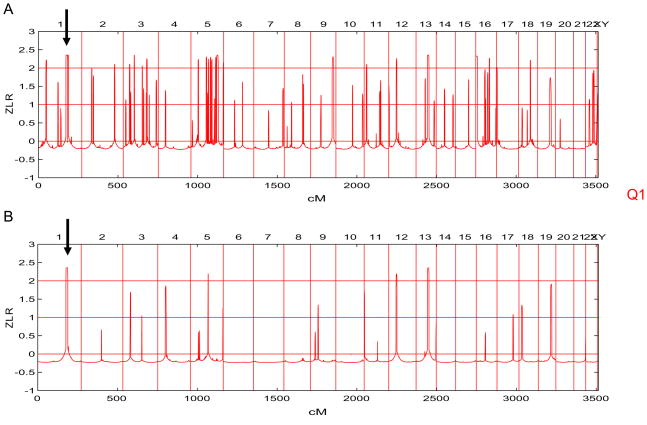
Previous studies in children with focal segmental glomerulosclerosis (FSGS) and nephrotic syndrome (NS) in the USA have revealed inter-ethnic differences in their clinical presentation and outcome. However, ethnicity was based on self-identification rather than on molecular genetic data. Here, we show that genetic heterogeneity exists in self-identified Hispanic (Spanish-American) patients with steroid-resistant nephrotic syndrome (SRNS), as patients may be either of Caucasian or Mesoamerican (Native-American) genetic background. Twenty-one self-identified Hispanic patients with SRNS from 18 families were initially evaluated for mutations in the NPHS2 and WT1 genes. All patients resided and were cared for in the USA. We performed a total genome search for linkage in all Hispanic patients using 250K single nucleotide polymorphism microarrays, comparing Caucasian with Mesoamerican allele frequencies to determine regions of homozygosity by descent and to establish the correct allele frequency for each family. We found that only ten families (56%) of the 18 self-identified Hispanic families are genetically of Mesoamerican descent, whereas the other eight families (44%) are of Caucasian descent. Due to the small number of families examined, we were unable to draw any conclusion on the prevalence of NPHS2 and WT1 in this ethnic group, but the data do suggest that self-identification of ethnicity in Hispanic-American patients is not an adequate basis for genetic studies, as this cohort may represent not only patients of Mesoamerican origin but also patients of Caucasian origin. Thus, one needs to critically review previous studies of FSGS/SRNS patients that involved Hispanic patients as a group. Future larger studies may employ a total genome search for linkage to test self-identified Hispanic ethnicity for true Mesoamerican versus Caucasian ethnicity in order to generate valid genetic data.
Conflict of interest statement
Figures
References
-
- Andreoli SP. Racial and ethnic differences in the incidence and progression of focal segmental glomerulosclerosis in children. Adv Ren Replace Ther. 2004;11:105–109. - PubMed
-
- Srivastava T, Simon SD, Alon US. High incidence of focal segmental glomerulosclerosis in nephrotic syndrome of childhood. Pediatr Nephrol. 1999;13:13–18. - PubMed
-
- Kim JS, Bellew CA, Silverstein DM, Aviles DH, Boineau FG, Vehaskari VM. High incidence of initial and late steroid resistance in childhood nephrotic syndrome. Kidney Int. 2005;68:1275–1281. - PubMed
-
- Bonilla-Felix M, Parra C, Dajani T, Ferris M, Swinford RD, Portman RJ, Verani R. Changing patterns in the histopathology of idiopathic nephrotic syndrome in children. Kidney Int. 1999;55:1885–1890. - PubMed
-
- Boyer O, Moulder JK, Somers MJ. Focal and segmental glomerulosclerosis in children: a longitudinal assessment. Pediatr Nephrol. 2007;22:1159–1166. - PubMed
Publication types
MeSH terms
Substances
Grants and funding
LinkOut - more resources
Full Text Sources
Miscellaneous
