Review
. 2009 Nov 6;16(5):369-77.
doi: 10.1016/j.ccr.2009.09.024.

Signaling to p53: ribosomal proteins find their way

Affiliations
Review

Signaling to p53: ribosomal proteins find their way

Yanping Zhang et al. Cancer Cell. .

Abstract

Inherently disparate cell growth and division, which are intimately coupled through a delicate network of intracellular and extracellular signaling, require ribosomal biogenesis. A number of events imparting instability to ribosomal biogenesis can cause nucleolar stress. In response to this stress, several ribosomal proteins bind to MDM2 and block MDM2-mediated p53 ubiquitination and degradation, resulting in p53-dependent cell cycle arrest. By doing so, the ribosomal proteins play a crucial role in connecting deregulated cell growth with inhibition of cell division. The ribosomal protein-MDM2-p53 signaling pathway provides a molecular switch that may constitute a surveillance network monitoring the integrity of ribosomal biogenesis.


Figures
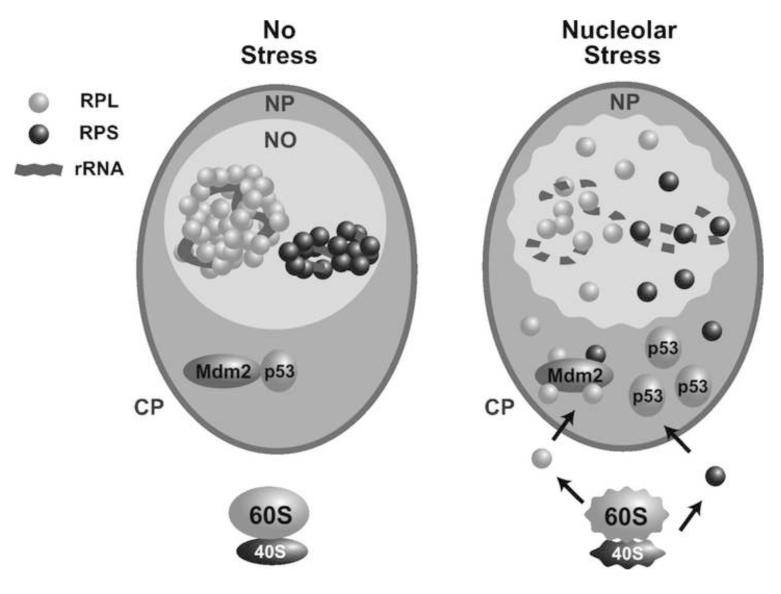
Figure 1
Figure 1. Schematic of RP-MDM2-p53 pathway regulation by nucleolar stress
Under normal growth conditions (no stress), small (S, 40S) and large (L, 60S) RPs are assembled in the nucleolus (NO) and transported to the cytoplasm (CP) for protein synthesis. Under nucleolar stress, ribosomal biogenesis is inhibited and Ribosome-free forms of RPs (RPL and RPS) enter the nucleoplasm (NP) to interact with MDM2, resulting in p53 stabilization and activation. Similarly, RPs either released from breaking down (indicated by wavy edges) of cytoplasmic Ribosomes or overproduced in the cytoplasm can enter the nucleoplasm to interact with MDM2.

References

    1. Adams DJ, van der Weyden L, Mayeda A, Stamm S, Morris BJ, Rasko JE. ZNF265--a novel spliceosomal protein able to induce alternative splicing. J Cell Biol. 2001;154:25–32. - PMC - PubMed
    1. Alam SL, Sun J, Payne M, Welch BD, Blake BK, Davis DR, Meyer HH, Emr SD, Sundquist WI. Ubiquitin interactions of NZF zinc fingers. Embo J. 2004;23:1411–1421. - PMC - PubMed
    1. Amsterdam A, Sadler KC, Lai K, Farrington S, Bronson RT, Lees JA, Hopkins N. Many ribosomal protein genes are cancer genes in zebrafish. PLoS Biol. 2004;2:E139. - PMC - PubMed
    1. Appella E, Anderson CW. Post-translational modifications and activation of p53 by genotoxic stresses. Eur J Biochem. 2001;268:2764–2772. - PubMed
    1. Argentini M, Barboule N, Wasylyk B. The contribution of the acidic domain of MDM2 to p53 and MDM2 stability. Oncogene. 2001;20:1267–1275. - PubMed

Publication types

MeSH terms

Substances
