


Gynecomastia: pathophysiology, evaluation, and management
- PMID: 19880691
- PMCID: PMC2770912
- DOI: 10.1016/S0025-6196(11)60671-X
Gynecomastia: pathophysiology, evaluation, and management
Abstract
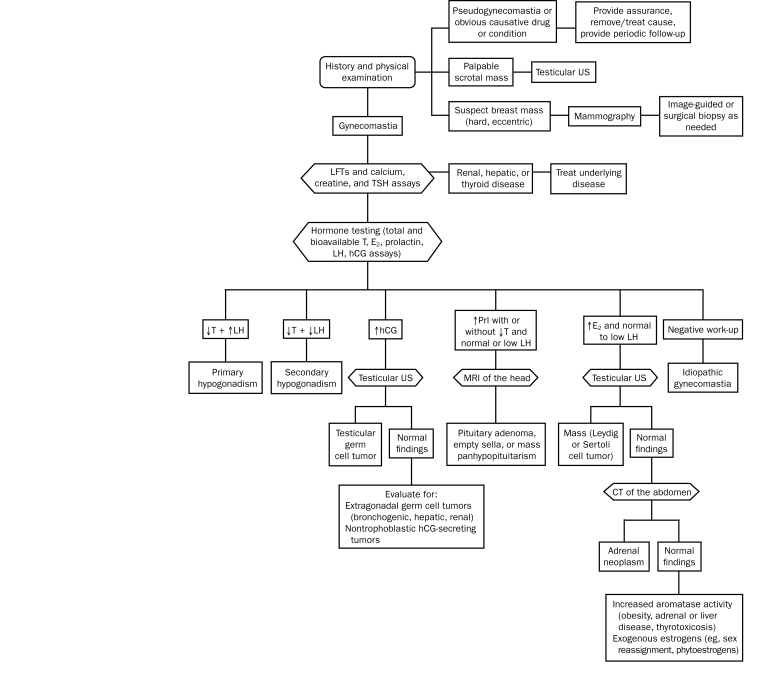
Gynecomastia, defined as benign proliferation of male breast glandular tissue, is usually caused by increased estrogen activity, decreased testosterone activity, or the use of numerous medications. Although a fairly common presentation in the primary care setting and mostly of benign etiology, it can cause patients considerable anxiety. The initial step is to rule out pseudogynecomastia by careful history taking and physical examination. A stepwise approach that includes imaging and laboratory testing to exclude neoplasms and endocrinopathies may facilitate cost-effective diagnosis. If results of all studies are normal, idiopathic gynecomastia is diagnosed. The evidence in this area is mainly of observational nature and lower quality.
Figures
Comment in
-
Radiation therapy for gynecomastia.Mayo Clin Proc. 2010 Apr;85(4):398-9; author reply 399. doi: 10.4065/mcp.2009.0745. Mayo Clin Proc. 2010. PMID: 20360300 Free PMC article. No abstract available.
References
-
- Braunstein GD. Gynecomastia. N Engl J Med. 2007;357(12):1229-1237 - PubMed
-
- Georgiadis E, Papandreou L, Evangelopoulou C, et al. Incidence of gynaecomastia in 954 young males and its relationship to somatometric parameters. Ann Hum Biol. 1994;21(6):579-587 - PubMed
-
- Niewoehner CB, Nuttal FQ. Gynecomastia in a hospitalized male population. Am J Med. 1984;77(4):633-638 - PubMed
-
- Nordt CA, DiVasta AD. Gynecomastia in adolescents. Curr Opin Pediatr. 2008;20(4):375-382 - PubMed
Publication types
MeSH terms
Substances
LinkOut - more resources
Full Text Sources
Other Literature Sources
Medical
