Marital status as an independent predictor of event-free survival of patients with heart failure
- PMID: 19880958
- PMCID: PMC2813674
- DOI: 10.4037/ajcc2009388
Marital status as an independent predictor of event-free survival of patients with heart failure
Abstract
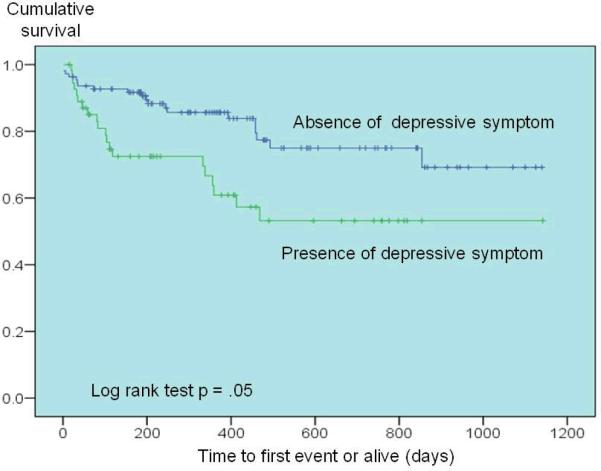
Background: Depressive symptoms are a well-known predictor of mortality in patients with heart failure, and positive spousal support is associated with improved outcomes in these patients. However, in the context of depressive symptoms, the effect on survival of having a spouse is unknown.
Objective: To determine the effect of marital status on event-free survival in patients with heart failure who did or did not have depressive symptoms.
Methods: Depressive symptoms were assessed by using the Beck Depression Inventory-II in patients with heart failure who were followed-up for up to 4 years to collect data on mortality and hospitalizations. Patients were grouped according to the presence and absence of depressive symptoms by using the standard cutoff score of 14 on the Beck Depression Inventory-II. Kaplan-Meier and Cox regression analyses were used to compare event-free survival for married and nonmarried patients who were stratified according to the presence or absence of depressive symptoms.
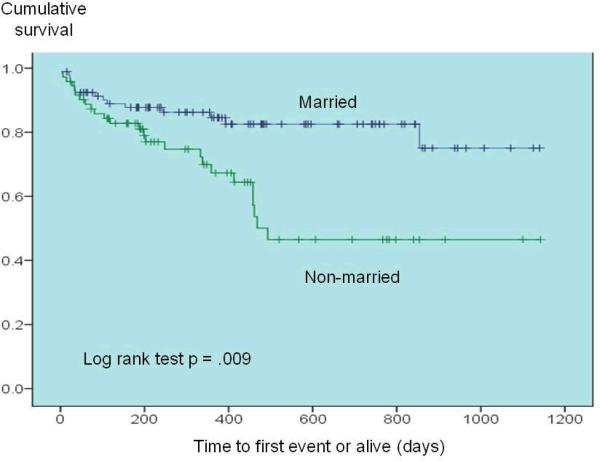
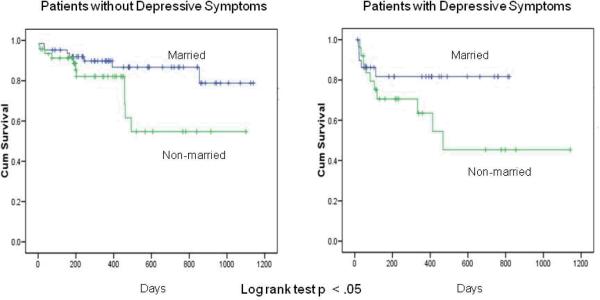
Results: Of 166 patients, 56% were married, and 33% had depressive symptoms. Levels of depressive symptoms were similar between married and nonmarried patients (10.9 vs 12.1; P = .39). Married patients experienced longer event-free survival than did nonmarried patients (P = .009), even with stratification according to depressive symptoms (P = .01).
Conclusions: Patients with a spouse had longer event-free survival than nonmarried patients did, even in the context of depressive symptoms.
Figures
References
-
- Thom T, Haase N, Rosamond W, et al. Heart disease and stroke statistics--2006 update: a report from the American Heart Association Statistics Committee and Stroke Statistics Subcommittee. Circulation. 2006;113(6):e85–151. - PubMed
-
- Levy D, Kenchaiah S, Larson MG, et al. Long-term trends in the incidence of and survival with heart failure. N Engl J Med. 2002;347(18):1397–1402. - PubMed
-
- Jiang W, Alexander J, Christopher E, et al. Relationship of depression to increased risk of mortality and rehospitalization in patients with congestive heart failure. Arch Intern Med. 2001;161(15):1849–1856. - PubMed
-
- Jiang W, Kuchibhatla M, Clary GL, et al. Relationship between depressive symptoms and long-term mortality in patients with heart failure. Am Heart J. 2007;154(1):102–108. - PubMed
-
- Rutledge T, Reis VA, Linke SE, et al. Depression in heart failure a meta-nalytic review of prevalence, intervention effects, and associations with clinical outcomes. J Am Coll Cardiol. 2006;48(8):1527–1537. - PubMed
Publication types
MeSH terms
Grants and funding
LinkOut - more resources
Full Text Sources
Medical