


Transport theory for HIV diffusion through in vivo distributions of topical microbicide gels
- PMID: 19883580
- PMCID: PMC2770622
- DOI: 10.1016/j.bpj.2009.08.010
Transport theory for HIV diffusion through in vivo distributions of topical microbicide gels
Abstract
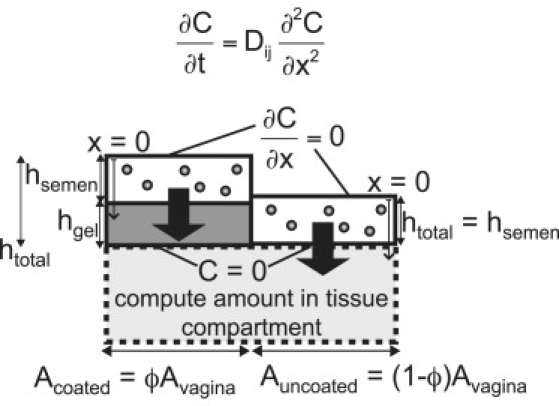
Topical microbicide products are being developed for the prevention of sexually transmitted infections. These include vaginally-applied gels that deliver anti-HIV molecules. Gels may also provide partial barriers that slow virion diffusion from semen to vulnerable epithelium, increasing the time during which anti-HIV molecules can act. To explore the barrier function of microbicide gels, we developed a deterministic mathematical model for HIV diffusion through realistic gel distributions. We applied the model to experimental data for in vivo coating distributions of two vaginal gels in women. Time required for a threshold number of virions to reach the tissue surface was used as a metric for comparing different scenarios. Results delineated how time to threshold increased with increasing gel layer thickness and with decreasing diffusion coefficient. We note that for gel layers with average thickness > approximately 100 microm, the fractional area coated, rather than the gel layer thickness, was the primary determinant of time to threshold. For gel layers < approximately 100 microm, time to threshold was brief, regardless of fractional area coated. Application of the model to vaginal coating data showed little difference in time to threshold between the two gels tested. However, the protocol after gel application (i.e., with or without simulated coitus) had a much more significant effect. This study suggests that gel distribution in layers of thickness >100 microm and fractional area coated >0.8 is critical in determining the ability of the gel to serve as a barrier to HIV diffusion.
Figures



References
-
- Rosario M.C., Jacqmin P., Dorr P., van der Ryst E., Hitchcock C. A pharmacokinetic-pharmacodynamic disease model to predict in vivo antiviral activity of maraviroc. Clin. Pharmacol. Ther. 2005;78:508–519. - PubMed
-
- Rosario M.C., Poland B., Sullivan J., Westby M., van der Ryst E. A pharmacokinetic-pharmacodynamic model to optimize the phase IIa development program of maraviroc. J. Acquir. Immune Defic. Syndr. 2006;42:183–191. - PubMed
-
- Davenport M.P., Ribeiro R.M., Zhang L., Wilson D.P., Perelson A.S. Understanding the mechanisms and limitations of immune control of HIV. Immunol. Rev. 2007;216:164–175. - PubMed
-
- Perelson A.S. Modelling viral and immune system dynamics. Nat. Rev. Immunol. 2002;2:28–36. - PubMed
-
- Perelson A.S., Neumann A.U., Markowitz M., Leonard J.M., Ho D.D. HIV-1 dynamics in vivo: virion clearance rate, infected cell life-span, and viral generation time. Science. 1996;271:1582–1586. - PubMed
Publication types
MeSH terms
Substances
Grants and funding
LinkOut - more resources
Full Text Sources
Other Literature Sources
Medical
