


Non-redundant patent sequence databases with value-added annotations at two levels
- PMID: 19884134
- PMCID: PMC2808894
- DOI: 10.1093/nar/gkp960
Non-redundant patent sequence databases with value-added annotations at two levels
Abstract
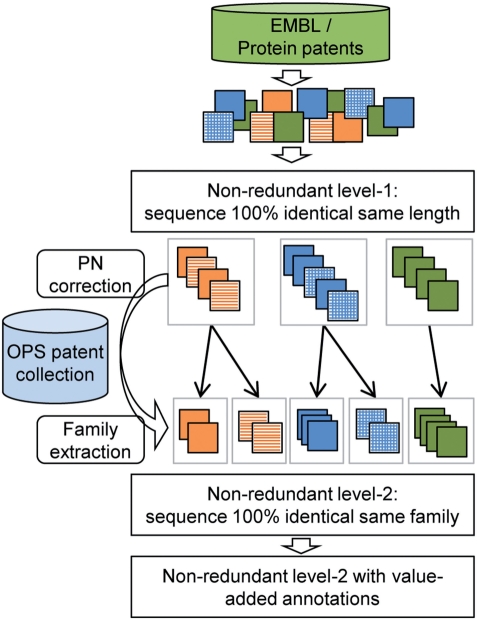
The European Bioinformatics Institute (EMBL-EBI) provides public access to patent data, including abstracts, chemical compounds and sequences. Sequences can appear multiple times due to the filing of the same invention with multiple patent offices, or the use of the same sequence by different inventors in different contexts. Information relating to the source invention may be incomplete, and biological information available in patent documents elsewhere may not be reflected in the annotation of the sequence. Search and analysis of these data have become increasingly challenging for both the scientific and intellectual-property communities. Here, we report a collection of non-redundant patent sequence databases, which cover the EMBL-Bank nucleotides patent class and the patent protein databases and contain value-added annotations from patent documents. The databases were created at two levels by the use of sequence MD5 checksums. Sequences within a level-1 cluster are 100% identical over their whole length. Level-2 clusters were defined by sub-grouping level-1 clusters based on patent family information. Value-added annotations, such as publication number corrections, earliest publication dates and feature collations, significantly enhance the quality of the data, allowing for better tracking and cross-referencing. The databases are available format: http://www.ebi.ac.uk/patentdata/nr/.
Figures


References
-
- Thangaraj H. Information from patent office could aid replication. Nature. 2007;447:638. - PubMed
-
- Seeber F. Patent searches as a complement to literature searches in the life sciences—a ‘how-to’ tutorial. Nat. Protoc. 2007;2:2418–2428. - PubMed
-
- Andree PJ, Harper MF, Nauche S, Poolman RA, Shaw J, Swinkels JC, Wycherley S. A comparative study of patent sequence databases. World Pat. Inform. 2008;30:300–308.
Publication types
MeSH terms
LinkOut - more resources
Full Text Sources
Other Literature Sources
