Review
. 2009 Nov;119(11):3189-202.
doi: 10.1172/JCI39375. Epub 2009 Nov 2.

Acromegaly pathogenesis and treatment

Affiliations
Review

Acromegaly pathogenesis and treatment

Shlomo Melmed. J Clin Invest. 2009 Nov.

Abstract

Dysregulated growth hormone (GH) hypersecretion is usually caused by a GH-secreting pituitary adenoma and leads to acromegaly - a disorder of disproportionate skeletal, tissue, and organ growth. High GH and IGF1 levels lead to comorbidities including arthritis, facial changes, prognathism, and glucose intolerance. If the condition is untreated, enhanced mortality due to cardiovascular, cerebrovascular, and pulmonary dysfunction is associated with a 30% decrease in life span. This Review discusses acromegaly pathogenesis and management options. The latter include surgery, radiation, and use of novel medications. Somatostatin receptor (SSTR) ligands inhibit GH release, control tumor growth, and attenuate peripheral GH action, while GH receptor antagonists block GH action and effectively lower IGF1 levels. Novel peptides, including SSTR ligands, exhibiting polyreceptor subtype affinities and chimeric dopaminergic-somatostatinergic properties are currently in clinical trials. Effective control of GH and IGF1 hypersecretion and ablation or stabilization of the pituitary tumor mass lead to improved comorbidities and lowering of mortality rates for this hormonal disorder.


Figures
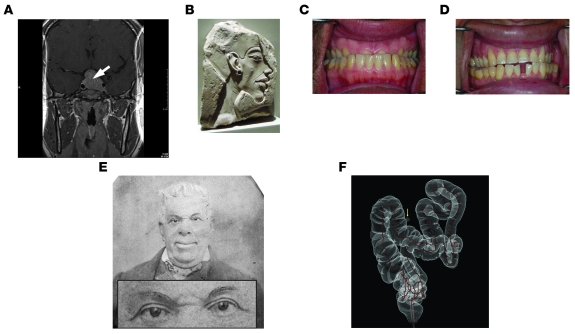
Figure 1
Figure 1. Impact of long-term GH and IGFI exposure.
(A) MRI of GH-secreting pituitary macroadenoma depicting lateral tumor extension into cavernous sinus and dorsal elevation of optic chiasm (coronal image). (B) Image of limestone relief portrait of Egyptian Akhenaten, circa 1365 BCE, showing jaw prognathism and thickened lips. Reproduced with permission from Wikipedia (http://commons.wikimedia.org/wiki/File:ReliefPortraitOfAkhenaten01.png). Source: Altes Museum, Berlin, Germany. (C) Jaw prognathism and mandibular overbite and (D) widened incisor tooth gap in two acromegaly patients. (E) Governor Pio Pico of California in 1858. Note acromegaly facial features and mild left proptosis consistent with cavernous sinus tumor invasion. Reproduced with permission from Pituitary (S40). (F) Dolicomegacolon in acromegaly as visualized by CT colonography. The colonic centerline (red) is visible. Yellow arrow indicates a diverticulum of the transverse colon. Reproduced with permission from the Journal of clinical endocrinology and metabolism (125).
Figure 2
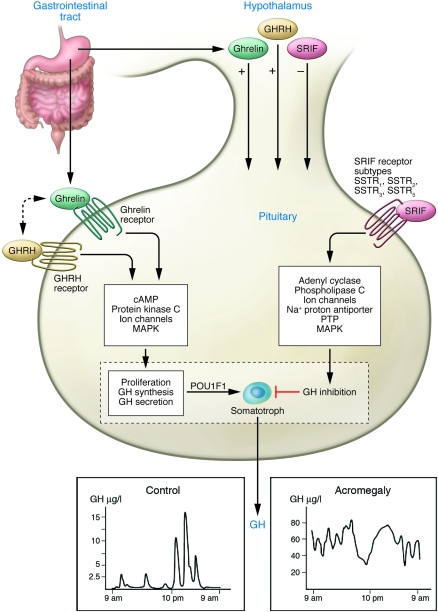
Figure 2. Normal and disrupted GHRH–GH–IGF1 axis and molecular targets for therapy.
Pituitary somatotroph cell development and gene expression are determined by the POU1F1 transcription factor. Net GH secretion is determined by integration of hypothalamic, nutritional, hormonal, and intrapituitary signals. GH synthesis and secretion are induced by hypothalamic GHRH and gut-derived ghrelin. GHRH may also act as a coagonist for the ghrelin receptor (28). Hypothalamic SRIF suppresses GH secretion mainly by high-affinity binding to SSTR2 and SSTR5 receptor subtypes expressed on somatotrophs (90). SSTR ligands (SRLs) signal through SSTR2 and SSTR5 to control GH hypersecretion and shrink tumor mass. GH secretion patterns in a normal subject and in acromegaly are depicted in the insets showing secretory bursts (mainly at night) and daytime troughs. Insets modified with permission from Expert opinion on biological therapy (S41).
Figure 3
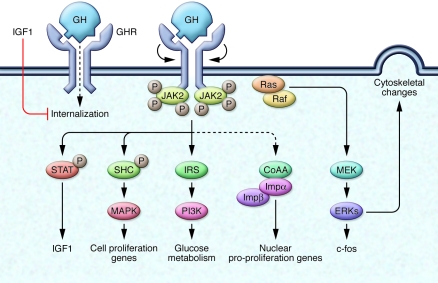
Figure 3. GH action.
GH binds to the GHR dimer, which undergoes internal rotation, resulting in JAK2 phosphorylation (P) and subsequent signal transduction. GH signaling is mediated by JAK2 phosphorylation of depicted signaling molecules or by JAK2-independent signaling including Src/ERK pathways (S42). Ligand binding to a preformed GHR dimer results in internal rotation and subsequent phosphorylation cascades. GH targets include IGF-I, c-fos, cell proliferation genes, glucose metabolism, and cystoskeletal proteins. GHR internalization and translocation (dotted lines) induce nuclear proproliferation genes via importin α/β (Impα/Impβ) coactivator (CoAA) signaling. IGF-I may also block GHR internalization, acting in a feedback loop. The GHR antagonist, pegvisomant, blocks GHR signaling; SRLs also attenuate GH binding and signaling (not shown).
Figure 4
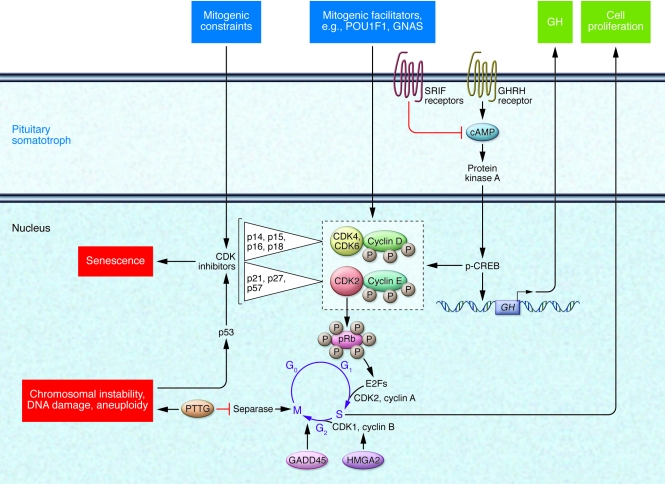
Figure 4. Depiction of intracellular pathways associated with somatotroph transformation and proliferation.
GH transcription and somatotroph proliferation are induced by cAMP acting through CREB (26). SRIF inhibits cAMP and CREB activity (S43) to suppress GH secretion. Pituitary CDKs likely exhibit overlapping functions in G1 cell-cycle progression. Somatotroph mitogenic factors include POU1F1, GHRH, and GNAS as well as endocrine hormones. Mitogenic constraints include SRIF and tumor suppressor genes, including MEN1. Cell-cycle progression through G/S is mediated by CDKs that phosphorylate Rb to release E2F proteins that drive DNA synthesis. In somatotroph tumors, the cAMP pathway may be constitutively activated. Furthermore, HMGA2 and PTTG, overexpression, and CDK inhibitor loss have been shown to result in experimental pituitary tumorigenesis. Chromosomal instability, DNA damage, and senescence, hallmarks of GH-secreting adenomas, may act to constrain malignant transformation of somatotroph tumors. Modified with permission from the Journal of molecular endocrinology (ref. S44, S45; copyrighted by the Society for Endocrinology).

References

    1. Melmed S. Medical progress: acromegaly. . N. Engl. J. Med. 2006;355:2558–2573. doi: 10.1056/NEJMra062453. - DOI - PubMed
    1. Ayuk J., Sheppard M.C. Does acromegaly enhance mortality? Rev. Endocr. Metab. Disord. . 2008;9:33–39. doi: 10.1007/s11154-007-9067-8. - DOI - PubMed
    1. Nachtigall L., et al. Changing patterns in diagnosis and therapy of acromegaly over two decades. J. Clin. Endocrinol. Metab. . 2008;93:2035–2041. doi: 10.1210/jc.2007-2149. - DOI - PubMed
    1. Molitch M.E. Clinical manifestations of acromegaly. Endocrinol. Metab. Clin. North Am. . 1992;21:597–614. - PubMed
    1. Colao A., Ferone D., Marzullo P., Lombardi G. Systemic complications of acromegaly: epidemiology, pathogenesis, and management. Endocr. Rev. 2004;25:102–152. doi: 10.1210/er.2002-0022. - DOI - PubMed

Publication types

Substances