


doi: 10.7861/clinmedicine.9-5-466.
Hugo Karl Liepmann and apraxia
Affiliations
- PMID: 19886110
- PMCID: PMC4953459
- DOI: 10.7861/clinmedicine.9-5-466
Item in Clipboard
Hugo Karl Liepmann and apraxia
Clin Med (Lond).
2009 Oct.
Abstract
John Hughlings Jackson (1835-1911) first clearly described apraxia in 1861, though he did not provide the specific name. Apraxias are subtle motor disorders in which there is an interruption of the organisation of movement mainly located in the left hemisphere. Hugo Karl Liepmann (1863-1925) was responsible for their elucidation, distinguishing ideomotor, limb-kinetic or innervatory, and ideational apraxias that affect distinct central associational areas of the cortex with characteristic clinical results. This notion was later expanded and clarified by Geschwind's 'disconnection syndromes'. This article summarises the history of this important and common pattern of motor dysfunction.
Figures
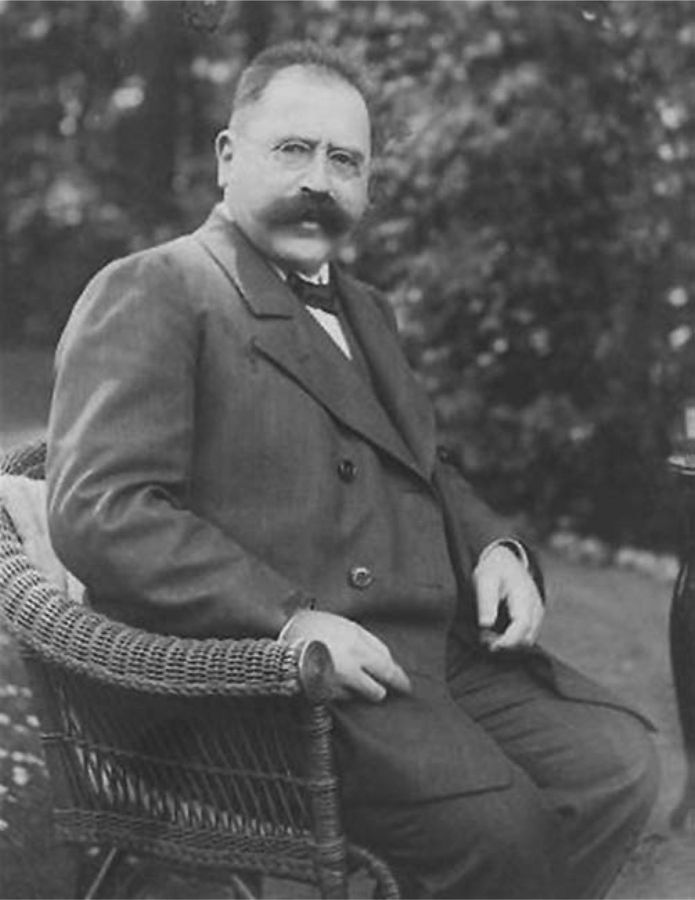
Hugo Karl Liepmann.
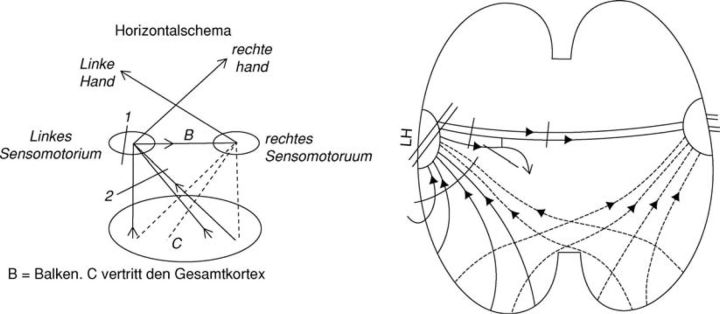
Liepmann's schema showing callosaL motor signalling. Note the arrows between the two hemispheres, direction from left to right. Reproduced with permission from S. Karger AG, Basel.,
References
-
- Geschwind N, Damasio AR. Apraxia. In: Vinken PJ, Bruyn GW, Klawans HL. (eds). Handbook of clinical neurology, vol 45 Amsterdam: Elsevier, 1985:423–32.10.1007/978-94-010-2093-0_14 - DOI
-
- Liepmann H. Das Krankheitsbild der Apraxie (‘motorischen Asymbolie’) auf Grund eines Falles von einseitiger Apraxie. (The syndrome of apraxia (motor asymbolia) based on a case of unilateral apraxia). Translated by Bohne WHO, Liepmann K, Rottenberg DA. from Monatsschrift für Psychiatrie und Neurologie, 1900, vol 8:15–44. In: Rottenberg DA, Hochberg FH. (eds). Neurological classics in modern translation. New York: Hafner Press, 1977.
-
- Liepmann H. Der weitere Krankheitsverlauf bei dem einseitig Apraktischen und der Gehirnbefund auf Grund von Serienschnitten. Monatschrift fur Psychiatrie und Neurologie 1905;17:289–311, 19: 217–43.
-
- Liepmann H. Drei Aufsätze aus dem Apraxiegebiet. Berlin: Karger, 1908.
Publication types
MeSH terms
Personal name as subject
- Actions
LinkOut - more resources
Full Text Sources
