Review
. 2009 Dec;19(6):701-7.
doi: 10.1016/j.sbi.2009.10.002. Epub 2009 Nov 2.

Macromolecular micromovements: how RNA polymerase translocates

Affiliations
Review

Macromolecular micromovements: how RNA polymerase translocates

Vladimir Svetlov et al. Curr Opin Struct Biol. 2009 Dec.

Abstract

Multi-subunit DNA-dependent RNA polymerases synthesize RNA molecules thousands of nucleotides long. The reiterative reaction of nucleotide condensation occurs at rates of tens of nucleotides per second, invariably linked to the translocation of the enzyme along the DNA template, or threading of the DNA and the nascent RNA molecule through the enzyme. Reiteration of the nucleotide addition/translocation cycle without dissociation from the DNA and RNA requires both isomorphic and metamorphic conformational flexibility of a magnitude substantial enough to accommodate the requisite molecular motions. Here we review some of the more recently acquired insights into the structural flexibility and morphic fluctuations of RNA polymerases and their mechanistic implications.


Figures

Figure 1
Figure 1
Mobile structural elements in the vicinity of the active site (T. thermophilus elongation complex, 205J): trigger loop (cartoon blue), bridge helix (cartoon green), catalytic triad (sticks purple), catalytic Mg++ ions (spheres, red and orange), substrate NTP (sticks, orange).
Figure 2
Figure 2
Molecular mechanics simulation of the L930P, T931P substitutions in the T. thermophilus elongation complex (205J): “wild type” (WT) TL (cartoon,teal), “PP” TL (cartoon, red), WT BH (cartoon, green), “PP” BH (cartoon, yellow), catalytic Mg++ ions (spheres, red and orange), substrate NTP (sticks, orange), Pro930&931(sticks, black), WT Arg1239 (sticks, teal), “PP” Arg1239 (sticks, red), WT His1242 (sticks, blue), “PP” His1242 (sticks, dark red).
Figure 3
Figure 3
Interactions of the BH (cartoon, teal) in the backtracked yeast elongation complex (3GTG) with TL (cartoon, purple), RNA (cartoon, red), DNA (cartoon, green) and Rpb2 fragments (cartoon, sand).
Figure 4
Figure 4
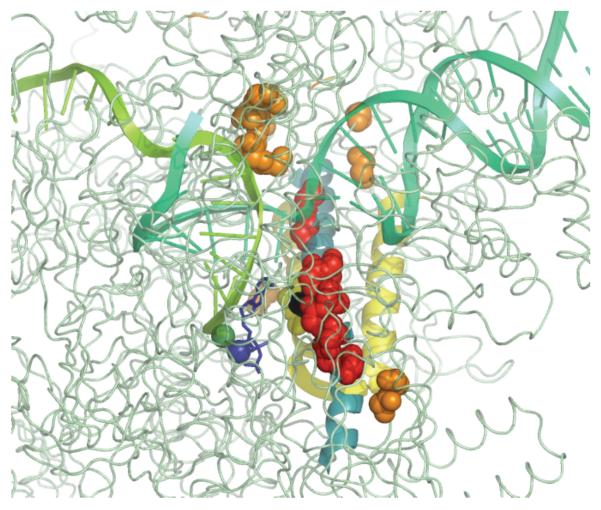
Location of the flexible residues within the T. thermophilus elongation complex (2O5J): RNAP (cartoon, grey), RNA (cartoon, chartreuse), DNA (cartoon, limegreen), BH (cartoon, teal), TL (cartoon, yellow), NTP (sticks, blue), catalytic Mg++ (spheres, green and blue), flexible residues (spheres, orange, except: within BH – red, Leu1086 (Val829 in yeast) – black, within TL – yellow).
Figure 5
Figure 5
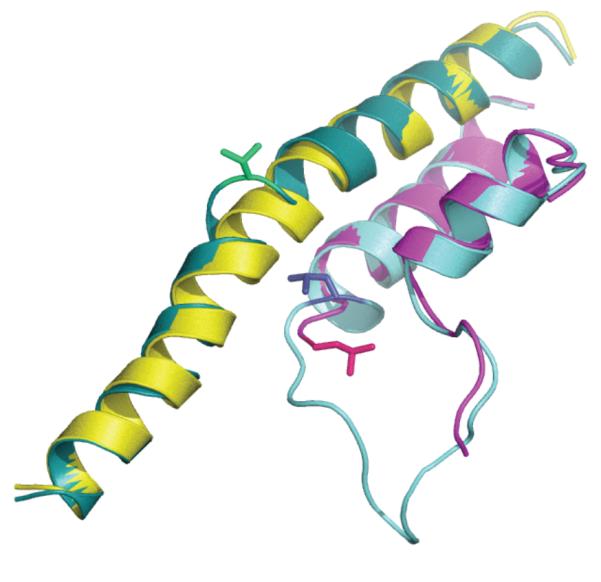
“Bent” (“looped-out”) conformation of the BH (cartoon, teal) in yeast backtracked (3GTG) vs. “straight” (cartoon, yellow) in the yeast pre-translocated (1Y77) elongation complexes. Also shown Val829 (sticks, green), ordered TL (cartoon, light blue) and L1081 (stick, dark blue) forming “wedge” to BH, disordered TL (cartoon, magenta) and L1081 (stick, hotpink) flipped away from the BH.

References

    1. Kornberg RD. The molecular basis of eukaryotic transcription. Proc Natl Acad Sci U S A. 2007;104:12955–12961. - PMC - PubMed
    1. Brueckner F, Armache KJ, Cheung A, Damsma GE, Kettenberger H, Lehmann E, Sydow J, Cramer P. Structure-function studies of the RNA polymerase II elongation complex. Acta Crystallogr D Biol Crystallogr. 2009;65:112–120. - PMC - PubMed
    1. Nudler E. RNA polymerase active center: the molecular engine of transcription. Annu Rev Biochem. 2009;78:335–361. - PMC - PubMed
    1. Borukhov S, Nudler E. RNA polymerase: the vehicle of transcription. Trends Microbiol. 2008;16:126–134. - PubMed
    1. Landick R. The regulatory roles and mechanism of transcriptional pausing. Biochem Soc Trans. 2006;34:1062–1066. - PubMed

Substances

LinkOut - more resources