. 2010 Jan;38(2):618-32.
doi: 10.1093/nar/gkp890. Epub 2009 Nov 4.

The 5'-untranslated region of the mouse mammary tumor virus mRNA exhibits cap-independent translation initiation

Affiliations

The 5'-untranslated region of the mouse mammary tumor virus mRNA exhibits cap-independent translation initiation

Maricarmen Vallejos et al. Nucleic Acids Res. 2010 Jan.

Abstract

In this study, we demonstrate the identification of an internal ribosome entry site (IRES) within the 5'-untranslated region (5'-UTR) of the mouse mammary tumor virus (MMTV). The 5'-UTR of the full-length mRNA derived from the infectious, complete MMTV genome was cloned into a dual luciferase reporter construct containing an upstream Renilla luciferase gene (RLuc) and a downstream firefly luciferase gene (FLuc). In rabbit reticulocyte lysate, the MMTV 5'-UTR was capable of driving translation of the second cistron. In vitro translational activity from the MMTV 5'-UTR was resistant to the addition of m(7)GpppG cap-analog and cleavage of eIF4G by foot-and-mouth disease virus (FMDV) L-protease. IRES activity was also demonstrated in the Xenopus laevis oocyte by micro-injection of capped and polyadenylated bicistronic RNAs harboring the MMTV-5'-UTR. Finally, transfection assays showed that the MMTV-IRES exhibits cell type-dependent translational activity, suggesting a requirement for as yet unidentified cellular factors for its optimal function.


Figures
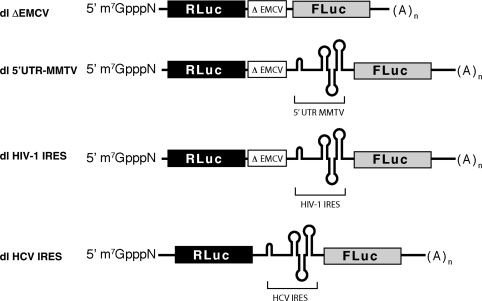
Figure 1.
Figure 1.
Schematic representation of the bicistronic mRNAs used in this study. Bicistronic mRNAs dl ΔEMCV (19,21), dl HIV-1 IRES (19) and dl HCV IRES (20) have been previously described. RNAs correspond to the dual luciferase (dl) reporter construct containing an upstream Renilla luciferase gene (RLuc) and a downstream firefly luciferase gene (FLuc). In these RNAs, ΔEMCV corresponds to a defective encephalomyocarditis virus internal ribosome entry site known to inhibit ribosome re-initiation and readthrough (19,21), while HIV-1 IRES and HCV IRES correspond to the IRESes described in the HIV-1 5′-UTR (19) and the HCV 5′-UTR (20).
Figure 2.
Figure 2.
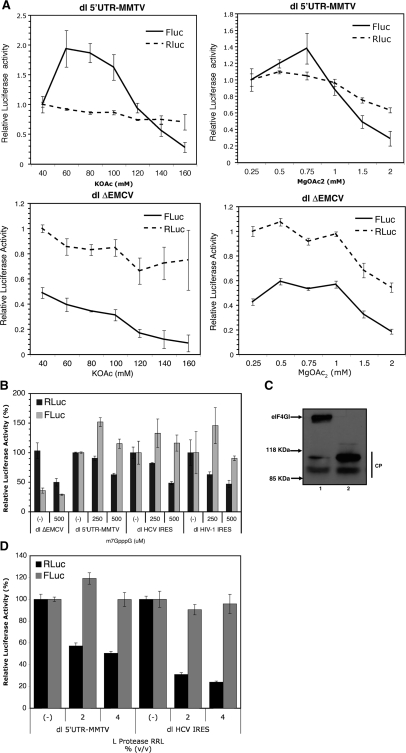
Assessment of IRES activity within the MMTV-5′-UTR in nuclease-treated rabbit RRL. (A) dl 5′-UTR MMTV and dl ΔEMCV in vitro transcripts with 5′-caps were synthesized using T7 RNA polymerase and translated in RRL in the presence of different concentrations of KOAc and MgOAc2. (B) In vitro transcribed capped bicistronic RNA corresponding to dl ΔEMCV (19,21), dl 5′UTR-MMTV, dl HCV IRES (20) or dl HIV-1 IRES (19) were translated in salt-optimized RRL in the absence (−) or presence of 250 or 500 µM of m7GpppG cap-analog. In these assays, Mg2+ ions were adjusted to optimal concentrations as indicated in ‘Materials and Methods’ section (22). RLuc and FLuc luciferase activities [relative light units (RLUs)] were measured as indicated in ‘Materials and Methods’ section. The relative RLuc and FLuc activities for each RNA in the absence of cap-analog were arbitrarily set to 100% (±SEM). RLuc and FLuc values for the dl ΔEMCV RNA were compared against the dl 5′UTR-MMTV RNA. Values are the mean ± SEM from three independent experiments each conducted in triplicates. (C) Analysis of eIF4GI cleavage. RRL translation reactions (10 µl) with (lane 2) or without (lane 1) FMDV L protease (2% v/v) were resolved by SDS gradient 5–20% PAGE, transferred to nitrocellulose paper and incubated with a mixture of polyclonal antibodies against the N- and C-terminal fragments of eIF4GI as described in ‘Materials and Methods’ section. Positions of molecular mass standards (in kilo daltons) are shown. Polyclonal antibodies against N- and C-terminal peptides of eIF4GI were described previously (24). The cleavage products, CP in the figure, obtained with the FMDV-L protease treatment have been previously characterized (41). (D) Capped bicistronic RNA dl 5′UTR-MMTV or dl HCV IRES (20) were translated in RRL in the absence (−) or presence of 2 or 4% v/v of FMDV-L protease. The relative RLuc and FLuc activities for each RNA in the absence of FMDV-L protease were arbitrarily set to 100% (±SEM). Values are the mean ± SEM from three independent experiments each conducted in triplicates.
Figure 3.
Figure 3.
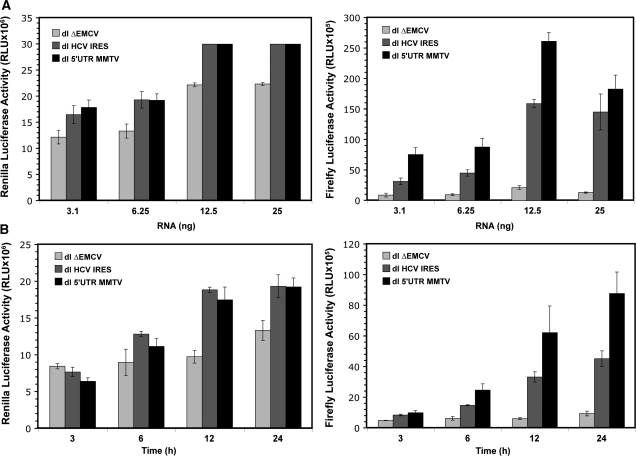
Assessment of IRES activity present within the MMTV-5′-UTR in X. laevis oocytes. (A) Different concentrations (3.1, 6.25, 12.5 or 25 ng) of capped and polyadenylated RNA corresponding to dl ΔEMCV, dl 5′UTR-MMTV or dl HCV IRES vectors were microinjected into X. laevis oocyte as described in ‘Material and Methods’ section. Oocytes were harvested 24 h after the microinjection and processed. Renilla luciferase (RLuc) and Firefly luciferase (FLuc) activities were determined (in RLUs). The RLuc (left panel) and FLuc (right panel) activities for each RNA in each concentration are shown. Oocytes injected with 12.5 and 25 ng of RNA showed saturating RLuc values. RLU values for oocytes injected with 25 ng RNA were obtained by diluting samples (1/4 volumes) prior to measurement. Each value is the mean ± SEM from at least nine oocytes obtained from two different animals. (B) Capped and polyadenylated RNA corresponding to the dl ΔEMCV, dl 5′UTR-MMTV or dl HCV IRES vectors (6.25 ng) were microinjected into X. laevis oocyte as described in ‘Material and Methods’ section. Oocytes were harvested 3, 6, 12 or 24 h after the microinjection and processed. RLuc and FLuc activities were determined (in RLU). The RLuc (left panel) and FLuc (right panel) activities for each RNA in each concentration are shown. Each value is the mean ± SEM from at least three oocytes obtained from different animals.
Figure 4.
Figure 4.
A comparison of the efficiency of MMTV-IRES-initiated translation in cell lines of different origin. (A) NMuMG, 293-T, HeLa, T47D and NIH 3T3 cells were co-transfected with either dl ΔEMCV (200 ng) or dl 5′UTR-MMTV (200 ng) and pcDNA3.1 lacZ (50 ng) plasmids. β-Galactosidase and total proteins were quantified as indicated in ‘Materials and Methods’ section. RLuc and FLuc activities were measured and normalized by the total protein content and the β-galactosidase activity. Thus, the [(FLuc/RLuc)/(total protein) × (β-galactosidase)] ratio was used as an index of IRES activity. The ratio obtained with the dl ΔEMCV and the dl 5′UTR-MMTV plasmids are independently depicted. Values are the mean ± SEM from three independent experiments each conducted in triplicates. (B) NMuMG, 293-T, HeLa, T47D and NIH 3T3 cells were co-transfected with either dl ΔEMCV (200 ng) or dl 5′UTR-MMTV (200 ng) and pcDNA3.1 lacZ (50 ng) plasmids. Total RNA was extracted from each transfected cell type and quantified. Extracted RNA (3 µg) was used as template in a one-step RT-PCR designed to specifically detect the dl ΔEMCV and dl 5′UTR-MMTV bicistronic RNA (bottom panel). A schematic representation of the experimental procedure showing the primers and the size of the expected amplicons is presented (top panel). In vitro transcribed FLuc monocictronic RNA (200 ng; lane 2), RLuc monocistronic RNA (200 ng; lane 3) or an equimolar mixture of both the FLuc and RLuc monocistronic RNAs (lane 4) were included as negative controls. An additional water control (−) for the RT-PCR was included (lane 5).
Figure 5.
Figure 5.
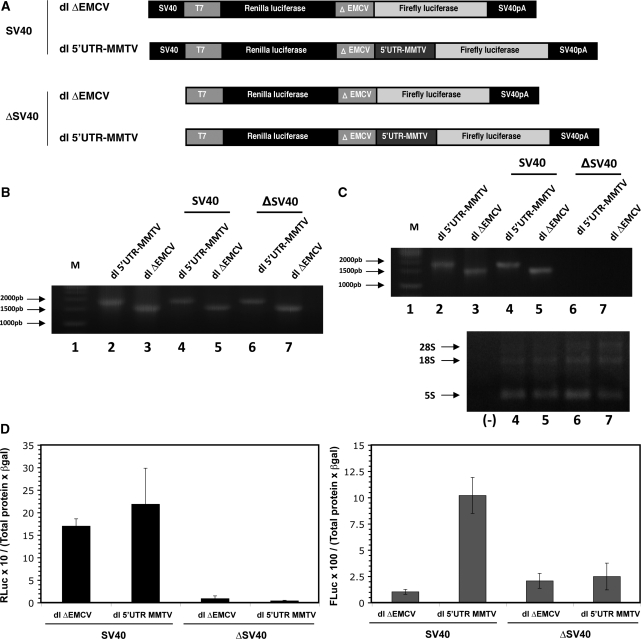
Analysis of a promoter-less bicistronic construct containing the MMTV 5′-UTR sequence. (A) Schematic representation of the bicistronic constructs. The SV40 promoter from dl ΔEMCV (lane 3) or dl 5′UTR-MMTV was removed to generate the equivalent promoter-less (ΔSV40) vectors. (B) NMuMG cells were transfected with DNA (200 ng) corresponding to the vectors depicted in (A) together with the pcDNA3.1 lacZ (50 ng) plasmid. Total DNA was extracted from transfected NMuMG cells and the presence of the transfected plasmids was confirmed by PCR. Plasmids (100 ng) dl ΔEMCV (lane 3) or dl 5′UTR-MMTV (lane 2) were used as amplification controls. (C) Total RNA was extracted from transfected NMuMG cells and the presence of transcripts for the dl ΔEMCV (lane 3), the dl 5′UTR-MMTV, the Δ SV40-dl ΔEMCV and Δ SV40-dl 5′UTR-MMTV was evaluated by a one-step RT-PCR designed to detect the bicistronic RNA (depicted in Figure 3B). In vitro transcribed RNA (100 ng) generated from plasmids dl ΔEMCV (lane 3) or dl 5′UTR-MMTV (lane 2) were used as amplification controls. The presence of template RNA was confirmed in parallel by loading the total RNA (10 µg) used in the RT-PCR onto a 0.7% denaturing agarose gel. (D) NMuMG cell were co-transfected with either the SV40 or Δ SV40 version of dl ΔEMCV (200 ng) or dl 5′UTR-MMTV (200 ng) plasmids together with the pcDNA3.1 lacZ (50 ng) plasmid. Cells were processed, and β-galactosidase and total proteins were quantified. RLuc and FLuc activities were measured, and data are presented as [RLuc/(total protein) × (β-galactosidase)] (left panel) and [FLuc/(total protein) × (β-galactosidase)] (right panel).
Figure 6.
Figure 6.
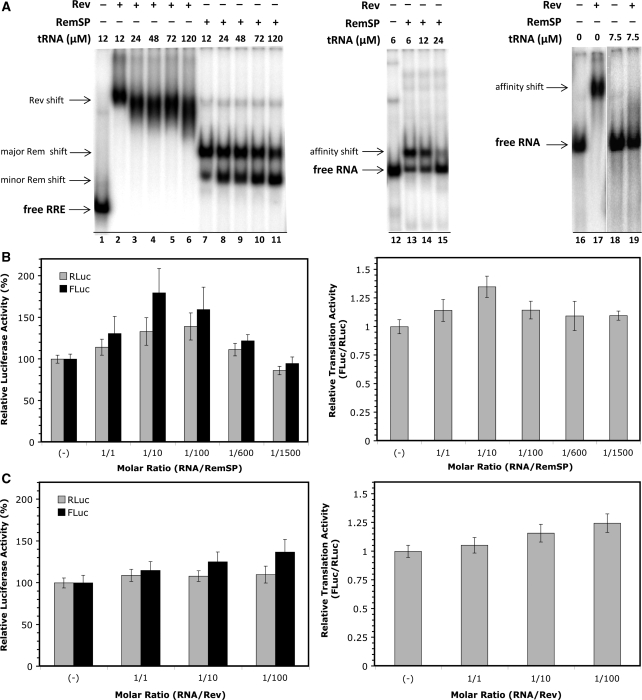
Neither the MMTV Rem nor the HIV-1 Rev proteins are directly implicated in translation driven from the MMTV-IRES. (A) RNA-binding activity as a measure of functionality for recombinant Rev and RemSP proteins was determined by radio-labeled RNA EMSA. Recombinant Rev binds to and shifts HIV-1 RRE RNA (compare lane 1 with 2). Recombinant RemSP binds to and shifts HIV-1 RRE (compare lane 1 with 7). The specificity of the interaction of Rev (lanes 2–6) and RemSP (lanes 7–11) with the target RNA was evaluated by adding increasing concentrations of competitor RNA (tRNA). The use of random RNA sequences as control confirmed that both RemSP and Rev can bind RNA at high protein concentrations (compare lanes 12 and 13 with 16 and 17, respectively). Binding is lost when relatively low concentrations of competitor RNA are present (lanes 15 and 19, respectively), i.e. there is no specificity for binding to the control RNA. The concentration of radio-labeled test RNA in all test samples was ∼0.5 µM. (B and C) T7 polymerase-generated capped and polyadenylated dl 5′UTR-MMTV RNAs were mixed with different molar concentrations of recombinant RemSP (B) or Rev (C) protein. The mean RLuc and FLuc luciferase activities in absence of the recombinant protein were arbitrarily set at 100% (±SEM). Values are the mean ± SEM from three independent experiments each conducted in triplicates. RLuc and FLuc values are relative to the 100% activity in the absence of recombinant protein (left panel). The (FLuc/RLuc) ratio was used as an index of IRES activity (right panel).

References

    1. Callahan R. MMTV-induced mutations in mouse mammary tumors: their potential relevance to human breast cancer. Breast Cancer Res. Treat. 1996;39:33–44. - PubMed
    1. Cohen JC, Varmus HE. Endogenous mammary tumour virus DNA varies among wild mice and segregates during inbreeding. Nature. 1979;278:418–423. - PubMed
    1. Indik S, Gunzburg WH, Kulich P, Salmons B, Rouault F. Rapid spread of mouse mammary tumor virus in cultured human breast cells. Retrovirology. 2007;4:73. - PMC - PubMed
    1. Indik S, Gunzburg WH, Salmons B, Rouault F. Mouse mammary tumor virus infects human cells. Cancer Res. 2005;65:6651–6659. - PubMed
    1. Wang Y, Holland JF, Bleiweiss IJ, Melana S, Liu X, Pelisson I, Cantarella A, Stellrecht K, Mani S, Pogo BG. Detection of mammary tumor virus env gene-like sequences in human breast cancer. Cancer Res. 1995;55:5173–5179. - PubMed

Publication types