


Effects of experimental weight perturbation on skeletal muscle work efficiency, fuel utilization, and biochemistry in human subjects
- PMID: 19889869
- PMCID: PMC2806213
- DOI: 10.1152/ajpregu.00053.2009
Effects of experimental weight perturbation on skeletal muscle work efficiency, fuel utilization, and biochemistry in human subjects
Abstract
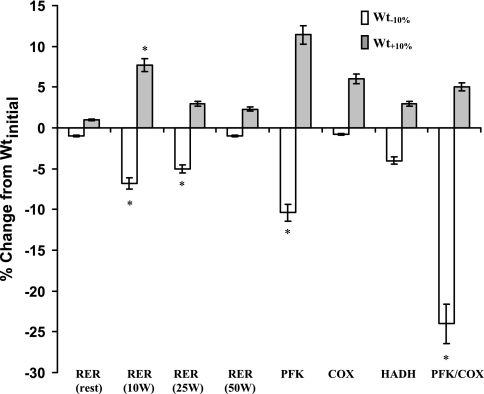
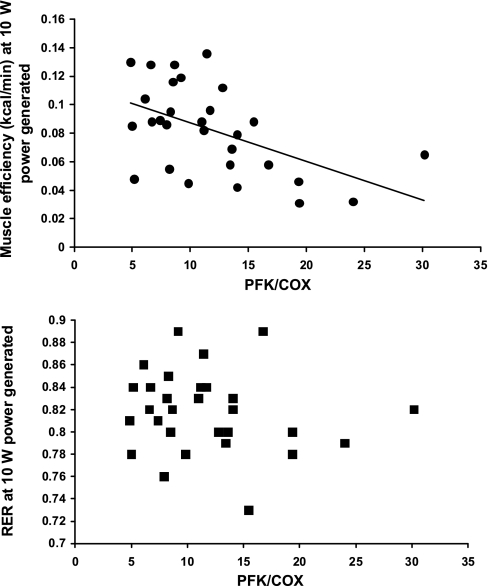
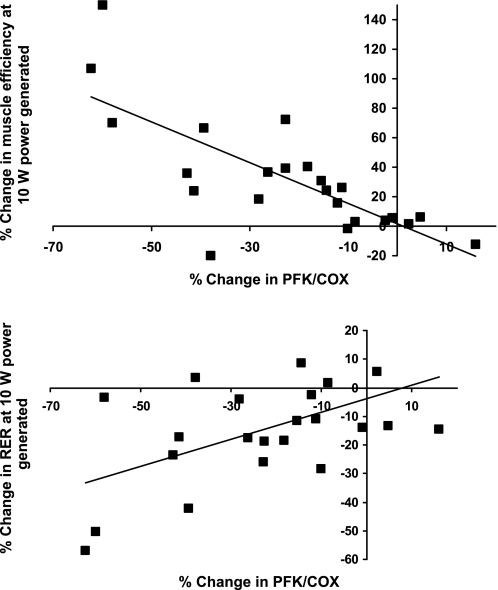
Maintenance of a body weight 10% above or below that "customary" for lean or obese individuals results in respective increases or decreases in the energy expended in low levels of physical activity (nonresting energy expenditure, NREE). These changes are greater than can be accounted for by the altered body weight or composition and are due mainly to altered skeletal muscle work efficiency at low levels of power generation. We performed biochemical analysis of vastus lateralis muscle needle biopsy samples to determine whether maintenance of an altered body weight was associated with changes in skeletal muscle histomorphology. We found that the maintenance of a 10% reduced body weight was associated with significant declines in glycolytic (phosphofructokinase, PFK) enzyme activity and, in particular, in the ratio of glycolytic to oxidative (cytochrome c oxidase, COX) enzyme activity without significant changes in the activities of enzymes relevant to mitochondrial density, respiratory chain activity, or fuel transport; or in skeletal muscle fiber type or glycogen stores. The fractional change in the ratio of PFK/COX activity in subjects following weight loss was significantly correlated with changes in the systemic respiratory exchange ratio (RER) and measures of mechanical efficiency of skeletal muscle at low workloads (pedaling a bicycle to generate 10 or 25 W of power). Thus, predictable changes in systemic skeletal muscle biochemistry accompany the maintenance of an altered body weight and account for a significant portion of the variance in skeletal muscle work efficiency and fuel utilization at reduced body weight.
Figures
References
-
- Adamo K, Graham T. Comparison of traditional measurements with macroglycogen and proglycogen analysis of muscle glycogen. J Appl Physiol 84: 908– 913, 1998 - PubMed
-
- Ahima R, Prabakaran D, Mantzoros C, Qu D, Lowell B, Maratosflier E, Flier J. Role of leptin in the neuroendocrine response to fasting. Nature 382: 250– 252, 1996 - PubMed
-
- Alonso M, Lomako J, Lomako W, Whelan W. A new look at the biogenesis of glycogen. FASEB J 9: 1126– 1137, 1995 - PubMed
-
- American Physiological Society Guiding principles for research involving animals and human beings. Am J Physiol Regul Integr Comp Physiol 283: R281– R283, 2002 - PubMed
Publication types
MeSH terms
Substances
Grants and funding
LinkOut - more resources
Full Text Sources
Medical
