. 2009 Nov 24;106(47):20115-20.
doi: 10.1073/pnas.0907024106. Epub 2009 Nov 5.

Local maternal control of seed size by KLUH/CYP78A5-dependent growth signaling

Affiliations

Local maternal control of seed size by KLUH/CYP78A5-dependent growth signaling

Nikolai M Adamski et al. Proc Natl Acad Sci U S A. .

Abstract

Seed development in plants involves the coordinated growth of the embryo, endosperm, and maternal tissue. Several genes have been identified that influence seed size by acting maternally, such as AUXIN RESPONSE FACTOR2, APETALA2, and DA1. However, given the lack of gain-of-function effects of these genes on seed size, it is unclear whether their activity levels are limiting in WT plants and whether they could thus be used to regulate seed size in development or evolution. Also, whether the altered seed sizes reflect local gene activity or global physiological changes is unknown. Here, we demonstrate that the cytochrome P450 KLUH (KLU) regulates seed size. KLU acts locally in developing flowers to promote seed growth, and its activity level is limiting for seed growth in WT. KLU is expressed in the inner integument of developing ovules, where it non-cell autonomously stimulates cell proliferation, thus determining the growth potential of the seed coat and seed. A KLU-induced increase in seed size leads to larger seedlings and higher relative oil content of the seeds. Genetic analyses indicate that KLU acts independently of other tested maternal factors that influence integument cell proliferation. Thus, the level of KLU-dependent growth factor signaling determines size in ovules and seeds, suggesting this pathway as a target for crop improvement.


Conflict of interest statement

The authors declare no conflict of interest.

Figures
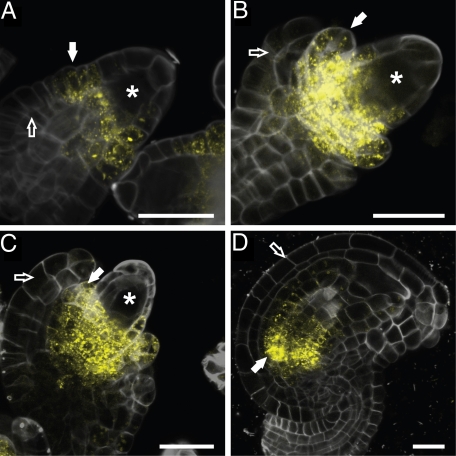
Fig. 1.
Fig. 1.
Expression pattern of KLU in developing ovules. (A–D) Fluorescence of a vYFPer reporter protein expressed under the control of the KLU promoter during progressively later stages of ovule development. Reporter expression is detected at the base of the nucellus and in the inner integument (solid arrow), but is absent from the outer integument (open arrow). Asterisk indicates the megaspore mother cell (A and B) and developing embryo sac (C) within the nucellus. (A) Stage 2-II ovule. (B) Stage 2-III ovule. (C) Stage 2-V ovule. (D) Stage 3-VI ovule. Stages are in accordance with those described by Schneitz et al. (32). (Scale bars: 20 μm.)
Fig. 2.
Fig. 2.
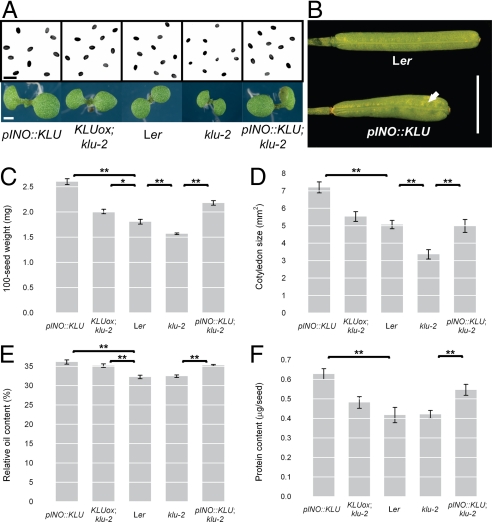
Effects of altered KLU activity in developing ovules. (A) Light micrographs of mature seeds (Upper) and 7-day old seedlings (Lower) of the genotypes indicated below. (B) Expression of KLU in ovules from the pINO::KLU construct (Bottom) leads to the formation of wider siliques with uneven growth of the silique walls (solid arrow) compared with the slender siliques of WT with their smooth surface (Top). (C–F) Quantification of seed and embryo characteristics in response to altered KLU activity. Ten plants per genotype were grown to maturity without any assisted pollination and harvested for measurements. The KLUox; klu-2 line has higher expression of KLU than WT in the endogenous pattern [same as klu-2 RLox2 in the article by Anastasiou et al. (19)], and is therefore most appropriately compared with Ler WT plants. Concerning KLU activity in ovules, the initial 4 genotypes represent a series of decreasing activity levels, whereas the fifth genotype represents an ovule-specific rescue of KLU function in an otherwise mutant background, and is therefore compared with nontransgenic klu-2 mutants. (C) Weight of 100 seeds. (D) Cotyledon area of 7-day-old seedlings. (E) Relative oil content of seeds as determined by NMR spectroscopy. (F) Absolute protein content per seed. Values shown are mean ± SEM. *Significantly different from control at P < 0.05, **significantly different from control at P < 0.01; both after Bonferroni correction. (Scale bars: A, 1 mm; B, 5 mm.)
Fig. 3.
Fig. 3.
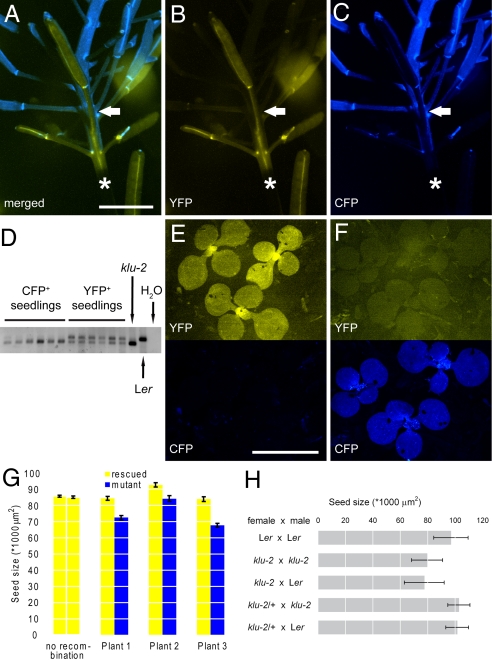
KLU acts locally in the maternal tissue of developing flowers to promote seed growth. (A–C) Fluorescence micrographs of one of the three genetically grafted plants analyzed in G, showing the transition in the inflorescence from genotypically WT tissue marked by YFP fluorescence (yellow) to klu-2 mutant tissue marked by CFP expression (blue). The approximate point of transition is indicated by the solid arrow. The asterisk indicates a section of stem covered by the shadow of the silique at the bottom of the image. (A) Merged image. (B) YFP channel. (C) CFP channel. (D–F) Analysis of seedlings germinated from seeds that were harvested from WT (E) or mutant (F) siliques of the plant shown in A–C. (D) PCR analysis of seedlings shown in E and F to detect the presence of the WT KLU allele in the rescue construct. Whereas YFP-positive seedlings still contain the WT allele, it has been lost from the CFP-positive but YFP-negative seedlings. Amplifications on nontransgenic klu-2 mutant and Ler WT DNA are shown as controls. (E) Seedlings from YFP-positive WT silique. (F) Seedlings from CFP-positive klu-2 mutant silique. (E and F, Top) YFP channel. (E and F, Bottom) CFP channel. (G) Size of seeds from WT (yellow bars) and mutant (blue bars) siliques of three independent chimeras. The leftmost two bars show seed size from early (Left, flowers 1–6) and late (Right, flowers 20–25) siliques of a nonrecombined rescue plant for comparison. In all three recombined plants, seeds from mutant siliques were significantly smaller at P < 0.05 (two-tailed t test). (H) Size of seeds resulting from the indicated reciprocal crosses. Note that error bars in H show SD as a measure of variability in the seed populations. Values shown are mean ± SEM (G) and mean ± SD (H). (Scale bars: 5 mm.)
Fig. 4.
Fig. 4.
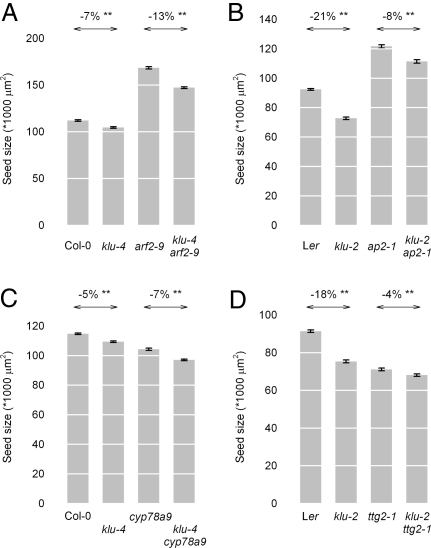
Double-mutant analysis. (A–D) Seed sizes of the indicated single- and double-mutant combinations. Percentages above arrows indicate the reduction in seed size caused by eliminating KLU function in the respective backgrounds. (A) arf2–9 klu-4 double mutants. (B) ap2–1 klu-2 double mutants. (C) cyp78a9 klu-4 double mutants. (D) klu-2 ttg2–1 double mutants. **Difference indicated by the arrow is statistically significant at P < 0.01 (two-tailed t test).
Fig. 5.
Fig. 5.
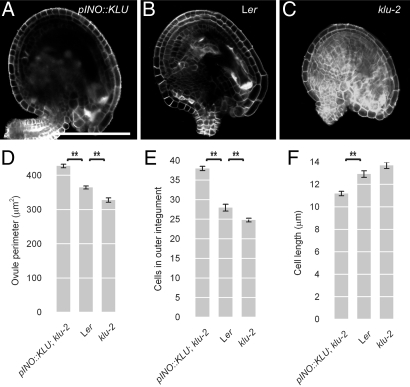
KLU promotes cell proliferation in the integuments. (A–C) Confocal optical sections through Calcofluor White-stained ovules at 2 days after emasculation. (A) Ovule from a pINO::KLU-expressing plant. (B) WT ovule from a Ler plant. (C) klu-2 mutant ovule. (D–F) Quantification of ovule dimensions in response to changing KLU activity. (D) Length of the outer integument as measured from the insertion point at the funiculus to the tip at the micropyle. (E) Number of cells in the outer integument. (F) Average length of cells in the outer integument as calculated from outer integument length and cell number for individual ovules. Values shown are mean ± SEM. **Significantly different from control at P < 0.01 after Bonferroni correction. (Scale bar: 100 μm.)

References

    1. Harper JL, Lovell PH, Moore KG. The shapes and sizes of seeds. Annu Rev Ecol Syst. 1970;1:327–356.
    1. Venable DL. Size-number trade-offs and the variation of seed size with plant resource status. Am Nat. 1992;140:287–304.
    1. Shomura A, et al. Deletion in a gene associated with grain size increased yields during rice domestication. Nat Genet. 2008;40:1023–1028. - PubMed
    1. Berger F, Grini PE, Schnittger A. Endosperm: An integrator of seed growth and development. Curr Opin Plant Biol. 2006;9:664–670. - PubMed
    1. Colombo L, Battaglia R, Kater MM. Arabidopsis ovule development and its evolutionary conservation. Trends Plants Sci. 2008;13:444–450. - PubMed

Publication types

MeSH terms