. 2010 Feb;9(1):54-63.
doi: 10.1111/j.1474-9726.2009.00535.x. Epub 2009 Nov 6.

DNA methylation pattern changes upon long-term culture and aging of human mesenchymal stromal cells

Affiliations
Free PMC article

DNA methylation pattern changes upon long-term culture and aging of human mesenchymal stromal cells

Simone Bork et al. Aging Cell. 2010 Feb.
Free PMC article

Abstract

Within 2-3 months of in vitro culture-expansion, mesenchymal stromal cells (MSC) undergo replicative senescence characterized by cell enlargement, loss of differentiation potential and ultimate growth arrest. In this study, we have analyzed DNA methylation changes upon long-term culture of MSC by using the HumanMethylation27 BeadChip microarray assessing 27,578 unique CpG sites. Furthermore, we have compared MSC from young and elderly donors. Overall, methylation patterns were maintained throughout both long-term culture and aging but highly significant differences were observed at specific CpG sites. Many of these differences were observed in homeobox genes and genes involved in cell differentiation. Methylation changes were verified by pyrosequencing after bisulfite conversion and compared to gene expression data. Notably, methylation changes in MSC were overlapping in long-term culture and aging in vivo. This supports the notion that replicative senescence and aging represent developmental processes that are regulated by specific epigenetic modifications.


Figures
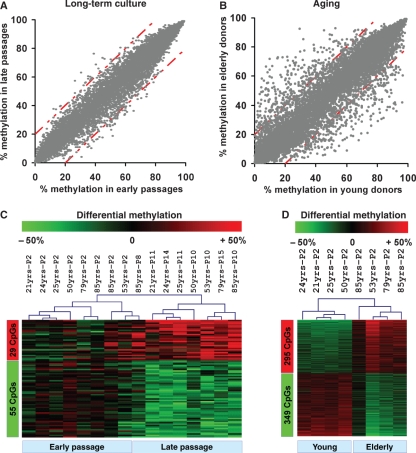
Fig. 1
Fig. 1
CpG methylation changes upon long-term culture and aging. DNA methylation at 27 578 different CpG sites was analyzed using the HumanMethylation27 BeadChip microarray. Scatter plots represent the mean methylation levels of mesenchymal stromal cells from early passage vs. late passage (A) or of young vs. elderly donors (B). Differential methylation of more than 20% was considered to be relevant and this is demonstrated by the dashed red lines. Heat map presentation of differentially methylated CpGs in long-term culture (C) and aging (D) are shown. Notably, unsupervised hierarchical clustering of CpG sites that revealed differential methylation in long-term culture revealed an age-associated relationship of methylation profiles.
Fig. 2
Fig. 2
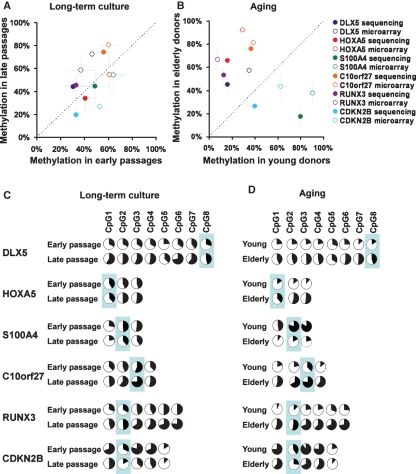
Pyrosequencing of differentially methylated CpGs. For six CpG sites differential methylation of the HumanMethylation27 BeadChip (open circles) was validated by pyrosequencing (filled circles) (all 16 samples, ± SEM). Overall, methylation levels were lower in pyrosequencing but there was a striking correlation in differential methylation between the two methods for long-term culture (A) and aging (B). This differential methylation was also observed in CpGs in close vicinity to the analyzed CpG site represented on the microarray (blue box; C, D). The percentage of methylation at each CpG site is indicated in black.
Fig. 3
Fig. 3
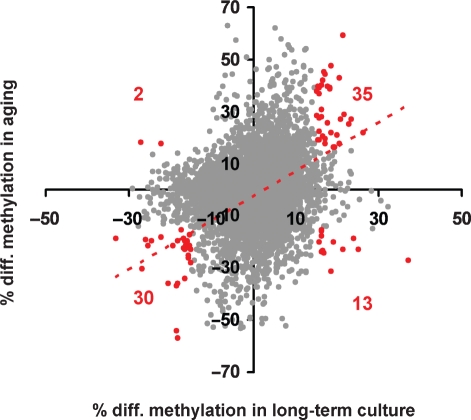
Comparison of differential methylation upon long-term culture and aging. Methylation changes upon long-term culture were plotted against methylation changes upon aging. CpGs with a more than 15% differential methylation in both comparisons are depicted (red spots). These differentially methylated CpGs revealed that DNA methylation changes upon long-term culture and aging are overlapping (correlation coefficient R = 0.61; P = 4.6 × 10⁹).
Fig. 4
Fig. 4
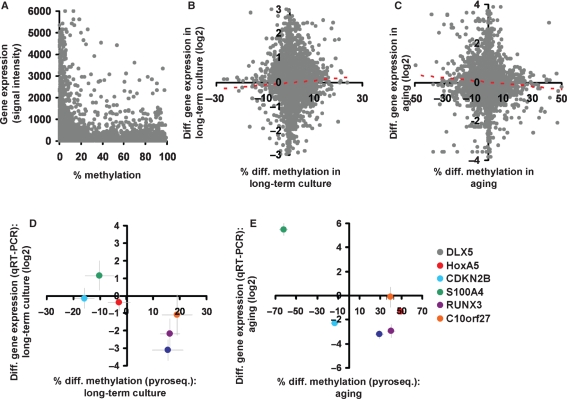
Correlation of DNA methylation and gene expression. DNA methylation data of the HumanMethylation27 BeadChip was matched with Affymetrix mRNA expression profiles. As expected, signal intensity in gene expression data revealed higher expression of nonmethylated genes (A). However, differential methylation upon long-term culture (B) or aging (C) was not necessarily reflected in differential gene expression. Six differentially methylated genes that have been analyzed by pyrosequencing were further analysed by quantitative RT-PCR and in this subset hypermethylation coincides with lower gene expression and vice versa (D, E) (all 16 samples, ± SEM).

References

    1. Banfi A, Muraglia A, Dozin B, Mastrogiacomo M, Cancedda R, Quarto R. Proliferation kinetics and differentiation potential of ex vivo expanded human bone marrow stromal cells: implications for their use in cell therapy. Exp. Hematol. 2000;28:707–715. - PubMed
    1. Baxter MA, Wynn RF, Jowitt SN, Wraith JE, Fairbairn LJ, Bellantuono I. Study of telomere length reveals rapid aging of human marrow stromal cells following in vitro expansion. Stem Cells. 2004;22:675–682. - PubMed
    1. Bonab MM, Alimoghaddam K, Talebian F, Ghaffari SH, Ghavamzadeh A, Nikbin B. Aging of mesenchymal stem cell in vitro. BMC Cell Biol. 2006;7:14. - PMC - PubMed
    1. Brandeis M, Frank D, Keshet I, Siegfried Z, Mendelsohn M, Nemes A, Temper V, Razin A, Cedar H. Sp1 elements protect a CpG island from de novo methylation. Nature. 1994;371:435–438. - PubMed
    1. Chambers SM, Shaw CA, Gatza C, Fisk CJ, Donehower LA, Goodell MA. Aging hematopoietic stem cells decline in function and exhibit epigenetic dysregulation. PLoS Biol. 2007;5:201. - PMC - PubMed

Publication types

Associated data