. 2010 Jan;38(Database issue):D552-6.
doi: 10.1093/nar/gkp937. Epub 2009 Nov 6.

STITCH 2: an interaction network database for small molecules and proteins

Affiliations

STITCH 2: an interaction network database for small molecules and proteins

Michael Kuhn et al. Nucleic Acids Res. 2010 Jan.

Abstract

Over the last years, the publicly available knowledge on interactions between small molecules and proteins has been steadily increasing. To create a network of interactions, STITCH aims to integrate the data dispersed over the literature and various databases of biological pathways, drug-target relationships and binding affinities. In STITCH 2, the number of relevant interactions is increased by incorporation of BindingDB, PharmGKB and the Comparative Toxicogenomics Database. The resulting network can be explored interactively or used as the basis for large-scale analyses. To facilitate links to other chemical databases, we adopt InChIKeys that allow identification of chemicals with a short, checksum-like string. STITCH 2.0 connects proteins from 630 organisms to over 74,000 different chemicals, including 2200 drugs. STITCH can be accessed at http://stitch.embl.de/.


Figures

Figure 1.
Figure 1.
Interaction network around aspirin. Human proteins predicted to interact with aspirin according to different sources of evidence are shown. Edges are colored according to the source of evidence (magenta: experimental information, cyan: manually curated databases, yellow: text-mining). Clicking on the node ‘aspirin’ will display a pop-up showing the structure and description.
Figure 2.
Figure 2.
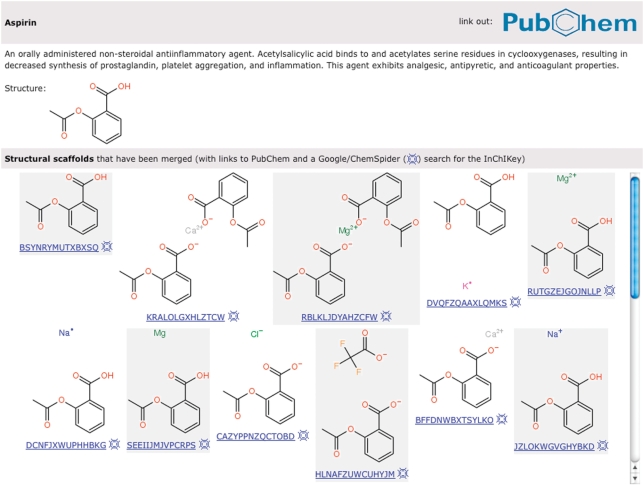
Different structural scaffolds corresponding to aspirin. For the drug aspirin, a link to PubChem and a short description is shown. Different salts of aspirin that will have the same bioactivity have been consolidated and merged with the main, uncharged form. Below each chemical structure, the first part of the InChIKey is shown, corresponding to an encoded (hashed) description of the structure. This short string can be used to search for more information about the compound on the Internet.
Figure 3.
Figure 3.
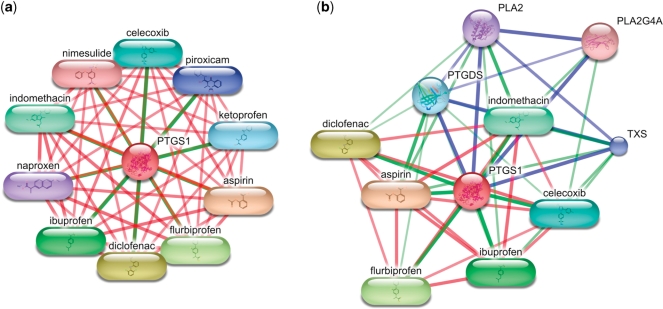
Interactions of prostaglandin-endoperoxide synthase 1 (PTGS1). (a) The highest-scoring interaction partners of PTGS1 are non-steroidal anti-inflammatory drugs (NSAIDs). As the confidence scores for these interactions are very high, no interacting proteins are shown. (b) The user may ask STITCH to display more of the interaction context and to let at least one-third of the interaction partners be proteins. In this case, STITCH is skipping 19 high-scoring chemicals in order to include four interacting proteins. In both networks, the color of the edge corresponds to the type of connected nodes (e.g. green: chemical–protein interaction) and the width of the edge correlates with the confidence score.

References

    1. Han L, Wang Y, Bryant SH. A survey of across-target bioactivity results of small molecules in PubChem. Bioinformatics. 2009;25:2251–2255. - PMC - PubMed
    1. Zanzoni A, Soler-López M, Aloy P. A network medicine approach to human disease. FEBS lett. 2009;583:1759–1765. - PubMed
    1. Peterson RT. Chemical biology and the limits of reductionism. Nature Chem. Biol. 2008;4:635–638. - PubMed
    1. Ovaa H, van Leeuwen F. Chemical biology approaches to probe the proteome. Chembiochem : Eur. J. Chem. Biol. 2008;9:2913–2919. - PubMed
    1. Rix U, Superti-Furga G. Target profiling of small molecules by chemical proteomics. Nature Chem. Biol. 2009;5:616–624. - PubMed

Publication types