


Isolation of prasinoviruses of the green unicellular algae Ostreococcus spp. on a worldwide geographical scale
- PMID: 19897754
- PMCID: PMC2798645
- DOI: 10.1128/AEM.01799-09
Isolation of prasinoviruses of the green unicellular algae Ostreococcus spp. on a worldwide geographical scale
Abstract
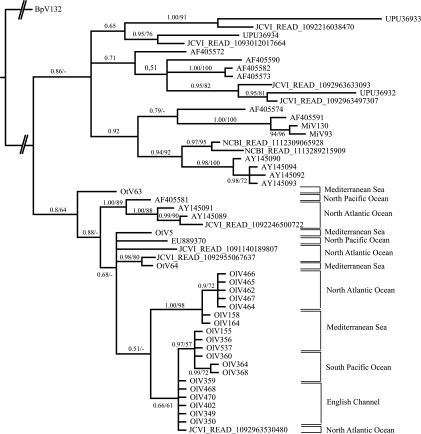
Ostreococcus spp. are extremely small unicellular eukaryotic green algae found worldwide in marine environments, and they are susceptible to attacks by a diverse group of large DNA viruses. Several biologically distinct species of Ostreococcus are known and differ in the ecological niches that they occupy: while O. tauri (representing clade C strains) is found in marine lagoons and coastal seas, strains belonging to clade A, exemplified by O. lucimarinus, are present in different oceans. We used laboratory cultures of clonal isolates of these two species to assay for the presence of viruses in seawater samples from diverse locations. In keeping with the distributions of their host strains, we found a decline in the abundance of O. tauri viruses from a lagoon in southwest France relative to the Mediterranean Sea, whereas in the ocean, no O. tauri viruses were detected. In contrast, viruses infecting O. lucimarinus were detected from distantly separated oceans. DNA sequencing, phylogenetic analyses using a conserved viral marker gene, and a Mantel test revealed no relationship between geographic and phylogenetic distances in viruses infecting O. lucimarinus.
Figures
References
-
- Abascal, F., R. Zardoya, and D. Posada. 2005. ProtTest: selection of best-fit models of protein evolution. Bioinformatics 21:2104-2105. - PubMed
-
- Angly, F. E., B. Felts, M. Breitbart, P. Salamon, R. A. Edwards, C. Carlson, A. M. Chan, M. Haynes, S. Kelley, H. Liu, J. M. Mahaffy, J. E. Mueller, J. Nulton, R. Olson, R. Parsons, S. Rayhawk, C. A. Suttle, and F. Rohwer. 2006. The marine viromes of four oceanic regions. PLoS Biol. 4:e368. - PMC - PubMed
-
- Bec, B., J. Husseini-Ratrema, Y. Collos, P. Souchu, and A. Vaquer. 2005. Phytoplankton seasonal dynamics in a Mediterranean coastal lagoon: emphasis on the picoeukaryote community. J. Plankton Res. 27:881-894.
-
- Bellec, L., N. Grimsley, H. Moreau, and Y. Desdevises. 2009. Phylogenetic analysis of new Prasinoviruses (Phycodnaviridae) that infect the green unicellular algae Ostreococcus, Bathycoccus and Micromonas. Environ. Microbiol. Rep. 1:114-129. - PubMed
Publication types
MeSH terms
Substances
Associated data
- Actions
- Actions
- Actions
- Actions
- Actions
- Actions
- Actions
- Actions
- Actions
- Actions
- Actions
- Actions
- Actions
- Actions
- Actions
- Actions
- Actions
- Actions
- Actions
- Actions
LinkOut - more resources
Full Text Sources
Miscellaneous
