


Roles of Rev1, Pol zeta, Pol32 and Pol eta in the bypass of chromosomal abasic sites in Saccharomyces cerevisiae
- PMID: 19901007
- PMCID: PMC2796187
- DOI: 10.1093/mutage/gep045
Roles of Rev1, Pol zeta, Pol32 and Pol eta in the bypass of chromosomal abasic sites in Saccharomyces cerevisiae
Abstract
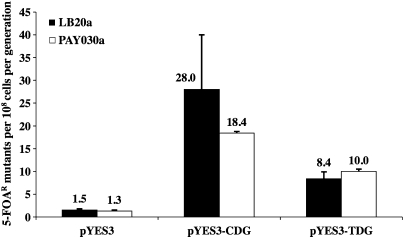
Translesion synthesis (TLS) on DNA is a process by which potentially cytotoxic replication-blocking lesions are bypassed, but at the risk of increased mutagenesis. The exact in vivo role of the individual TLS enzymes in Saccharomyces cerevisiae has been difficult to determine from previous studies due to differing results from the variety of systems used. We have generated a series of S.cerevisiae strains in which each of the TLS-related genes REV1, REV3, REV7, RAD30 and POL32 was deleted, and in which chromosomal apyrimidinic sites were generated during normal cell growth by the activity of altered forms of human uracil-DNA glycosylase that remove undamaged cytosines or thymines. Deletion of REV1, REV3 or REV7 resulted in slower growth dependent on (rev3Delta and rev7Delta) or enhanced by (rev1Delta) expression of the mutator glycosylases and a nearly complete abolition of glycosylase-induced mutagenesis. Deletion of POL32 resulted in cell death when the mutator glycosylases were expressed and, in their absence, diminished spontaneous mutagenesis. RAD30 appeared to be unnecessary for mutagenesis in response to abasic sites, as deleting this gene caused no significant change in either the mutation rates or the mutational spectra due to glycosylase expression.
Figures


References
-
- Cox MM, Goodman MF, Kreuzer KN, Sherratt DJ, Sandler SJ, Marians KJ. The importance of repairing stalled replication forks. Nature. 2000;404:37–41. - PubMed
-
- Marians KJ. PriA-directed replication fork restart in Escherichia coli. Trends Biochem. Sci. 2000;25:185–189. - PubMed
-
- Prakash S, Johnson RE, Prakash L. Eukaryotic translesion synthesis DNA polymerases: specificity of structure and function. Annu. Rev. Biochem. 2005;74:317–353. - PubMed
-
- Boiteux S, Guillet M. Abasic sites in DNA: repair and biological consequences in Saccharomyces cerevisiae. DNA Repair (Amst.) 2004;3:1–12. - PubMed
Publication types
MeSH terms
Substances
Grants and funding
LinkOut - more resources
Full Text Sources
Molecular Biology Databases
Miscellaneous
