


doi: 10.1128/AAC.01235-09.
Epub 2009 Nov 9.
In vitro activity of fosfomycin against blaKPC-containing Klebsiella pneumoniae isolates, including those nonsusceptible to tigecycline and/or colistin
Affiliations
- PMID: 19901089
- PMCID: PMC2798518
- DOI: 10.1128/AAC.01235-09
Item in Clipboard
In vitro activity of fosfomycin against blaKPC-containing Klebsiella pneumoniae isolates, including those nonsusceptible to tigecycline and/or colistin
Antimicrob Agents Chemother.
2010 Jan.
Abstract
In vitro activity of fosfomycin was evaluated against 68 bla(KPC)-possessing Klebsiella pneumoniae (KpKPC) isolates, including 23 tigecycline- and/or colistin-nonsusceptible strains. By agar dilution, 93% of the overall KpKPC were susceptible (MIC(50/90) of 16/64 microg/ml, respectively). The subgroup of 23 tigecycline- and/or colistin-nonsusceptible strains showed susceptibility rates of 87% (MIC(50/90) of 32/128 microg/ml, respectively). Notably, 5 out of 6 extremely drug-resistant (tigecycline and colistin nonsusceptible) KpKPC were susceptible to fosfomycin. Compared to agar dilution, disk diffusion was more accurate than Etest.
Figures
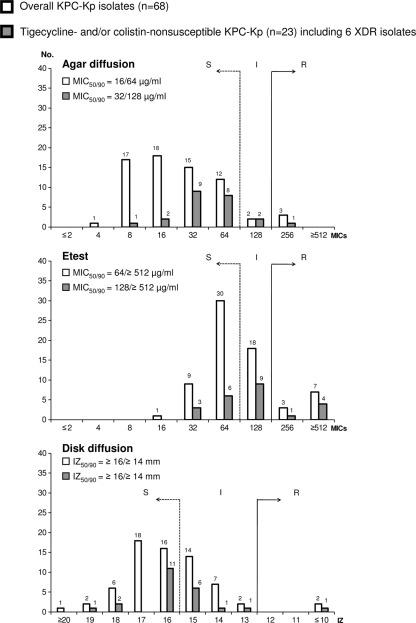
MIC distributions for fosfomycin were obtained using agar diffusion and Etest (MICs were adjusted up to the next highest doubling concentration, e.g., from 48 to 64 μg/ml). Inhibition zone (IZ) diameter distribution was obtained with disk diffusion. Results were interpreted according to CLSI criteria for E. coli (5). The number of KpKPC isolates that had each result is presented above the bars. Dashed line, susceptible cutoff; solid line, resistant cutoff; S, susceptible; I, intermediate; R, resistant.
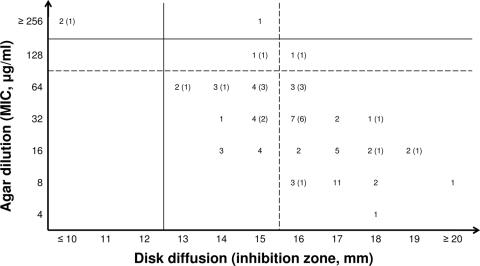
Comparison of the phenotypic test results obtained with the two methods suggested by the CLSI (i.e., disk diffusion and agar dilution). The overall number of KpKPC isolates that had each result is presented. Results for the subgroup of tigecycline- and/or colistin-NS isolates are reported in parentheses. Dashed lines, susceptibility cutoffs; solid lines, resistance cutoffs.
References
-
- Bratu, S., P. Tolaney, U. Karumudi, J. Quale, M. Mooty, S. Nichani, and D. Landman. 2005. Carbapenemase-producing Klebsiella pneumoniae in Brooklyn, NY: molecular epidemiology and in vitro activity of polymyxin B and other agents. J. Antimicrob. Chemother. 56:128-132. - PubMed
-
- Cai, Y., Y. Fan, R. Wang, M. M. An, and B. B. Liang. 2009. Synergistic effects of aminoglycosides and fosfomycin on Pseudomonas aeruginosa in vitro and biofilm infections in a rat model. J. Antimicrob. Chemother. 64:563-566. - PubMed
-
- CLSI. 2008. Development of in vitro susceptibility testing criteria and quality control parameters, 3rd ed. Approved guidelines; CLSI document M23-A3. CLSI, Wayne, PA.
-
- CLSI. 2009. Methods for dilution antimicrobial susceptibility tests for bacteria that grow aerobically, 8th ed. Approved standard; CLSI document M7-A8. Clinical and Laboratory Standards Institute, Wayne, PA.
-
- CLSI. 2009. Performance standards for antimicrobial susceptibility testing; 19th informational supplement. CLSI document M100-S19. Clinical and Laboratory Standards Institute, Wayne, PA.
Publication types
MeSH terms
Substances
Grants and funding
LinkOut - more resources
Full Text Sources
Medical
