


Hippocampal correlates of pain in healthy elderly adults: a pilot study
- PMID: 19901248
- PMCID: PMC2777070
- DOI: 10.1212/WNL.0b013e3181c0d454
Hippocampal correlates of pain in healthy elderly adults: a pilot study
Abstract
Background: Few neuroimaging investigations of pain in elderly adults have focused on the hippocampus, a brain structure involved in nociceptive processing that is also subject to involution associated with dementing disorders. The goal of this pilot study was to examine MRI- and magnetic resonance spectroscopy (MRS)-derived hippocampal correlates of pain in older adults.
Methods: A subset of 20 nondemented older adults was drawn from the Einstein Aging Study, a community-based sample from the Bronx, NY. Pain was measured on 3 time scales: 1) acute pain right now (pain severity); 2) pain over the past 4 weeks (Short Form-36 Bodily Pain); 3) chronic pain over the past 3 months (Total Pain Index). Hippocampal data included volume data normalized to midsagittal area and N-acetylaspartate to creatine ratios (NAA/Cr).
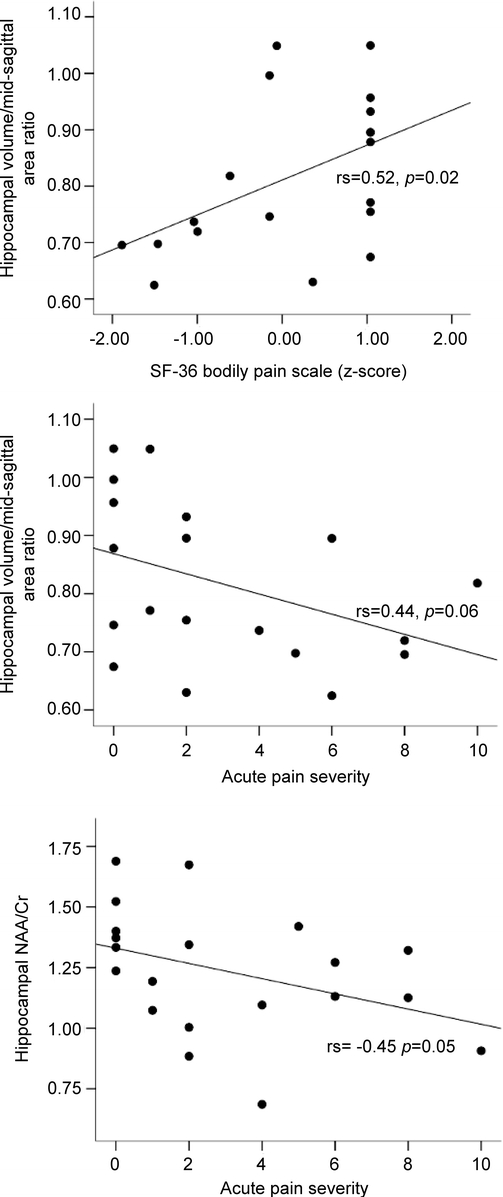
Results: Smaller hippocampal volume was associated with higher ratings on the Short Form-36 Bodily Pain (r(s) = 0.52, p = 0.02) and a nonsignificant trend was noted for higher ratings of acute pain severity (r(s) = -0.44, p = 0.06). Lower levels of hippocampal NAA/Cr were associated with higher acute pain severity (r(s) = -0.45, p = 0.05). Individuals with chronic pain had a nonsignificant trend for smaller hippocampal volumes (t = 2.00, p = 0.06) and lower levels of hippocampal NAA/Cr (t = 1.71, p = 0.10).
Conclusions: Older adults who report more severe acute or chronic pain have smaller hippocampal volumes and lower levels of hippocampal N-acetylaspartate/creatine, a marker of neuronal integrity. Future studies should consider the role of the hippocampus and other brain structures in the development and experience of pain in healthy elderly and individuals with Alzheimer disease.
Figures
References
-
- Thomas E, Mottram S, Peat G, Wilkie R, Croft P. The effect of age on the onset of pain interference in a general population of older adults: prospective findings from the North Staffordshire Osteoarthritis Project (NorStOP). Pain 2007;129:21–27. - PubMed
-
- Gibson SJ, Farrell M. A review of age differences in the neurophysiology of nociception and the perceptual experience of pain. Clin J Pain 2004;20:227–239. - PubMed
-
- Tracey I. Neuroimaging of pain mechanisms. Curr Opin Support Palliat Care 2007;1:109–116. - PubMed
-
- Raz N, Rodrigue KM, Head D, Kennedy KM, Acker JD. Differential aging of the medial temporal lobe: a study of a five-year change. Neurology 2004;62:433–438. - PubMed
Publication types
MeSH terms
Grants and funding
LinkOut - more resources
Full Text Sources
Medical
Miscellaneous
