


Designing and implementing effective venous thromboembolism prevention protocols: lessons from collaborative efforts
- PMID: 19902150
- PMCID: PMC2813533
- DOI: 10.1007/s11239-009-0405-4
Designing and implementing effective venous thromboembolism prevention protocols: lessons from collaborative efforts
Abstract
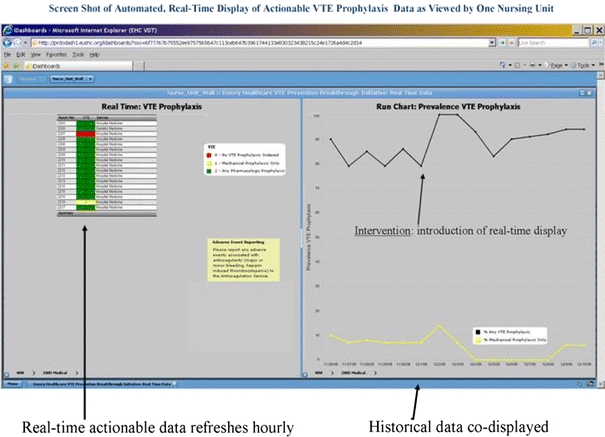
Hospital acquired venous thromboembolism (VTE) is a major source of morbidity and mortality, yet proven prevention measures are often underutilized. The lack of a validated VTE risk assessment model, difficulty integrating VTE risk assessment and prevention protocols into the routine process of care, and the lack of standardized metrics for VTE prophylaxis have all been barriers. Recently, a VTE risk assessment/prevention protocol has been validated, leading to portable strategies achieving breakthrough levels of adequate prophylaxis in a variety of inpatient settings. VTE prevention protocol design and implementation strategies have been collected in implementation guides available from the Society of Hospital Medicine and the Agency for Healthcare Research and Quality. These guides were the centerpieces of national collaborative efforts to improve VTE involving over 150 medical centers, honing the approach to accelerate improvement described in this article. Embedding a VTE prevention protocol into admission, transfer, and perioperative order sets is a key strategy. A VTE prevention protocol is defined as a VTE risk assessment with no more than three levels of risk, tightly linked to recommended prophylaxis for each level. A balance between the need to provide protocol guidance and the need for efficiency and ease-of-use by the clinician must be maintained. The power of this protocol driven approach is bolstered by a quality improvement framework, multidisciplinary teams, ongoing monitoring of the process, and real time identification and mitigation of non-adherents via a technique that measures progress and prompts concurrent intervention, an approach we call "measure-vention."
Figures
References
-
- U.S. Department of Health and Human Services (2008) Surgeon general’s call to action to prevent deep vein thrombosis and pulmonary embolism. http://www.surgeongeneral.gov/topics/deepvein/. Accessed 29 Sept 2008
-
- Dentali F, Douketis JD, Gianni M, Lim W, Crowther MA. Meta-analysis: anticoagulant prophylaxis to prevent symptomatic venous thromboembolism in hospitalized medical patients. Ann Intern Med. 2007;146(4):278–288. - PubMed
Publication types
MeSH terms
Substances
Grants and funding
LinkOut - more resources
Full Text Sources
Other Literature Sources
Medical
Miscellaneous
