


Discriminative stimulus functions of methanandamide and delta(9)-THC in rats: tests with aminoalkylindoles (WIN55,212-2 and AM678) and ethanol
- PMID: 19902182
- PMCID: PMC3727230
- DOI: 10.1007/s00213-009-1708-z
Discriminative stimulus functions of methanandamide and delta(9)-THC in rats: tests with aminoalkylindoles (WIN55,212-2 and AM678) and ethanol
Abstract
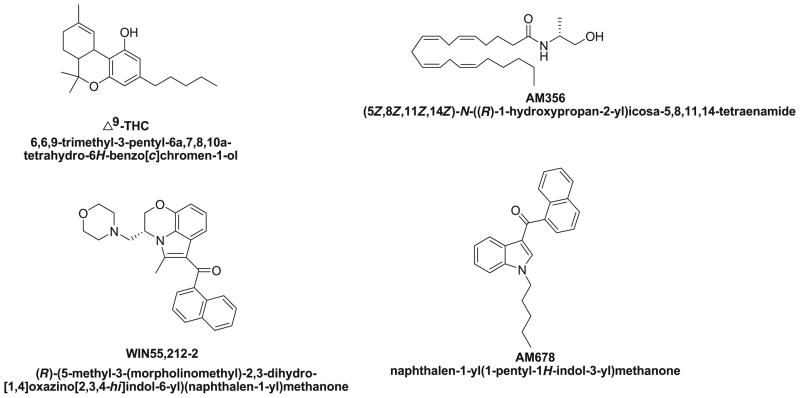
Objective: The aim of the study was to characterize in vivo the aminoalkylindoles WIN55,212-2 (WIN) and AM678 (naphthalen-1-yl(1-pentyl-1H-indol-3-yl)methanone) as cannabinoid receptor (CB(1)R) ligands using drug discrimination. Tests also involved delta(9)-tetrahydrocannabinol (THC) and R-(+)-methanandamide (mAEA), a metabolically stable analog of the endogenous ligand anandamide, as well as the CB(1)R selective antagonist/inverse agonist rimonabant; tests with ethanol assessed pharmacological specificity. We used two different drug discriminations (mAEA and THC) allowing us to explore potential differences in CB(1)R activation which could be attributed to variations in their respective CB(1)R signaling mechanisms.
Methods: There were two concurrently trained groups of rats. One group discriminated between i.p. injected vehicle and 10 mg/kg mAEA. The other group was trained to discriminate between vehicle and 1.8 mg/kg THC.
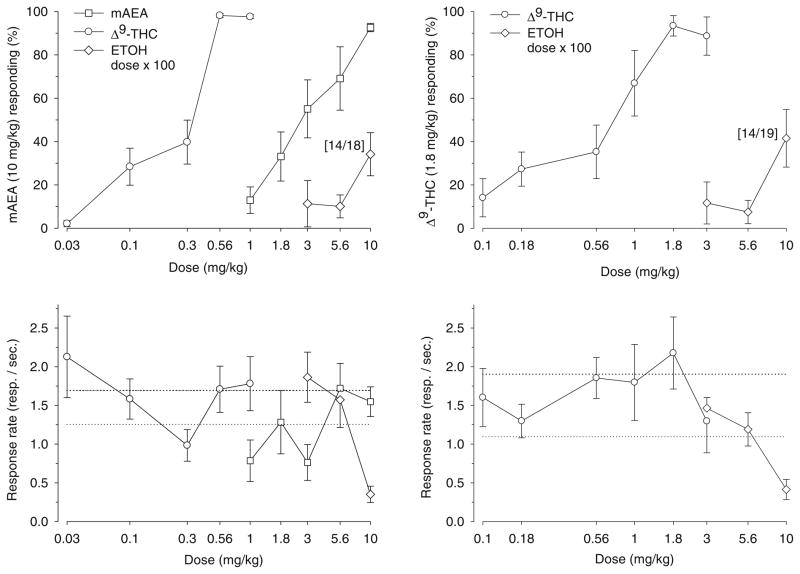
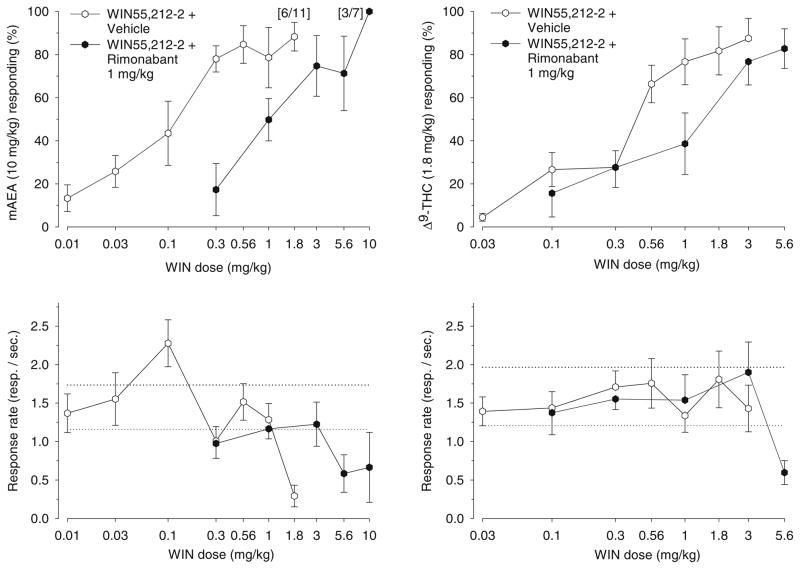
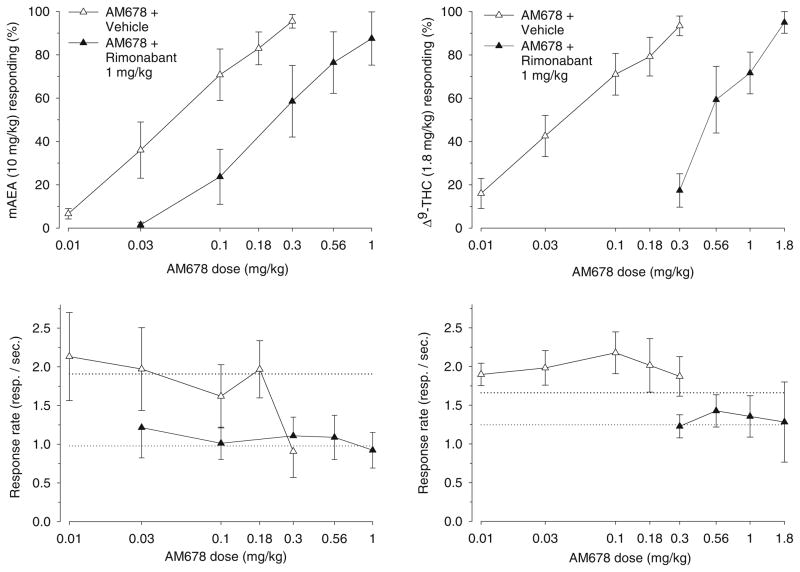
Results: Dose generalization curves for AM678, WIN55,212-2, THC, and mAEA suggested the following rank order of potency: AM678 > WIN55,212-2 > or = THC > mAEA in both drug discrimination groups. Challenge by 1 mg/kg rimonabant resulted in shifts to the right of the generalization curves for the two aminoalkylindoles (4.4-fold for AM678 and 11.3-fold for WIN in the mAEA group, whereas for the THC group, the corresponding values were 13 and 2.6, respectively), suggesting surmountable antagonism. Ethanol did not generalize in either of the two groups, suggesting pharmacological specificity.
Conclusion: Data are congruent with the general observation that there is substantial overlap in the discriminative stimulus effects of CB(1)R ligands across different chemical classes. However, the quantitative differences in the interactions between the two aminoalkylindoles and rimonabant in the two discrimination groups suggest subtle variations in the ligand-receptor activation(s).
Figures
References
-
- Abadji V, Lin S, Taha G, Griffin G, Stevenson LA, Pertwee RG, Makriyannis A. (R)-Methanandamide: a chiral novel anandamide possessing higher potency and metabolic stability. J Med Chem. 1994;37:1889–1893. - PubMed
-
- Alici T, Appel JB. Increasing the selectivity of the discriminative stimulus effects of Δ9-tetrahydrocannabinol: complete generalization with methanandamide. Pharmacol Biochem Behav. 2004;79:431–437. - PubMed
-
- Basavarajappa BS, Hungund BL. Role of the endocannabinoid system in the development of tolerance to alcohol. Alcohol Alcohol. 2005;40:15–24. - PubMed
-
- Bergman J, France CP, Holtzman SG, Katz JL, Koek W, Stephens DN. Agonist efficacy, drug dependence, and medications development: preclinical evaluation of opioid, dopaminergic, and GABAA-ergic ligands. Psychopharmacology (Berl) 2000;153:67–84. - PubMed
Publication types
MeSH terms
Substances
Grants and funding
LinkOut - more resources
Full Text Sources
Miscellaneous
