. 2010 Feb;45(2):138-48.
doi: 10.1016/j.exger.2009.11.002. Epub 2009 Nov 10.

Skeletal muscle autophagy and apoptosis during aging: effects of calorie restriction and life-long exercise

Affiliations

Skeletal muscle autophagy and apoptosis during aging: effects of calorie restriction and life-long exercise

Stephanie Eva Wohlgemuth et al. Exp Gerontol. 2010 Feb.

Abstract

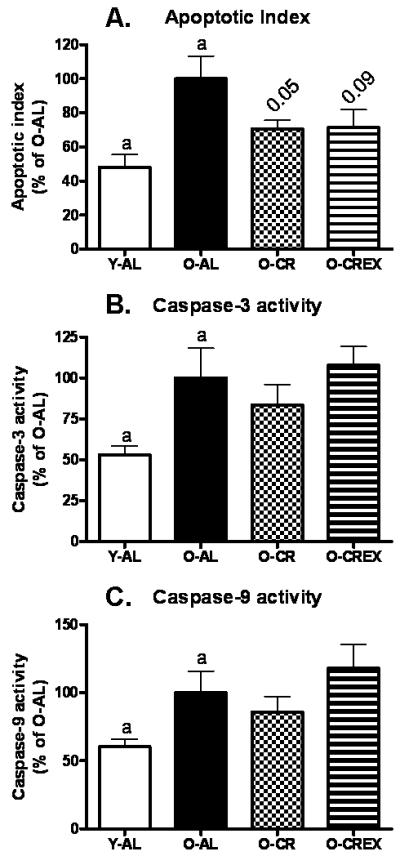
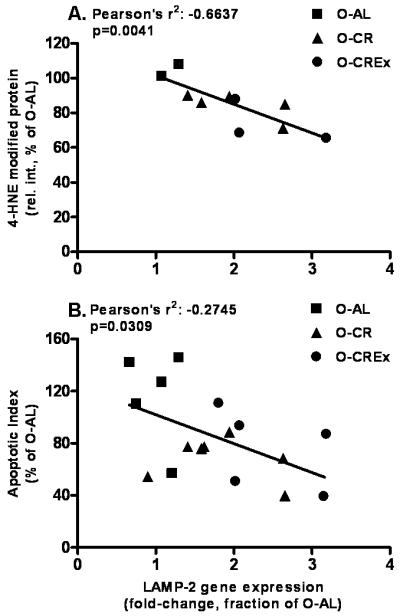
Sarcopenia, loss of muscle mass and function, is a common feature of aging. Oxidative damage and apoptosis are likely underlying factors. Autophagy, a process for the degradation of cellular constituents, may be a mechanism to combat cell damage and death. We investigated the effect of age on autophagy and apoptosis in plantaris muscle of male Fischer 344 rats that were either fed ad libitum, or mild, life-long calorie restricted (CR) alone or combined with life-long voluntary exercise. Upstream autophagy-regulatory proteins were either upregulated with age (Beclin-1) or unchanged (Atg7 and 9). LC3 gene and protein expression pattern as well as LAMP-2 gene expression, both downstream regulators of autophagy, however, suggested an age-related decline in autophagic degradation. Atg protein expression and LC3 and LAMP-2 gene expression were improved in CR rats with or without exercise. The age-related increase in oxidative damage and apoptosis were attenuated by the treatments. Both, oxidative damage and apoptosis correlated negatively with autophagy. We conclude that mild CR attenuates the age-related impairment of autophagy in rodent skeletal muscle, which might be one of the mechanisms by which CR attenuates age-related cellular damage and cell death in skeletal muscle in vivo.


Figures

Figure 1
Figure 1
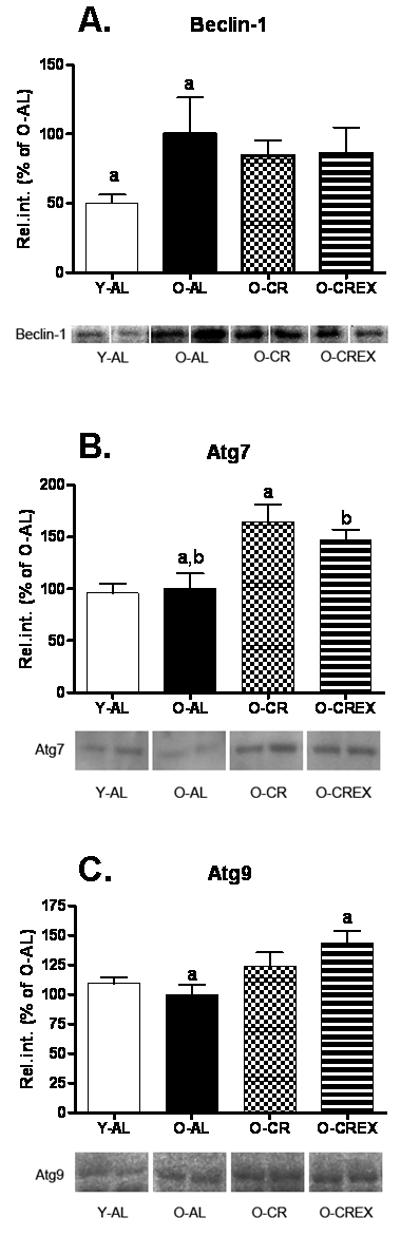
Protein expression of autophagy regulatory proteins Beclin-1 (A.); Atg7 (B.); Atg9 (C.) in tissue extracts (in % of O-AL) of plantaris muscle from young (6 mon), old ad libitum fed rats (24 mon), old, mildly calorie restricted rats (8% CR 24 mon) and old mildly restricted and exercised rats (8% CR+Ex 24 mon). Representative blots are shown below. Data are presented as mean ± standard error of the mean (SEM) and displayed as percent of O-AL. Identical indices indicate significant difference between groups, with significance level set at p<0.05.
Figure 2
Figure 2
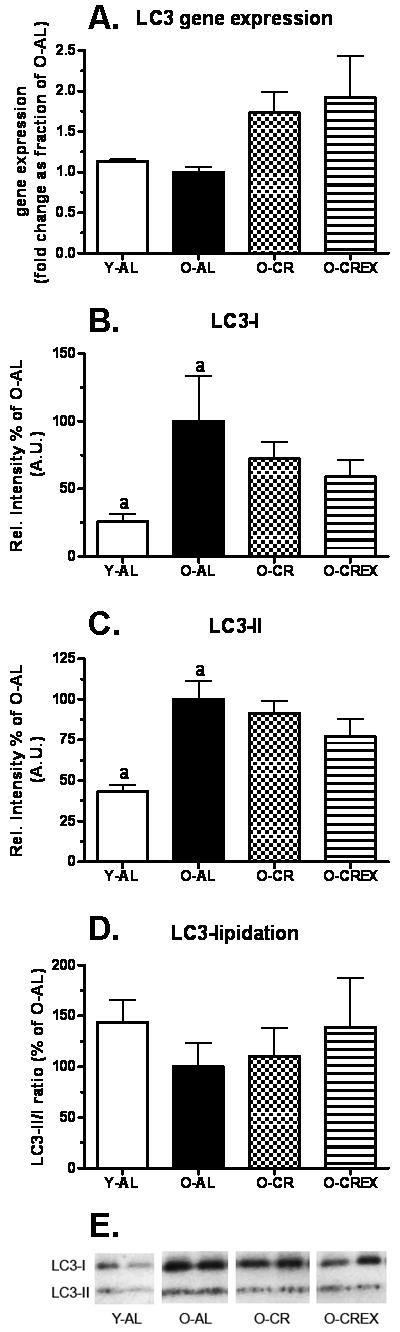
Gene (A) and Protein (B, C, D, E) expression of LC3 in tissue extracts of plantaris muscle from young (6 mon), old ad libitum fed rats (24 mon), old, mildly calorie restricted rats (8% CR 24 mon) and old mildly restricted and exercised rats (8% CR+Ex 24 mon). A. LC3 gene expression (fold-change as fraction of O-AL; see Methods), B. LC3-I; C. LC3-II; D. Ratio of LC3-II and LC3-I protein expression. Representative blots for protein expression are shown below. Data are presented as mean ± standard error of the mean (SEM) and protein expression data displayed as percent of O-AL. Identical indices indicate significant difference between groups, with significance level set at p<0.05.
Figure 3
Figure 3
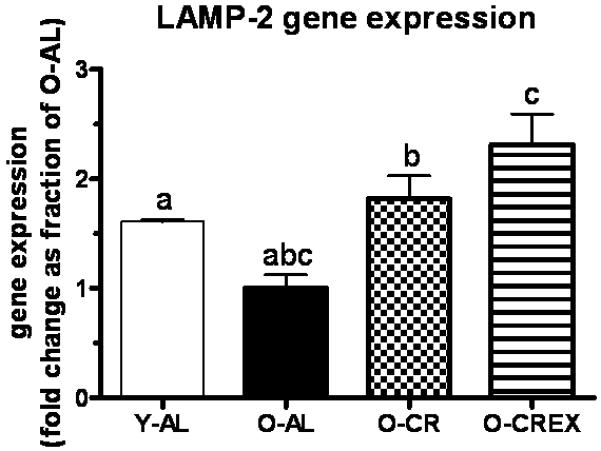
Gene expression of LAMP-2 (fold-change as fraction of O-AL; see Methods) in tissue extracts of plantaris muscle from young (6 mon), old ad libitum fed rats (24 mon), old, mildly calorie restricted rats (8% CR 24 mon) and old mildly restricted and exercised rats (8% CR+Ex 24 mon). Data are presented as mean ± standard error of the mean (SEM). Identical indices indicate significant difference between groups, with significance level set at p<0.05.
Figure 4
Figure 4
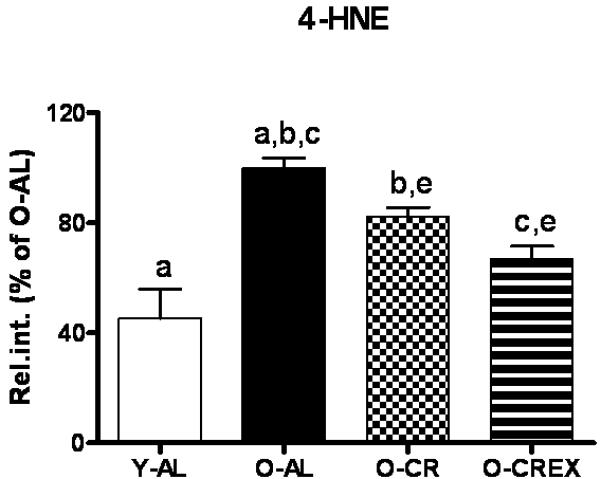
Levels of 4-HNE-modified mitochondrial proteins in the mitochondrial fraction of plantaris muscle from young (6 mon), old ad libitum fed rats (24 mon), old mildly calorie restricted rats (8% CR 24 mon), and old mildly restricted and exercised rats (8% CR+Ex 24 mon) as measured by dot blot analysis. Data are presented as mean ± standard error of the mean (SEM) and displayed as percent of O-AL. Identical indices indicate significant difference between groups, with significance level set at p<0.05.
Figure 5
Figure 5
Apoptotic index as determined by quantification of cytosolic mono- and oligonucleosomes (A), and activity of caspase-3 (B) and caspase-9 (C) in tissue extracts of plantaris muscle from young (6 mon), old ad libitum fed rats (24 mon), old mildly calorie restricted rats (8% CR 24 mon), and old mildly restricted and exercised rats (8% CR+Ex 24 mon). Data are presented as mean ± standard error of the mean (SEM) and displayed as percent of O-AL. Identical indices indicate significant difference between groups, with significance level set at p<0.05.
Figure 6
Figure 6
Linear regression analyses between LAMP-2 gene expression (fold-change as fraction of O-AL) and 4-HNE-modified mitochondrial proteins (A), and the apoptotic index (B), respectively. Only data obtained from old animals were included in the regression analysis. Pearson’s r2 and p-values are displayed in the graphs.

References

    1. Attaix D, Ventadour S, Codran A, Bechet D, Taillandier D, Combaret L. The ubiquitin-proteasome system and skeletal muscle wasting. Essays Biochem. 2005;41:173–86. - PubMed
    1. Bergamini E, Cavallini G, Donati A, Gori Z. The anti-ageing effects of caloric restriction may involve stimulation of macroautophagy and lysosomal degradation, and can be intensified pharmacologically. Biomed Pharmacother. 2003;57:203–8. - PubMed
    1. Bergamini E, Cavallini G, Donati A, Gori Z. The role of macroautophagy in the ageing process, anti-ageing intervention and age-associated diseases. Int J Biochem Cell Biol. 2004;36:2392–404. - PubMed
    1. Bevilacqua L, Ramsey JJ, Hagopian K, Weindruch R, Harper ME. Long-term caloric restriction increases UCP3 content but decreases proton leak and reactive oxygen species production in rat skeletal muscle mitochondria. Am J Physiol Endocrinol Metab. 2005;289:E429–38. - PubMed
    1. Cao Y, Klionsky DJ. Physiological functions of Atg6/Beclin 1: a unique autophagy-related protein. Cell Res. 2007;17:839–49. - PubMed

Publication types

MeSH terms