


Bringing the Hutchinsonian niche into the 21st century: ecological and evolutionary perspectives
- PMID: 19903876
- PMCID: PMC2780934
- DOI: 10.1073/pnas.0905137106
Bringing the Hutchinsonian niche into the 21st century: ecological and evolutionary perspectives
Abstract
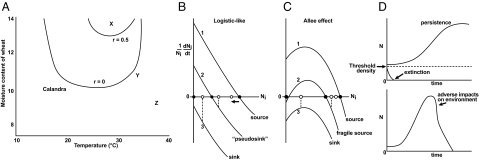
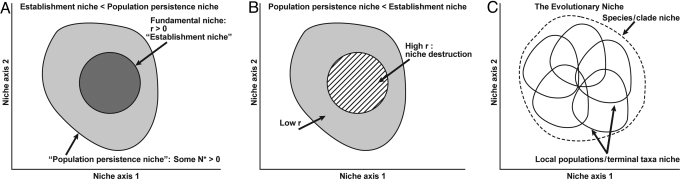
G. Evelyn Hutchinson more than a half century ago proposed that one could characterize the ecological niche of a species as an abstract mapping of population dynamics onto an environmental space, the axes of which are abiotic and biotic factors that influence birth and death rates. If a habitat has conditions within a species' niche, a population should persist without immigration from external sources, whereas if conditions are outside the niche, it faces extinction. Analyses of species' niches are essential to understanding controls on species' geographical range limits and how these limits might shift in our rapidly changing world. Recent developments in ecology and evolutionary biology suggest it is time to revisit and refine Hutchinson's niche concept. After reviewing techniques for quantifying niches, I examine subtleties that arise because of impacts species have on their own environments, the density-dependent modulation of how individuals experience environments, and the interplay of dispersal and temporal heterogeneity in determining population persistence. Moreover, the evolutionary record over all time scales reveals a spectrum of rates of change in species' niches, from rapid niche evolution to profound niche conservatism. Substantial challenges revolving around the evolutionary dimension of the Hutchinsonian niche include quantifying the magnitude of evolved intraspecific and clade-level variation in niches and understanding the factors that govern where along the spectrum of potential evolutionary rates any given lineage lies. A growing body of theory provides elements of a conceptual framework for understanding niche conservatism and evolution, paving the way for an evolutionary theory of the niche.
Conflict of interest statement
The author declares no conflict of interest.
Figures
References
-
- Hutchinson GE. Concluding remarks. Cold Spring Harbor Symp. 1957;22:415–427.
-
- Schoener TW. In: The Encyclopedia of Ecology. Levin SA, editor. Princeton: Princeton Univ Press; 2009. pp. 3–13.
-
- Soberon J. Grinnellian and Eltonian niches and geographic distributions of species. Ecol Lett. 2007;10:1115–1123. - PubMed
-
- Hutchinson GE. An Introduction to Population Ecology. New Haven, CT: Yale Univ Press; 1978.
-
- James FC, Johnston RF, Warner NO, Niemi G, Boecklen W. The Grinnellian niche of the Wood Thrush. Am Nat. 1984;124:17–47.
Publication types
MeSH terms
LinkOut - more resources
Full Text Sources
Other Literature Sources
