


Review
doi: 10.1038/nrn2726.
Epub 2009 Nov 11.
Understanding microRNAs in neurodegeneration
Affiliations
- PMID: 19904280
- PMCID: PMC4120241
- DOI: 10.1038/nrn2726
Item in Clipboard
Review
Understanding microRNAs in neurodegeneration
Nat Rev Neurosci.
2009 Dec.
Abstract
Interest in the functions of microRNAs (miRNAs) in the nervous system has recently expanded to include their roles in neurodegeneration. Investigations have begun to reveal the influence of miRNAs on both neuronal survival and the accumulation of toxic proteins that are associated with neurodegeneration, and are providing clues as to how these toxic proteins can influence miRNA expression.
Figures
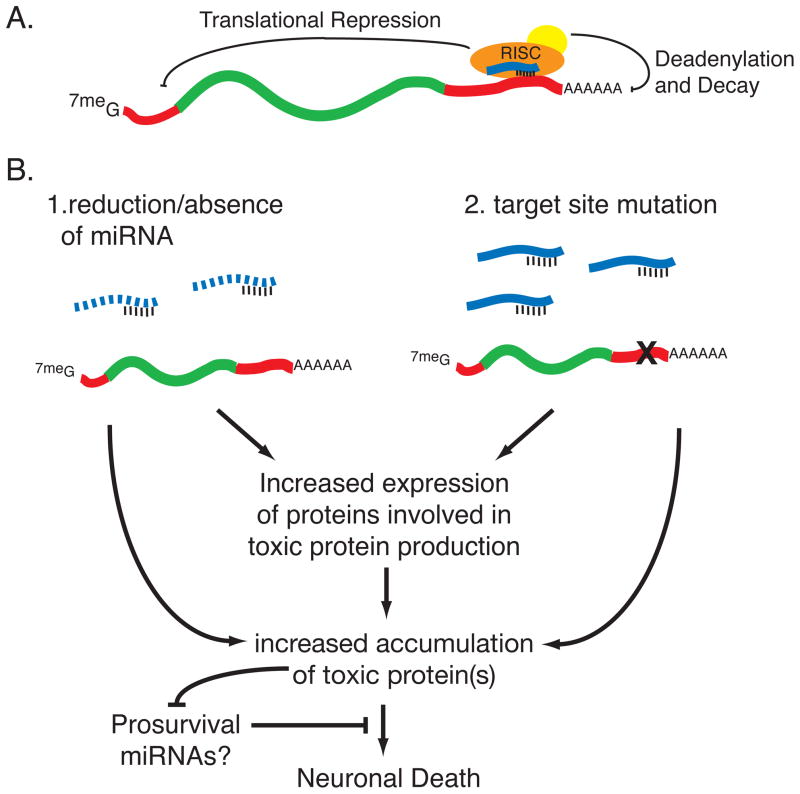
Messenger RNA repression by microRNA and its affect on neuredegeneration. a| MicroRNAs (blue) bind their target mRNAs through sequences in the 3′ UTR. MicroRNAs require only a short span of sequence complementarity at the 5′ end of the miRNA to guide the RNA-induced silencing complex (RISC) to the mRNA, which promotes either translational repression or mRNA decay. Although many mechanisms for RNA silencing have been proposed, the prevailing view in the field is that RISC-mediated translational control occurs at the step of translation initiation. RISC-induced mRNA decay is thought to occur by deadenylation of the poly(A) tail followed by mRNA destruction. b| Proposed mechanisms by which miRNAs could influence neurodegeneration. Alterations in miRNA function could result from changes in miRNA expression through genetic or epigenetic changes, resulting in either the reduction or absence of the miRNA. Alternatively, mutation of a miRNA binding site in the 3′-UTR of a target mRNA can disrupt miRNA-mediated repression. miRNAs have been shown to regulate proteins involved in the production of toxic proteins as well as toxic proteins themselves. Thus, reductions on miRNA activity may lead to the increased accumulation of toxic proteins which in turn could cause neuronal death or affect the expression of as of yet unidentified prosurvival miRNAs. miR-9 may be an example of a prosurvival miRNA through its interaction with REST/CoREST.
References
Publication types
MeSH terms
Substances
Grants and funding
LinkOut - more resources
Full Text Sources
Other Literature Sources
