Prevalence of tooth transposition. A meta-analysis
- PMID: 19905852
- PMCID: PMC8973221
- DOI: 10.2319/052109-284.1
Prevalence of tooth transposition. A meta-analysis
Abstract
Objective: To synthesize currently existing data and investigate the prevalence of tooth transposition as well as its relation to gender, dental arch, and quadrant occurrence.
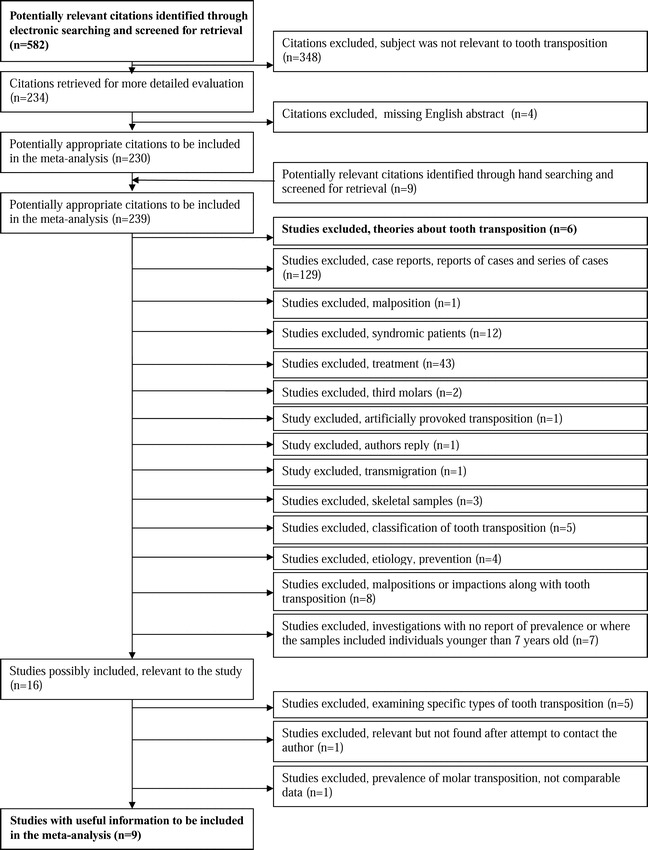
Materials and methods: Several electronic databases were searched in order to identify the potentially relevant studies. Initially, 591 papers were retrieved. After applying specific inclusion and exclusion criteria, nine studies were eligible for inclusion in this evaluation. Meta-analysis was performed by determining the event rate and the 95% confidence intervals estimated by the random effect model.
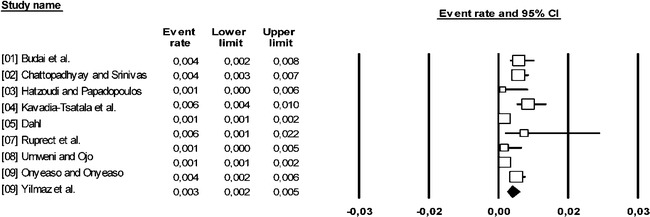
Results: Analysis of the data of the primary studies revealed that tooth transposition has a mean prevalence of 0.33%. This prevalence seems to be the same between the two genders. However, tooth transposition appears more frequently in the maxilla than in the mandible and more unilaterally than bilaterally.
Conclusion: Tooth transposition is a rare phenomenon that affects various populations, including across genders, in a similar manner. Some maxillary predisposition exists, and its unilateral occurrence is higher than that of bilateral.
Figures
References
-
- Hatzoudi M, Papadopoulos M. A. Prevalence of tooth transposition in Greek population. Hell Orthod Rev. 2006;9:11–22.
-
- Peck L, Peck S, Attia Y. Maxillary canine-first premolar transposition, associated dental anomalies and genetic basis. Angle Orthod. 1993;63:99–109. - PubMed
-
- Peck L, Peck S. Classification of maxillary tooth transpositions. Am J Orthod Dentofacial Orthop. 1995;107:505–517. - PubMed
-
- Onyeaso C. O, Onyeaso A. O. Occlusal/dental anomalies found in a random sample of Nigerian schoolchildren. Oral Health Prev Dent. 2006;4:181–186. - PubMed
-
- Papadopoulos M. A. Meta-analysis in evidence-based orthodontics. Orthod Craniofac Res. 2003;6:12–26. - PubMed
Publication types
MeSH terms
LinkOut - more resources
Full Text Sources