


Storage of murine red blood cells enhances alloantibody responses to an erythroid-specific model antigen
- PMID: 19906034
- PMCID: PMC3568949
- DOI: 10.1111/j.1537-2995.2009.02481.x
Storage of murine red blood cells enhances alloantibody responses to an erythroid-specific model antigen
Abstract
Background: Red blood cell (RBC) alloimmunization can be a serious complication of blood transfusion, but factors influencing the development of alloantibodies are only partially understood. Within FDA-approved time limits, RBCs are generally transfused without regard to length of storage. However, recent studies have raised concerns that RBCs stored for more than 14 days have altered biologic properties that may affect medical outcomes. To test the hypothesis that storage time alters RBC immunogenicity, we utilized a murine model of RBC storage and alloimmunization.
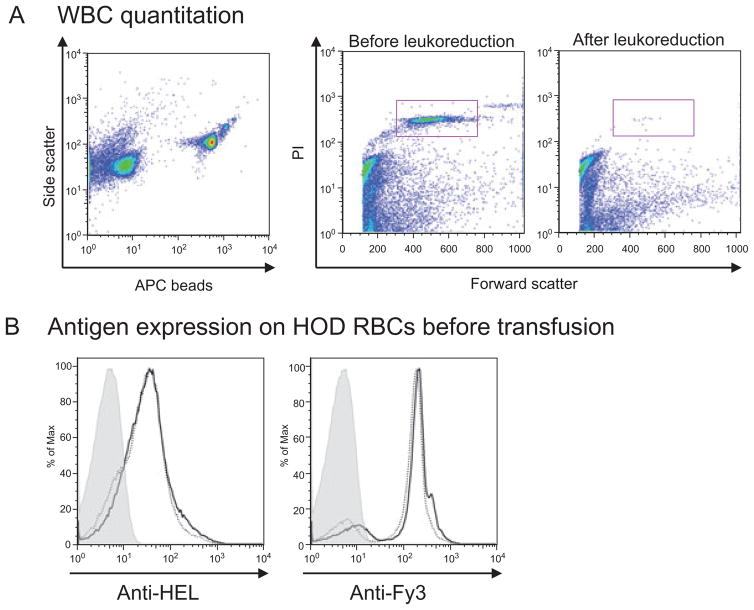
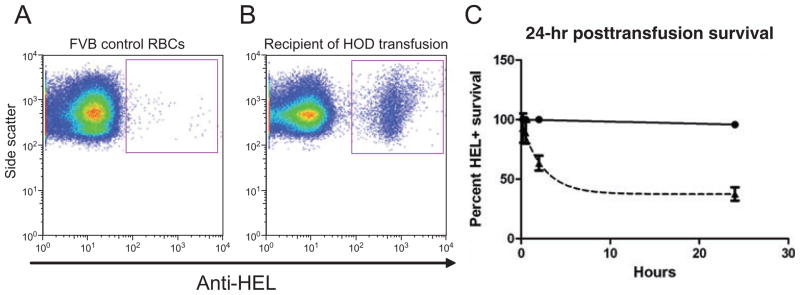
Study design and methods: Blood from transgenic HOD donor mice, which express a model antigen (hen egg lysozyme [HEL]) specifically on RBCs, was filter leukoreduced and stored for 14 days under conditions similar to those used for human RBCs. Fresh or 14-day-stored RBCs were transfused into wild-type recipients. The stability of the HOD antigen and posttransfusion RBC survival were analyzed by flow cytometry. RBC alloimmunization was monitored by measuring circulating anti-HEL immunoglobulin levels.
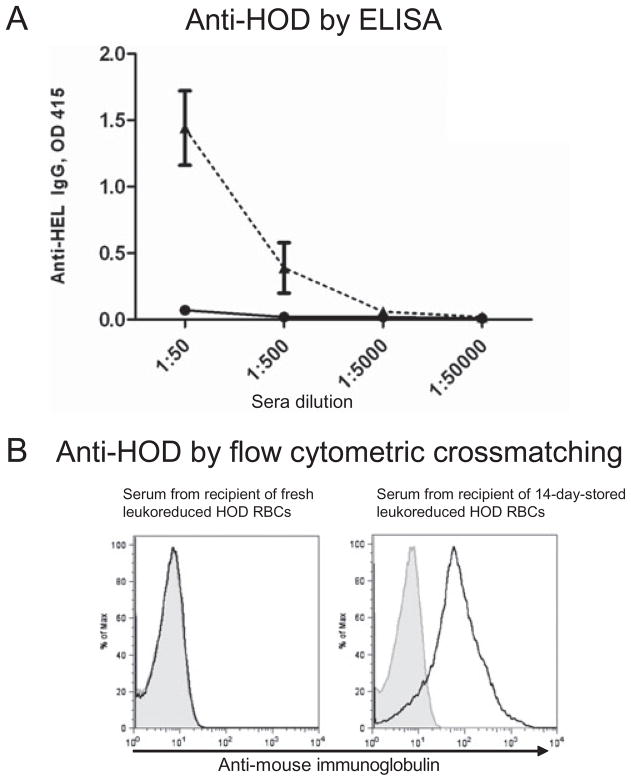
Results: Transfusion of 14-day-stored, leukoreduced HOD RBCs resulted in 10- to 100-fold higher levels of anti-HEL alloantibodies as detected by enzyme-linked immunosorbent assay than transfusion of freshly collected, leukoreduced RBCs. RBC expression of the HOD antigen was stable during storage.
Conclusions: These findings demonstrate that HOD murine RBCs become more immunogenic with storage and generate the rationale for clinical trials to test if the same phenomenon is observed in humans. Length of storage of RBCs may represent a previously unappreciated variable in whether or not a transfusion recipient becomes alloimmunized.
Conflict of interest statement
The authors declare that they have no conflicts of interest relevant to the manuscript submitted to
Figures
References
-
- Hillyer CD, Silberstein LE, Ness PM, Anderson KC, Roback JD, editors. Blood banking and transfusion medicine. 2. Philadelphia (PA): Churchill Livingstone, Elsevier; 2007.
-
- Heddle NM, Soutar RL, O’Hoski PL, Singer J, McBride JA, Ali MA, Kelton JG. A prospective study to determine the frequency and clinical significance of alloimmunization post-transfusion. Br J Haematol. 1995;91:1000–5. - PubMed
-
- Hoeltge GA, Domen RE, Rybicki LA, Schaffer PA. Multiple red cell transfusions and alloimmunization. Experience with 6996 antibodies detected in a total of 159,262 patients from 1985 to 1993. Arch Pathol Lab Med. 1995;119:42–5. - PubMed
-
- Seyfried H, Walewska I. Analysis of immune response to red blood cell antigens in multitransfused patients with different diseases. Mater Med Pol. 1990;22:21–5. - PubMed
-
- Noizat-Pirenne F, Tournamille C, Bierling P, Roudot-Thoraval F, LePennec PY, Rouger P, Ansart-Pirenne H. Relative immunogenicity of Fya and K antigens in a Caucasian population, based on HLA class II restriction analysis. Transfusion. 2006;46:1328–33. - PubMed
Publication types
MeSH terms
Substances
Grants and funding
LinkOut - more resources
Full Text Sources
