


Lateral phage transfer in obligate intracellular bacteria (wolbachia): verification from natural populations
- PMID: 19906794
- PMCID: PMC2822291
- DOI: 10.1093/molbev/msp275
Lateral phage transfer in obligate intracellular bacteria (wolbachia): verification from natural populations
Abstract
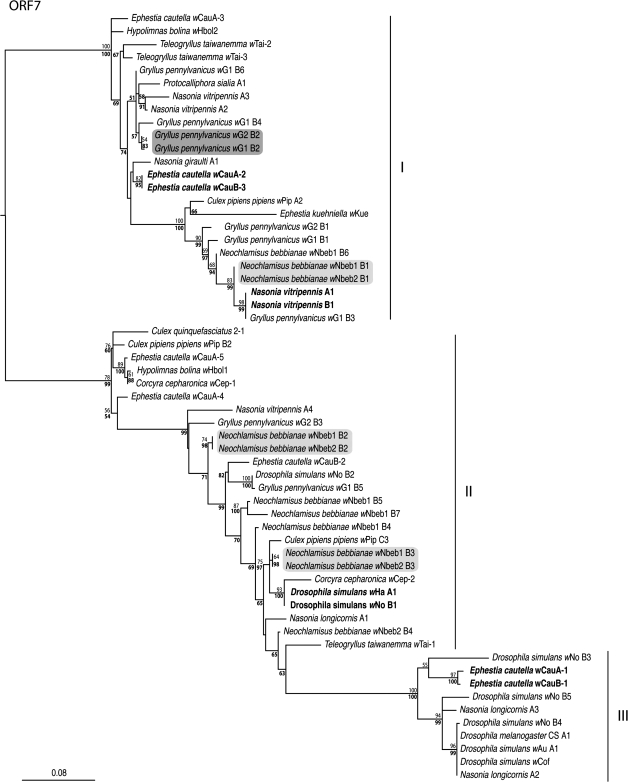
Lateral transfer of mobile DNA is a hallmark of bacteria with a free-living replicative stage; however, its significance in obligate intracellular bacteria and other heritable endosymbionts remains controversial. Comparative sequence analyses from laboratory stocks infected with Wolbachia pipientis provide some of the most compelling evidence that bacteriophage WO-B transfers laterally between infections of the same insect host. Lateral transfer between coinfections, however, has been evaluated neither in natural populations nor between closely related Wolbachia strains. Here, we analyze bacterial and phage genes from two pairs of natural sympatric field isolates, of Gryllus pennsylvanicus field crickets and of Neochlamisus bebbianae leaf beetles, to demonstrate WO-B transfers between supergroup B Wolbachia. N. bebbianae revealed the highest number of phage haplotypes yet recorded, hinting that lab lines could underestimate phage haplotype variation and lateral transfer. Finally, using the approximate age of insect host species as the maximum available time for phage transfer between host-associated bacteria, we very conservatively estimate phage WO-B transfer to occur at least once every 0-5.4 My within a host species. Increasing discoveries of mobile elements, intragenic recombination, and bacterial coinfections in host-switching obligate intracellular bacteria specify that mobile element transfer is common in these species.
Figures

References
-
- Bordenstein SR, Reznikoff WS. Mobile DNA in obligate intracellular bacteria. Nat Rev Microbiol. 2005;3:688–699. - PubMed
-
- Bordenstein SR, Wernegreen JJ. Bacteriophage flux in endosymbionts (Wolbachia): infection frequency, lateral transfer, and recombination rates. Mol Biol Evol. 2004;21:1981–1991. - PubMed
Publication types
MeSH terms
Grants and funding
LinkOut - more resources
Full Text Sources
Other Literature Sources
Miscellaneous
